
Spray Foam Insulation in Walnut, CA: Cost, Process, and What Actually Matters on Hillside Lots
Spray foam insulation in Walnut typically costs $2,800 to $7,400 for a retracted attic retrofit on a two-story tract home, with closed-cell running $3.50 to $6.50 per board foot and open-cell $1.75 to $3.25 per board foot. Most jobs are same-day or next-day once the estimate is done, and the material choice matters more here than in flat valley cities because Walnut’s hillside lots near the 60 freeway create stepped, low-clearance attic cavities that standard batt insulation never fits correctly. Call (866) 393-6041 for a free at-tic assessment and a line-item quote in under an hour.
Key Takeaways:
- 1
Most Walnut homes built in the 1970s-1990s still carry original R-11 to R-19 batts that sag and stop working in the heat.
- 2
Closed-cell spray foam from Demilec or Icynene adds air sealing and R-value in one pass, which matters on stepped hillside attics where batt installation is nearly impossible.
- 3
Air-sealing ridge vents and gable gaps in Walnut hill homes before foaming is the step that makes the real difference in summer cooling bills.
- 4
We respond to Walnut service calls within 90 minutes during weekdays and cover 91788, 91789, and 91795.
Fast, Reliable Spray Foam Insulation Across Walnut
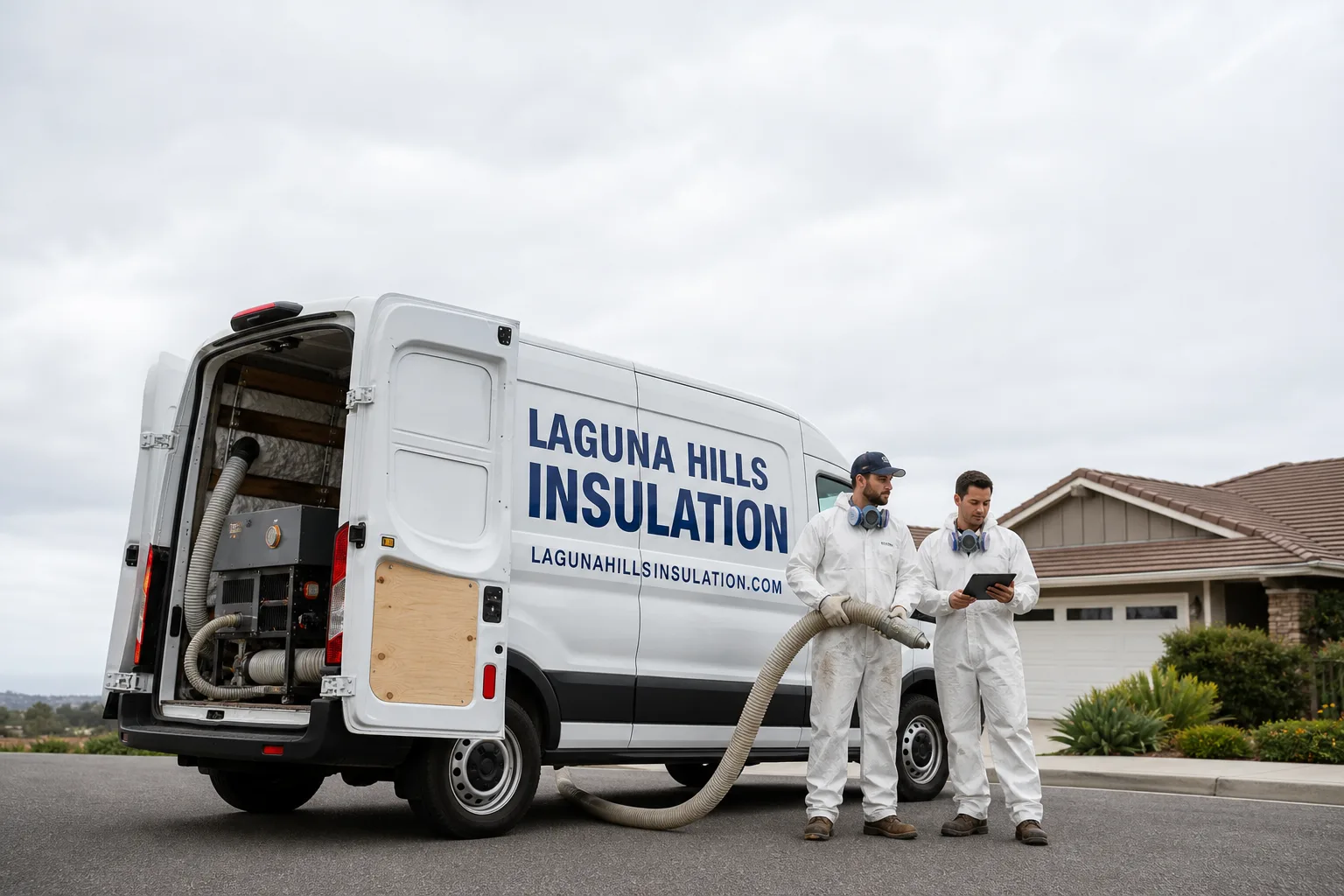
If you live in Walnut, you already know the pattern: afternoon heat settles into the upstairs bedrooms around 2 p.m. and doesn’t leave until after 10 p.m. That’s not just a summer nuisance. It’s what happens when a 1980s Mediterranean-style two-story off Grand Avenue still has R-11 batts in a stepped attic that was never designed for San Gabriel Valley heat. We’re Laguna Hills Insulation, and we work on Walnut homes every week. Our team knows the difference between a vaulted-ceiling tract home near Mt. SAC and a sloped-pad hillside property off Snow Creek Drive. Call (866) 393-6041 and we’ll send someone who has actually foamed attics in your neighborhood, not someone reading a map.
Walnut’s master-planned, hillside-contoured housing stock means most insulation work here is retrofit, not new build. That changes how spray foam gets installed. We think about access hatches, exposed rafter bays, and ridge-vent air leaks before we ever open a can of foam. This is why we’re the Spray Foam Insulation team Walnut homeowners call when the low-bid batt installer tells them “the attic’s too tight” and walks off the job.
Why Laguna Hills Insulation Is Walnut’s Preferred Spray Foam Insulation Company
Walnut homeowners tend to be comparison shoppers. You’re probably getting three bids right now, and we respect that. Here’s what separates us: we’re not a single-product contractor. We stock and install open-cell and closed-cell foam from Icynene and Demilec, but we also carry Owens Corning and Johns Manville batts, GreenFiber cellulose, and Rockwool mineral wool. If spray foam isn’t the right call for a particular Walnut attic, we’ll tell you that, and install blown-in fiberglass instead. Most contractors in the San Gabriel Valley can’t offer that choice because they only sell one material.
We’re led by Garrett Lund, who has built the company’s reputation on being material-agnostic. That means the right insulation for your Walnut home, not the one that’s easiest to sell. Our approach resonates here because Walnut’s housing stock is specific: 1970s-1990s stucco two-story homes with vaulted ceilings, exposed rafters, and stepped attic cavities that make a single-material solution unrealistic. Garrett’s method is to identify the actual thermal problem, then match a product to it. Sometimes that’s closed-cell foam from Demilec. Sometimes it’s GreenFiber cellulose in a flat attic near Lemon Avenue. You’ll get a straight answer either way. Call (866) 393-6041 and ask for a free assessment.
Spray Foam Insulation Contractors in Walnut
Spray foam insulation contractors in Walnut handle a different kind of retrofit than what you’d find in Pomona or Covina, and the difference is the terrain. On the hillside streets that climb south of the 60 toward the foothills, many homes sit on sloped pads with stepped attic cavities. These aren’t the wide-open attic spaces you see in flat valley housing. The roof pitch changes two or three times across the attic floor, creating low-clearance segments that are nearly impossible to reach with batt or blown-in material. Spray foam handles this geometry because it expands in place and adheres to the underside of the roof deck, including the awkward step transitions. We’ve done dozens of Walnut jobs where batt installers either gave up or sprayed only the flat middle section, leaving the ridge-vent-adjacent segments unsealed.
Cost for this kind of work in Walnut runs higher than flat-attic retrofits because crews work in tighter geometry. A stepped attic with vaulted ceilings and limited access typically lands between $3,200 and $6,800 for open-cell, depending on square footage and hatch placement. That’s the price of actually solving the problem, not just topping off old batts with another R-19 layer.
Rim Joist and Garage Ceiling Work
Walnut’s two-story tract homes often leak air at the rim joist where the first floor meets the foundation, particularly on the downslope side of a hillside lot. We see it constantly on sloped pads off Amar Road. Foaming the rim joist in these homes is a high-value job because it stops the stack effect, where hot air pours out the attic ridge vents and pulls dusty outside air in through the lower rim. Garage ceiling foam is another common request for homeowners on Canyon Drive or near the 60, where attached garages bake in direct sun and radiate heat into the bedroom above.
Roof Deck Applications
On some Walnut hillside homes, the roof deck itself becomes the conditioned envelope. This is common in vaulted-ceiling rooms with no attic space at all. Spray foam applied directly to the underside of the roof sheathing in these sections creates an unvented assembly that stops radiant heat gain before it enters the living volume. The local challenge is doing this in stepped sections where the roof pitch changes, and that’s where our experience on Walnut’s slope-parcel homes matters.
Spray Foam Attic Insulation in Walnut
Spray foam attic insulation in Walnut is the job we do most often, and it’s the one where local housing stock changes the scope the most. A standard vented attic retrofit in Walnut winds up being two or three disconnected foam applications because the attic floor steps with the roofline. Homeowners on Snow Creek Drive, Nogales Street, and near Suzanne Park call us when the second-floor bedrooms won’t cool below 78 degrees even with a newer HVAC system. The problem isn’t always the AC. It’s the attic. And the fix isn’t another layer of batt.
In a typical stepped attic, we remove or foam over the original R-11 batts and apply open-cell or closed-cell foam to the sloped rafter bays and the low-clearance step transitions. You need someone who can physically reach the far ridge-vent segment without tearing out ceiling drywall. That’s usually the hardest part. We’ve spent enough hours in Walnut attics to know which access hatches work and which ones need to be enlarged. Call (866) 393-6041 and we’ll walk your attic with you or send photos of what we find.
When Foam Over Batt Makes Sense
If the existing batts in your 1980s Walnut home are dry and only lightly compressed, spraying open-cell foam over them can be a reasonable option. The foam fills the gaps around the batt edges and seals the top plates. But if the batts are dark, dusty, or compressed from years of Santa Ana dust, they come out first. Foaming over failed batts traps absorbed heat and hides air leaks at the step transitions, which is why we don’t do it blindly.
Air-Sealing Before Foam
Before any foam goes in, we air-seal the ridge vents, gable gaps, and top plates in the attic. This is the detail that changes the outcome in Walnut more than anywhere else we work. Summer afternoons regularly hit the high 90s, and Santa Ana winds push hot, dusty air through ridge vents and gable gaps on hillside streets near the 60. Foam without sealing leaves the house breathing hot air all summer. We seal first, then foam. That order matters.
Trusted Brands We Service in Walnut
We stock and install Icynene and Demilec spray foam for Walnut retrofits, and we keep material on hand for open-cell and closed-cell applications without waiting on a supplier order from Los Angeles or Ontario. Both brands produce closed-cell foam with R-values around R-6.5 to R-7 per inch and open-cell around R-3.7 to R-4 per inch. For homeowners in Walnut asking about material availability and turnaround, we also carry Owens Corning and Johns Manville batts for hybrid jobs where foam handles the roof deck and batts or blown-in fill the flat ceiling sections. That mix shows up regularly on Walnut’s two-story tract homes with vaulted ceilings over the living room only, where a single material doesn’t cover every condition.
We’re also certified installers for GreenFiber cellulose, which matters if you want the eco-forward route on a flat-attic Walnut home and foam isn’t necessary. Garrett’s approach is to tell you which product actually fits. Not the most expensive option, not the cheapest, the one that solves your specific attic geometry.
Common Spray Foam Insulation Problems We See in Walnut Homes
- Sagging original R-11 batts under a foam layer. We see this on 1980s Walnut tract homes where a previous contractor sprayed foam right over compressed, dirty batts without removing them. The foam seals the top, but the trapped heat and hidden gaps at the step transitions stay. That’s a do-over job.
- Partially foamed stepped attics. On Walnut’s hillside lots, contractors often foam only the flat middle section and skip the low-clearance segment near the ridge vents. Santa Ana winds then pull hot, dusty air through the unsealed gable and ridge gaps straight into the freshly foamed cavity.
- No air-sealing before foam. This is the most common mistake in Walnut. The foam goes in over ridge vents that are still open, so the sealed envelope keeps leaking and the cooling bills don’t drop. We seal first, every time.
- Closed-cell foam on solo roof-deck sections with no ventilation plan. On vaulted-ceiling rooms, we often see unvented roof deck assemblies with no condensation strategy. Icynene and Demilec closed-cell products handle this well, but the detail work on step transitions in Walnut’s sloped pads requires precise installation, not a rush job.
Pricing for Spray Foam Insulation in Walnut, CA
For a typical Walnut two-story tract home with a stepped attic, expect to pay $3,200 to $7,400 depending on square footage, foam type, and whether we’re removing old batts first. Smaller jobs like a rim joist or garage ceiling typically run $1,200 to $2,600. Closed-cell foam costs more per board foot but delivers higher R-value and acts as its own vapor barrier, which matters in vaulted and unvented roof deck sections. Open-cell is the better value for flat, vented ceiling sections where you want air sealing at a lower price per square foot. We’ll give you a line-item quote so you can see exactly where the money goes. Call (866) 393-6041 for a free estimate. Walnut pricing runs about 15 to 20 percent above flat valley cities like Pomona because of the stepped attic geometry and tighter access, not because the material costs more.
We Also Serve Cities Near Walnut
Laguna Hills Insulation works throughout the eastern San Gabriel Valley and into the Pomona Valley. We regularly send crews to Walnut and the surrounding communities, including South San Jose Hills, Rowland Heights, West Covina, and Pomona. If you’re on the edge of one of those city lines, check with us about service area and response time for your street.
Serving Walnut, CA — Our Local Coverage Area
We’re based in the Walnut area and know this community well. Use the map below to see our service coverage — if you’re nearby, we can almost certainly help.
FAQs About Spray Foam Insulation in Walnut
Because Walnut’s hillside lots create stepped attic cavities that standard batt insulation can’t bridge. On flat valley cities like Pomona or Covina, a typical attic is a simple, open space. In Walnut, the roof pitch changes two or three times across the attic floor, and the low-clearance step sections near the ridge vents are exactly where Santa Ana winds push hot, dusty air into the house. Spray foam seals those transitions and stops the air movement. That’s the whole difference. Call (866) 393-6041 for an attic assessment specific to your street.
Yes. We foam stepped Walnut attics regularly, including the low-clearance sections that other contractors skip. The foam expands in place and adheres to the sloped rafter bays and step transitions without needing a crew member to physically stand in every corner. We often work from the accessible flat section and use extension wands to reach the tight ridge-vent areas. You don’t need a full-height attic for this.
If the batts are dry and only lightly compressed, you can foam over them. But most Walnut homes from the 1980s have batts that are dark, dusty, and compressed from years of Santa Ana dust and heat. Those come out first. We’ll make that call during the estimate and show you what’s in your attic before we start. Foaming over failed batts traps heat and hides air gaps. We don’t do it.
Yes, and it’s the single most effective retrofit for Walnut’s specific summer problem. The heat gain in your home isn’t primarily from walls; it’s from the attic. In 90s-100s°F heat, an unsealed Walnut attic can hit 140 degrees and radiate through your ceiling drywall all afternoon. Spray foam on the roofline or ceiling stops that radiant transfer, and customers consistently report second-floor rooms cooling down noticeably in the first summer after installation.
We’re certified for Icynene and Demilec spray foam products, both open-cell and closed-cell. We also carry Owens Corning and Johns Manville batts and GreenFiber cellulose for hybrid and flat-attic jobs. If foam isn’t the right fit for your Walnut attic, we’ll tell you that and offer the material that is. That’s the point of working with a material-agnostic contractor.
Written by Garrett Lund, Owner at Laguna Hills Insulation, serving Walnut and the San Gabriel Valley.