
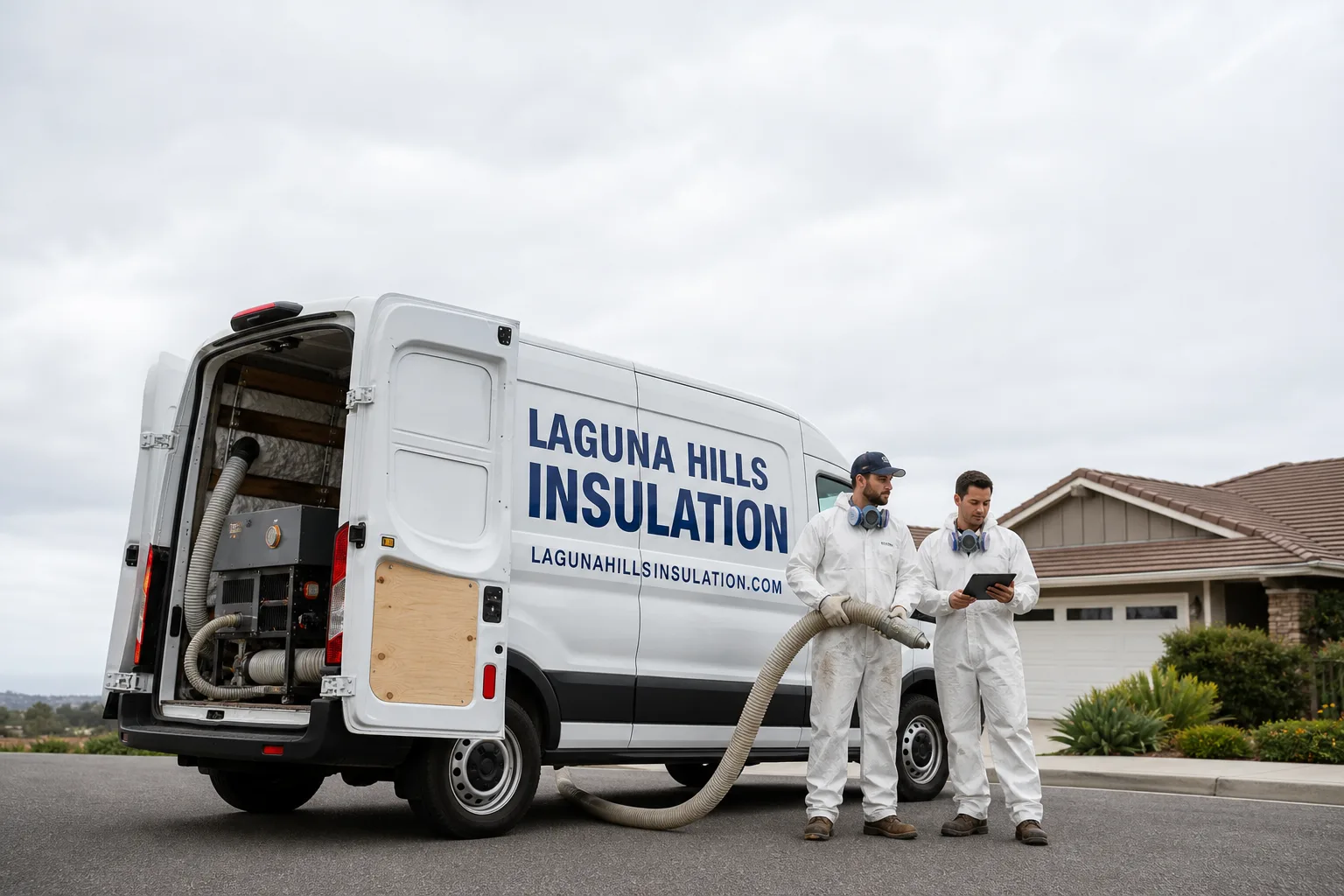
Fast, Reliable Spray Foam Insulation Across West Covina
Spray foam insulation in West Covina typically costs $3.50 to $7.50 per square foot for open-cell and $5.50 to $11.00 per square foot for closed-cell, with most attic projects falling between $4,500 and $14,000 depending on roof pitch, access, and the condition of existing insulation. Most West Covina homes we work on were built between 1948 and 1975, and they were not designed for the kind of heat we see now. The San Gabriel Valley regularly pushes past 95°F in summer, and those original insulation levels simply cannot keep up. If you’re in the 91790, 91791, 91792, or 91793 ZIP codes and your AC runs nonstop from June through October, call us at (866) 393-6041 for a free estimate. We know exactly what your house needs because we work on these homes every week.
Why Laguna Hills Insulation Is West Covina’s Preferred Spray Foam Insulation Company
West Covina homeowners call us for one reason: we work across the full spectrum of insulation materials and will tell you honestly which one fits your house, even if it means recommending a less expensive option. Garrett Lund built this company on a material-agnostic approach. We install attic insulation, blown-in insulation, and spray foam insulation all in-house, and we carry eight manufacturer brands: Owens Corning, Johns Manville, Knauf, Rockwool, CertainTeed, Icynene, Demilec, and GreenFiber. Most insulation contractors push whatever single product line they stock. We don’t. The right insulation wins the job, not the easiest upsell.
We’re familiar with the specific construction patterns in West Covina’s tract home neighborhoods, from the ranch-style homes off Azusa Avenue to the mid-century builds near Cameron Park. Our crews respond to West Covina calls quickly, and we’ve worked on homes throughout the 91790 and 91791 ZIP codes where hip roofs and minimal attic ventilation create real challenges that generic insulation crews miss.
Homeowners in West Covina consistently tell us the same thing: other contractors gave them a quote without ever looking in the attic. We always inspect the existing insulation, the roof framing layout, and the ventilation situation before recommending anything. That’s the difference between a quote and a real plan.
Spray Foam Insulation Contractors in West Covina
Spray Foam Insulation Contractors in West Covina handle one of the most technically demanding insulation applications in the trade, and the quality of the install matters more than the product itself. A proper spray foam job starts with evaluating what’s already in the attic, measuring the roof pitch, checking for existing baffles or venting, and determining whether your home needs open-cell or closed-cell foam. In West Covina, most projects involve removing old settled loose-fill or thin batt insulation before spraying, because foam applied over degraded material won’t adhere properly and can trap moisture.
For a typical West Covina ranch home with a low-pitch hip roof, a full attic foam application runs $5,500 to $12,800 depending on square footage and whether you choose open-cell or closed-cell. Open-cell spray foam from Icynene typically runs $3.50 to $5.50 per square foot, while closed-cell from Demilec runs $5.50 to $9.50 per square foot in this market. Closed-cell costs more because it creates both an air barrier and a vapor barrier in a single application, and it adds structural rigidity to the roof deck.
Open-Cell and Closed-Cell Options
Open-cell foam is the workhorse for most West Covina attics. It expands dramatically, fills odd-shaped cavities in hip roof framing, and delivers roughly R-3.5 to R-3.7 per inch. Closed-cell foam delivers R-6.5 to R-7 per inch and acts as a vapor retarder, which matters in unvented attic assemblies. In West Covina’s hot-summer climate, closed-cell foam on the roof deck dramatically cuts radiant heat transfer into the living space, but it costs significantly more. We’ll walk you through the trade-offs without pushing whichever one makes us more money.
Roof Deck and Rim Joist Work
Many West Covina homes built in the 1950s and 1960s have rim joists that were never insulated. Spray foam is the only practical way to reach those narrow band joist cavities, and it seals air leaks that batt insulation can’t touch. Roof deck applications, where the foam is sprayed directly onto the underside of the roof sheathing, are the gold standard for turning a hot, under-vented attic into a conditioned space. We also handle garage ceiling spray foam for attached garages that radiate heat into adjacent living areas.
Spray Foam Attic Insulation in West Covina
Spray Foam Attic Insulation in West Covina works differently than it does in neighboring cities because of one thing: the roof geometry. Most homes in the 91790 and 91791 ZIP codes were built with hip roofs, also called “coolie” roofs locally, that have very little ridge line for ventilation. When you combine that with West Covina’s hot-summer Mediterranean climate, where inland heat builds against the San Gabriel foothills and summer attic temperatures routinely hit 130°F to 145°F, standard insulation approaches fail. Foam sprayed directly onto the underside of a low-pitch hip roof without proper baffles blocks what little airflow exists, and the trapped heat can degrade the foam over time.
A full attic spray foam installation in West Covina typically costs $4,500 to $13,500, with most 1,200 to 1,800 square foot ranch homes falling in the $5,500 to $9,500 range. The price depends on whether we’re removing old insulation first, whether the attic is accessible or has tight clearance, and whether you need baffles installed before spraying. In West Covina’s older homes, we almost always recommend insulation removal first. Foam sprayed over settled loose-fill that’s been there since the Eisenhower administration won’t bond correctly, and you’ll pay twice.
Ventilation and Baffle Requirements
In West Covina’s 91790 and 91791 ZIP codes, many hip-roof homes were built with only two or three small static vents for the entire attic. Before we spray foam on a roof deck, we assess whether the attic will become an unvented assembly and plan accordingly. If baffles are needed to maintain airflow from soffit to ridge, we install them before the foam goes in. Skipping this step is the most common mistake we see from other contractors, and it’s the reason some West Covina homeowners end up calling us to fix a foam job that’s only a few years old.
R-Value Targets for West Covina
California’s Title 24 energy code requires R-38 or higher for attic insulation in climate zones that include West Covina. Most original attics in this city test at R-7 to R-11 after decades of settling. Closed-cell spray foam from Demilec delivers R-38 at roughly 5.5 to 6 inches of depth, while open-cell from Icynene needs closer to 10 to 11 inches. On tight hip roofs with limited space, closed-cell often makes more sense because you get the required R-value in half the depth.
Trusted Brands We Service in West Covina
We’re not married to one manufacturer, and that matters for West Covina homeowners because your house was built in a specific era with specific framing quirks. We work with Owens Corning and Johns Manville for fiberglass applications, Knauf for specialty batt work, and Icynene and Demilec for open-cell and closed-cell spray foam. We also stock GreenFiber cellulose for homeowners who want a recycled-material option. Because we carry multiple brands and product categories, we can source the right material for your specific roof pitch and ventilation setup instead of forcing whatever’s on the truck. For West Covina customers, that means faster turnaround and a solution matched to your house, not our inventory.
Common Spray Foam Insulation Problems We See in West Covina Homes
- Foam sprayed over old settled insulation: In many 1950s and 1960s West Covina homes, the original loose-fill or thin batts are still in the attic, compacted to R-7 or worse. Foam sprayed directly over this material won’t bond to the roof deck, and the trapped layer underneath can hold moisture against the framing. We remove old insulation before spraying, which adds cost but prevents a failed install.
- Blocked ventilation on hip roofs: The hip roof geometry common in West Covina’s tract homes leaves very little ridge line for hot air to escape. Foam applied without baffles seals off what little airflow existed, and the attic becomes an oven. We regularly see foam jobs from other contractors where the attic hit 150°F because nobody installed baffles first.
- Condensation on cool interior surfaces: Closed-cell foam in an unvented attic without proper thermal barriers can create condensation on ceiling surfaces during West Covina’s mild winter nights. This shows up as water stains or peeling paint on ceilings near exterior walls. It’s a design problem, not a product problem, and it’s why we plan the full assembly before spraying.
- Heat degradation from 95°F+ summers: Open-cell foam in particular degrades faster when exposed to sustained high heat in a sealed, under-vented attic. West Covina’s inland heat, amplified by the valley’s distance from the coast, pushes attics into the 140°F range for weeks at a time. Correct baffle installation and the right foam choice for your specific roof make this a non-issue.
Pricing for Spray Foam Insulation in West Covina, CA
Here’s what West Covina homeowners can expect to pay in 2026. Open-cell spray foam runs $3.50 to $5.50 per square foot installed. Closed-cell spray foam runs $5.50 to $9.50 per square foot installed. A typical attic in a 1,200 to 1,600 square foot ranch home falls between $4,500 and $12,500 depending on foam type, insulation removal, and baffle installation. Rim joist spray foam for a standard West Covina home runs $1,800 to $4,200. Garage ceiling spray foam runs $2,200 to $5,000. These ranges reflect West Covina’s specific market: older homes that need removal work, hip roofs that need baffles, and access challenges in tight attics. The single biggest cost variable is whether old insulation needs to come out first. Call (866) 393-6041 for an exact quote, and we’ll inspect your attic before giving you a number. Estimates are always free.
We Also Serve Cities Near West Covina
Our crew covers the full San Gabriel Valley. Beyond West Covina, we regularly work in Valinda, South San Jose Hills, La Puente, and Irwindale. Same Spray Foam Insulation standards, same material-agnostic approach, same straight answers. If you’re in a neighboring city and your attic’s running hot, call us and we’ll get you on the schedule.
Serving West Covina, CA — Our Local Coverage Area
We’re based in the West Covina area and know this community well. Use the map below to see our service coverage — if you’re nearby, we can almost certainly help.
FAQs About Spray Foam Insulation in West Covina
Yes, but the installation method matters more than in most other cities. Homes in West Covina’s 91790 and 91791 ZIP codes often have hip roofs with two or three small static vents, which means a standard spray foam approach will trap heat and degrade the foam. We install baffles to maintain airflow before spraying on the roof deck in these homes, converting the attic into a properly conditioned space rather than a sealed heat box. Call (866) 393-6041 and we’ll inspect your specific roof before recommending anything.
Spray foam creates both an air seal and a thermal barrier, while traditional blown-in or batt insulation only slows conductive heat transfer. In a West Covina ranch home with a low-pitch roof and minimal ventilation, that air sealing makes a significant difference. The trade-off is cost: spray foam runs $3.50 to $9.50 per square foot compared to blown-in insulation at roughly $1.50 to $3.00 per square foot. We’re honest about which approach makes sense for your house because we install both.
West Covina falls under California’s Title 24 climate zone requirements that call for R-38 or higher in attics. Closed-cell spray foam reaches R-38 at about 5.5 to 6 inches of depth, while open-cell needs roughly 10 to 11 inches. On West Covina’s low-clearance hip roofs, closed-cell often fits better because it delivers the required R-value in half the depth. Call (866) 393-6041 for an assessment of your specific attic and what’s realistic for your roof geometry.
Yes. West Covina homes with hip roofs and minimal ventilation often develop hot spots where air can’t move through the attic, and those hot spots radiate directly into the rooms below. Spray foam on the roof deck, installed with proper baffles, eliminates those hot spots by turning the attic into a conditioned space. A homeowner on South Lark Ellen Avenue in the 91791 ZIP had a 1962 ranch with an attic hitting 140°F and an AC that never cycled off. We found the original loose-fill settled to R-7 and a hip roof with only two small static vents. We installed Icynene spray foam on the roof deck, added baffles to maintain airflow, and brought the attic to R-38. Their summer cooling costs dropped by about 30%.
Spray foam applied over old, settled insulation is not safe for the assembly, because it won’t bond correctly and can trap moisture against the framing. In West Covina’s older homes, we recommend removing the original insulation before spraying. This adds cost but prevents the failure modes we see in foam jobs from other contractors who skipped that step. For older homes with existing insulation you’d rather keep, blown-in insulation or batts may be a better fit, and we’ll tell you if that’s the case.
If you’re tired of an attic that feels like an oven and cooling bills that climb every summer, call us at (866) 393-6041. We’ll inspect your West Covina home, tell you exactly what’s going on up there, and give you a straight answer about whether spray foam is the right fix. No push, no upsell, just an honest assessment from an insulation specialist who knows these houses.
Written by Garrett Lund, Owner at Laguna Hills Insulation, serving West Covina and the San Gabriel Valley.