
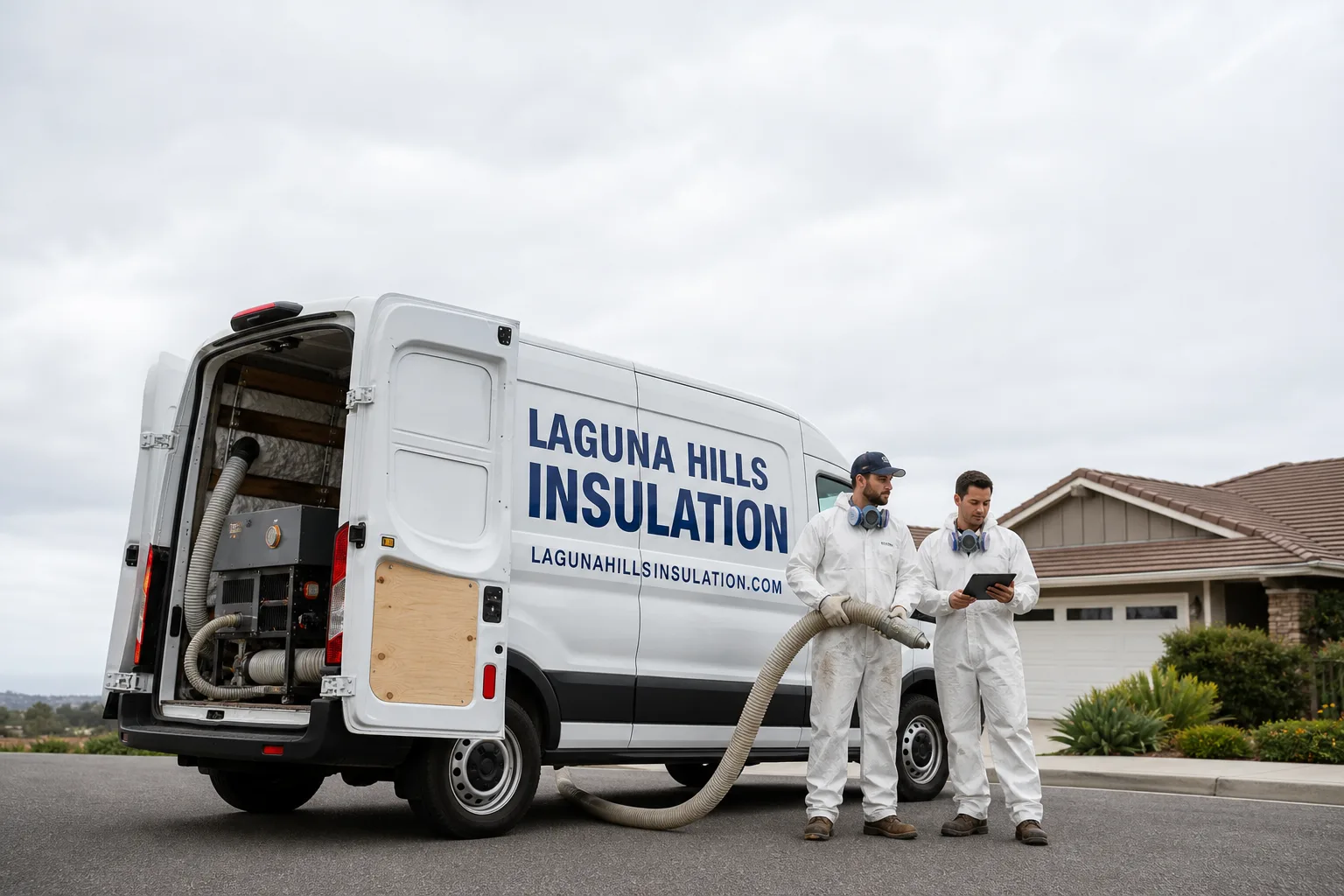
Fast, Reliable Spray Foam Insulation Across Newport Beach
Spray foam insulation in Newport Beach runs $2.40 to $6.90 per board foot installed, with most whole-home open-cell projects landing between $4,800 and $11,500 and closed-cell rim joist jobs starting around $1,900. Our team at Laguna Hills Insulation reaches most Newport Beach neighborhoods within 45 to 60 minutes, and we carry both open-cell and closed-cell systems from Icynene and Demilec so the material fits the house, not the other way around. If you’re dealing with a musty crawl space, a drafty older cottage, or condensation along attic edges in the marine layer, call (866) 393-6041 and we’ll give you a straight read on what’s actually happening.
Newport Beach isn’t an inland insulation job. The salt air, the morning marine layer, the humid onshore flow that hangs over Balboa Peninsula and West Newport most of the year. That changes what spray foam has to do here, and it changes the order of operations. More on that below.
Why Laguna Hills Insulation Is Newport Beach’s Preferred Spray Foam Insulation Company
We’ve worked in enough Newport Beach crawl spaces and attics to know that the real problems here are moisture and corrosion, not just heat gain. The older beach-close homes on Balboa Island, Cannery Village, and the Peninsula were built before vapor control was a standard consideration, and many of them sit on pier-and-beam foundations that draw humid air through open vents all year. A crew that only knows inland Orange County will spray foam over that wet framing and lock the problem in. We won’t.
Newport Beach homeowners regularly tell us they called two or three contractors before us and never got a straight answer about whether open-cell foam makes sense in a high-humidity home, or why their existing fiberglass smells like a bait bucket. Garrett Lund, who leads our team, has spent enough time in these assemblies to know when foam is the right call and when it needs to wait until the framing dries out. That honest sequencing is why much of our Newport Beach work comes from referrals within the same few ZIP codes: 92662, 92663, 92658, 92659.
We stock both Icynene and Demilec spray foam product lines and carry the full complement of vapor barriers, sealants, and corrosion treatments that coastal jobs require. When a Newport Beach homeowner calls, they’re not getting a sales pitch for one product. They’re getting a material assessment based on what’s actually happening under their house.
Open Cell Spray Foam in Newport Beach
Open cell spray foam in Newport Beach is a soft, breathable foam that expands aggressively to fill cavities and air-seal attics, rim joists, and interior walls. It runs roughly $2.40 to $4.60 per board foot installed in this market. The catch in Newport Beach is that open-cell foam absorbs humidity when it’s exposed to uncontrolled moisture flow, which is exactly what the marine layer delivers to Balboa Peninsula and West Newport attics for most of the year. If an open-cell install makes sense here, it almost always needs a vapor strategy paired with it.
Where It Works in Beach-Close Homes
Open-cell foam performs well in conditioned attic spaces and interior walls where the home’s envelope already controls moisture. In newer Newport Coast custom homes with sealed attics and mechanical ventilation, open cell delivers strong R-value and air sealing without the cost of closed cell. In older unvented attics on the Peninsula, we’re more cautious: the foam’s moisture absorption can eat into its thermal performance if the surrounding assembly isn’t dry.
What It Costs and When to Use It
A typical open-cell attic or wall cavity job in a Newport Beach cottage runs $3,500 to $7,800 depending on area and depth. For the 1920s bungalows on Balboa Island with framed walls and empty cavities, open cell is often the only realistic option for air sealing without tearing out plaster. We’ll tell you if it’s right for your house, and we’ll say so plainly if it isn’t. Call (866) 393-6041 for a specific number.
Spray Foam Insulation Contractors in Newport Beach
Spray foam insulation contractors in Newport Beach aren’t all the same, and the difference shows up in how they handle the coastal conditions specific to this city. We are not a blown-in-only crew that picked up a foam rig last season. Laguna Hills Insulation installs open-cell and closed-cell spray foam as a core service, backed by Icynene and Demilec product training, and we approach every beach-close job as a moisture-and-corrosion sequence rather than a simple spray-and-go.
What a Coastal-Correct Spray Foam Job Looks Like
In the beach-close neighborhoods, the right sequence is inspect and dry first, address vapor control second, spray foam last. That’s the reverse of what an inland Orange County crew typically does, and it’s the reason some foam jobs in Newport Beach fail from the inside out. On a Balboa Island bungalow, our crew found crawl-space fasteners and old joist hangers rusted to the point of flaking, with a layer of waterlogged fiberglass sitting beneath. We pulled the soaked material, treated and dried the framing, sealed penetrations, and applied closed-cell spray foam to form the vapor barrier, then used open cell in the attic above the re-sheathed deck. Two months later the homeowner reported the humid, musty smell that had driven the call was gone.
Why We Carry Two Foam Types
Open-cell and closed-cell solve different problems, and Newport Beach homes sit across the full spectrum of those problems. Closed-cell foam from Demilec creates an air barrier and a thermal barrier in a single application, and it acts as a vapor barrier too, which matters in crawl spaces that pull humid marine air. Open-cell is lighter, more affordable, and better suited to interior walls and conditioned attics where moisture is already managed. We’ll recommend the one that fits your assembly, even if it’s the cheaper option.
Trusted Brands We Service in Newport Beach
We install spray foam from Icynene and Demilec, two of the most recognized open- and closed-cell product lines in the industry, and we pair them with insulation materials from Owens Corning, Johns Manville, and Rockwool when a Newport Beach home needs a hybrid approach. That matters because many coastal homes here need closed-cell foam at the crawl space, open-cell in the attic, and mineral wool or fiberglass in specific cavity locations. We stock local inventory so Newport Beach homeowners aren’t waiting on a special order when a foam job needs to move quickly. Call (866) 393-6041 and we’ll tell you which product actually fits, not just what we happen to have on the truck.
Common Spray Foam Insulation Problems We See in Newport Beach Homes
- Foam sprayed over wet or corroded framing in beach-close crawl spaces. This is the big one on Balboa Island and the Peninsula. When closed-cell foam is applied directly over rusted fasteners or soggy batt, it traps salt-driven moisture inside the assembly and the corrosion keeps eating the framing from the inside out.
- Condensation at foam-edge seams in vented attics. In West Newport and the 92663 interior, attics vented for inland drying patterns pull damp marine-layer air directly into the foam edges. The result is a ring of condensation around the perimeter of the ceiling, and eventually mold.
- Open-cell foam absorbing onshore moisture and losing R-value. Open cell is an air barrier, not a vapor barrier. In high-humidity Balboa Peninsula homes, open-cell installed without a vapor strategy will slowly soak up marine moisture and lose thermal performance while creating conditions for microbial growth.
- Salt air corroding fasteners and hangers long before the foam fails. The ocean is close on nearly every side in Newport Beach, which means salt-laden air gets into every vented crawl and attic. Hangers, joist straps, and nails rust out years faster than inland hardware, and the insulation layer sitting on top often hides the problem until it’s severe.
Pricing for Spray Foam Insulation in Newport Beach, CA
Open-cell spray foam in Newport Beach typically runs $2.40 to $4.60 per board foot, and closed-cell runs $4.80 to $6.90 per board foot. A garage ceiling spray foam job in West Newport averages $1,800 to $3,400. A rim joist seal on a mid-century 92663 tract home usually comes in between $1,900 and $4,200 for full perimeter coverage. Whole-home open-cell attic work in a 1,500-square-foot Balboa Island cottage commonly lands between $4,800 and $9,000, while closed-cell crawl space encapsulation on a pier-and-beam Peninsula home can reach $8,000 to $14,000 depending on access and framing condition. The free estimate we give you is a real number, not a ballpark. Call (866) 393-6041 to schedule one.
We Also Serve Cities Near Newport Beach
Our spray foam crews work throughout coastal and central Orange County, including Costa Mesa, San Joaquin Hills, Fountain Valley, and Irvine. If you’re in one of those cities and need Spray Foam Insulation expertise, we can typically reach you the same week. We know the coastal-moisture conditions throughout the Newport Beach area and we bring the same inspect-dry-seal sequence to every job. See our Newport Beach coverage page for more local detail, or call (866) 393-6041.
Serving Newport Beach, CA — Our Local Coverage Area
We’re based in the Newport Beach area and know this community well. Use the map below to see our service coverage — if you’re nearby, we can almost certainly help.
FAQs About Spray Foam Insulation in Newport Beach
Because the moisture load is fundamentally different. Newport Beach sits in the marine layer with humid onshore air most of the year, and the older beach-close neighborhoods on Balboa Peninsula, Balboa Island, and West Newport have vented crawl spaces and attics that pull that damp air through the assembly constantly. Irvine and Anaheim are inland; their attics dry out, their crawl spaces stay reasonably dry, and vapor problems are less acute. In Newport Beach, spray foam becomes a moisture management decision as much as an insulation decision, and the sequence matters more than the product. Call (866) 393-6041 and we’ll walk you through what your specific house needs.
No, not directly. If the fasteners, hangers, or framing are already flaking with rust, spraying foam over them locks in salt-driven corrosion and traps whatever moisture is already in the wood. The correct order is to pull any wet insulation, treat and dry the framing, seal the penetrations that are letting in humid air, and then apply closed-cell foam as the vapor barrier. Skipping the inspection step is how failed coastal foam jobs happen. We do it in the right sequence on every Newport Beach job.
Usually yes, but it can be tight. The 1920s-to-1950s cottages and bungalows on Balboa Island and Cannery Village often have shallow crawl spaces and low attic clearances that make some methods harder. Closed-cell foam can be applied in tight spaces with a wand extension, and we handle limited-access installs regularly. We’ll tell you honestly if a particular area is too restricted to do the job properly before we start.
Sometimes. Open-cell foam is an air barrier with good R-value per inch, but it is not a vapor barrier. In a Newport Beach home with a properly conditioned attic or controlled ventilation, open cell works well. In a vented attic or crawl space pulling in marine air, open cell applied without a vapor strategy will absorb moisture over time and lose thermal performance. We install both open-cell and closed-cell foam, and we’ll recommend based on your house, not our inventory.
There are a few telltale signs in Newport Beach homes: a persistent musty or salty odor in the house, rust-colored staining on attic framing or crawl space fasteners, fiberglass batts that feel heavy or look flattened, condensation on ceiling edges in the morning, and visible corrosion on any metal brackets or hangers. If you’re seeing any of that in a beach-close neighborhood, the insulation likely needs to come out before new foam goes in. Call (866) 393-6041 and we’ll inspect it and tell you what’s actually going on.
Written by Garrett Lund, Owner at Laguna Hills Insulation, serving Newport Beach and coastal Orange County. Eight brands. Three methods. One specialist.