
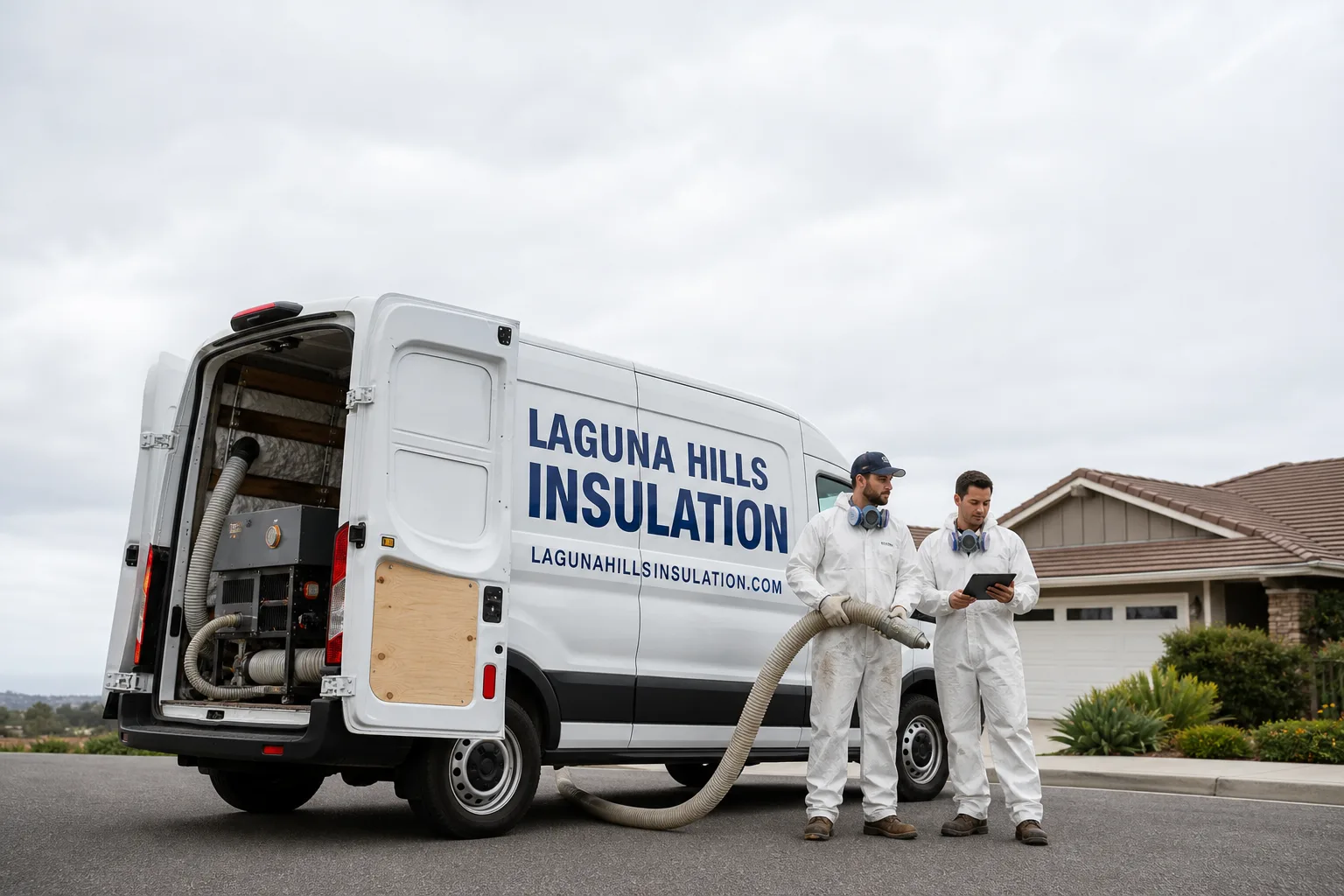
Fast, Reliable Spray Foam Insulation Across Costa Mesa
Spray foam insulation in Costa Mesa runs between $2,100 and $6,800 for a typical full garage or attic application, depending on open-cell versus closed-cell product and square footage. We get crews to Costa Mesa neighborhoods in 24 to 48 hours for most estimates, and same-week installation is usually available for garage jobs. Costa Mesa’s marine layer changes what spray foam needs to do here, and we plan every job around that reality, not a generic spec sheet. Call (866) 393-6041 and we’ll walk you through what your specific house actually needs.
Why Laguna Hills Insulation Is Costa Mesa’s Preferred Spray Foam Insulation Company
Homeowners in Costa Mesa keep calling us back because we don’t push one product. Garrett Lund runs our crews with a material-agnostic approach: eight manufacturer brands, three installation methods, and the willingness to tell you when spray foam is the wrong choice for your attic. We carry Icynene and Demilec open- and closed-cell foam lines, plus Rockwool mineral wool, Owens Corning fiberglass, and GreenFiber cellulose. That breadth matters in a city like Costa Mesa, where a 1950s Westside bungalow and a 1970s South Coast Metro tract home may need completely different insulation strategies.
We’re not guessing from a distance. Our technicians know that a 92627 job often means a shallow, low-pitch attic with decades of compressed insulation, while a 92626 job near South Coast Plaza might mean a cathedral ceiling or multifamily building that needs careful air sealing before anything else. That local knowledge shifts how we bid and how we install.
Garage Spray Foam Insulation in Costa Mesa
Garage Spray Foam Insulation in Costa Mesa is one of the most common requests we field, especially from homeowners on the Westside who’ve watched their garage door hardware corrode in salt air while the space bakes or chills with every season. The job typically involves applying closed-cell or open-cell foam to the garage ceiling and shared walls, then addressing any moisture-driven corrosion on tracks, hinges, and springs before it becomes a failure point. A standard two-car garage in Costa Mesa runs $1,800 to $4,200 for closed-cell foam, with open-cell coming in lower at $1,400 to $2,900. We quote both options and explain the trade-offs so you’re deciding with real numbers, not guesswork.
Moisture Control, Not Just Temperature
Costa Mesa’s marine layer means garage ceilings stay damp longer than anyone expects. Closed-cell foam acts as a vapor retarder, which helps, but only if the existing venting and door seals are in decent shape. We check that before spraying. On the house we worked in the Westside last spring, the original attic insulation had compressed to almost nothing and the garage door springs were rusted enough that the homeowner had stopped using the door. We removed the failed insulation, applied closed-cell foam to the garage ceiling and walls, and replaced the corroded hardware with galvanized springs and stainless hinges. Then we set up a corrosion inspection schedule so the problem didn’t creep back.
When to Prioritize the Garage
If your garage shares a wall with a bedroom or living space, spray foam there often returns more comfort per dollar than attic work alone. Costa Mesa homes built before 1960 rarely have proper air sealing between garage and living space, and the temperature swings from marine-layer mornings to Santa Ana afternoons make that gap obvious. We’ll tell you if the garage is the right first step.
Closed Cell Spray Foam Insulation in Costa Mesa
Closed Cell Spray Foam Insulation in Costa Mesa is the product we recommend most often for attics and garages in the marine-layer band because it handles the two jobs Costa Mesa’s climate throws at you: it insulates and it resists moisture. A full attic application in Costa Mesa typically costs $3,200 to $6,800 depending on square footage, roof pitch, and access. Closed-cell foam from Icynene or Demilec creates an air barrier and a thermal barrier in a single application, which matters here because trapped condensation against roof decking is a bigger threat than summer heat gain. We install it knowing the dew point math changes in June Gloom.
Why Closed-Cell Fits Costa Mesa’s Attics
Inland contractors can assume an attic will dry out. Costa Mesa attics don’t always. The marine layer keeps decking damp into July, and closed-cell foam’s low vapor permeability actually protects the framing when it’s applied correctly. That’s the difference between an insulation retrofit that works for 20 years and one that rots your roof sheathing from the inside.
Salt Air and Structural Protection
Closed-cell foam also adds rigidity and helps air seal around rim joists and top plates where salt air infiltrates. We commonly see corroded fasteners and rusted electrical boxes in Costa Mesa attics within a mile of the coast. Foam slows that exchange. It won’t stop salt air entirely, but paired with proper sealing, it makes a measurable difference.
Trusted Brands We Service in Costa Mesa
We stock and service spray foam systems from Icynene and Demilec, along with insulation lines from Owens Corning, Johns Manville, and Knauf. That matters for Costa Mesa customers because replacement parts, touch-up foam kits, and product-specific technical support are available quickly. If a previous contractor used a product we don’t stock, we’ll source the correct material rather than slapping a mismatched foam over it. Garrett Lund picks brands based on job conditions, not convenience. Sometimes that means Demilec closed-cell for a tight cathedral ceiling; sometimes it’s an open-cell product for a vented attic. You’ll hear the reasoning in plain English.
Common Spray Foam Insulation Problems We See in Costa Mesa Homes
- Foam applied without vapor management. Spray foam in Costa Mesa’s marine-layer attics traps condensation against roof decking if the installer ignores vapor control. We see rot and peeling paint in homes where an inland contractor used a one-size-fits-all approach.
- Corroded garage door hardware hidden behind new foam. Salt air attacks springs, hinges, and tracks faster in Costa Mesa than almost anywhere else in Orange County. If foam covers the rusted fasteners, the first sign of trouble is often a snapped spring, not a visible stain.
- Low-pitch Westside roofs with no added ventilation. Many 1950s bungalows in 92627 have shallow attics that can’t breathe. Foam without ventilation upgrades on these roofs leads to moisture buildup and reduced insulation performance. We won’t spray until the venting question is answered.
- Open-cell foam used where closed-cell was needed. Open-cell spray foam is cheaper, but it’s not always right for Costa Mesa’s damp coastal air. We’ve seen open-cell foam in garage ceilings that soaked up moisture like a sponge. Closed-cell is the safer call within a mile or two of the coast.
Pricing for Spray Foam Insulation in Costa Mesa, CA
Open-cell spray foam in Costa Mesa runs $0.45 to $0.80 per board foot installed, while closed-cell runs $0.90 to $1.60 per board foot. A typical garage ceiling and walls: $1,400 to $4,200. A full attic in a 1,200-square-foot home: $2,800 to $5,500. Rim joist work in a crawlspace or raised foundation: $600 to $1,800. Factors that move the price include roof pitch, attic access, existing insulation removal, and whether we need to add ventilation before spraying. Estimates are free, and we give you the open-cell and closed-cell numbers side by side so you’re choosing with full information. Call (866) 393-6041 for a quote specific to your Costa Mesa address.
We Also Serve Cities Near Costa Mesa
Our Spray Foam Insulation crews serve Costa Mesa and the surrounding communities, including Newport Beach, Fountain Valley, Huntington Beach, and San Joaquin Hills. Same coastal conditions, same brand access, same crews.
Serving Costa Mesa, CA — Our Local Coverage Area
We’re based in the Costa Mesa area and know this community well. Use the map below to see our service coverage — if you’re nearby, we can almost certainly help.
FAQs About Spray Foam Insulation in Costa Mesa
Closed-cell spray foam at 2 inches or thicker functions as its own vapor retarder, so a separate vapor barrier isn’t needed in most Costa Mesa garages. Open-cell foam does not provide the same vapor control, and in a marine-layer climate, it can absorb moisture from the air unless paired with additional vapor management. Call (866) 393-6041 and we’ll tell you which product fits your garage’s conditions and why.
Salt air accelerates corrosion on springs, hinges, rollers, and tracks by a factor of two to three times compared to inland Orange County. Spray foam reduces air exchange and keeps moisture more constant, but it can also hide early rust until hardware fails. We recommend galvanized or coated springs and stainless hinges at the time of installation, plus an annual hardware inspection.
Yes, and it’s usually the best option because closed-cell foam adds insulation value without eating up the limited attic space a low-pitch roof leaves you. The caveat is ventilation: Westside bungalows often need added intake or exhaust venting before foam is applied, or moisture gets trapped against the decking. We assess the roof before quoting.
Closed-cell foam is denser, more expensive, and acts as both an air and moisture barrier, which suits Costa Mesa’s marine-layer damp. Open-cell is lighter and cheaper with better sound damping, but it’s vapor permeable and can hold moisture near the coast. We stock both Icynene and Demilec product lines so the recommendation follows the house, not our inventory.
Once a year is enough for most Costa Mesa homes, ideally in fall before the winter marine layer returns. If your home is within half a mile of the ocean or you’ve already seen rust, twice-yearly inspections catch problems before a spring snaps. Call (866) 393-6041 and we’ll put you on a schedule that matches your exposure.
Ready to talk about what spray foam actually needs to do in your Costa Mesa home? Call (866) 393-6041 for a free estimate. We’ll give you honest numbers for open-cell and closed-cell, tell you which product fits your house, and schedule around your timeline.
Written by Garrett Lund, Owner at Laguna Hills Insulation, serving Costa Mesa since the company’s founding.