
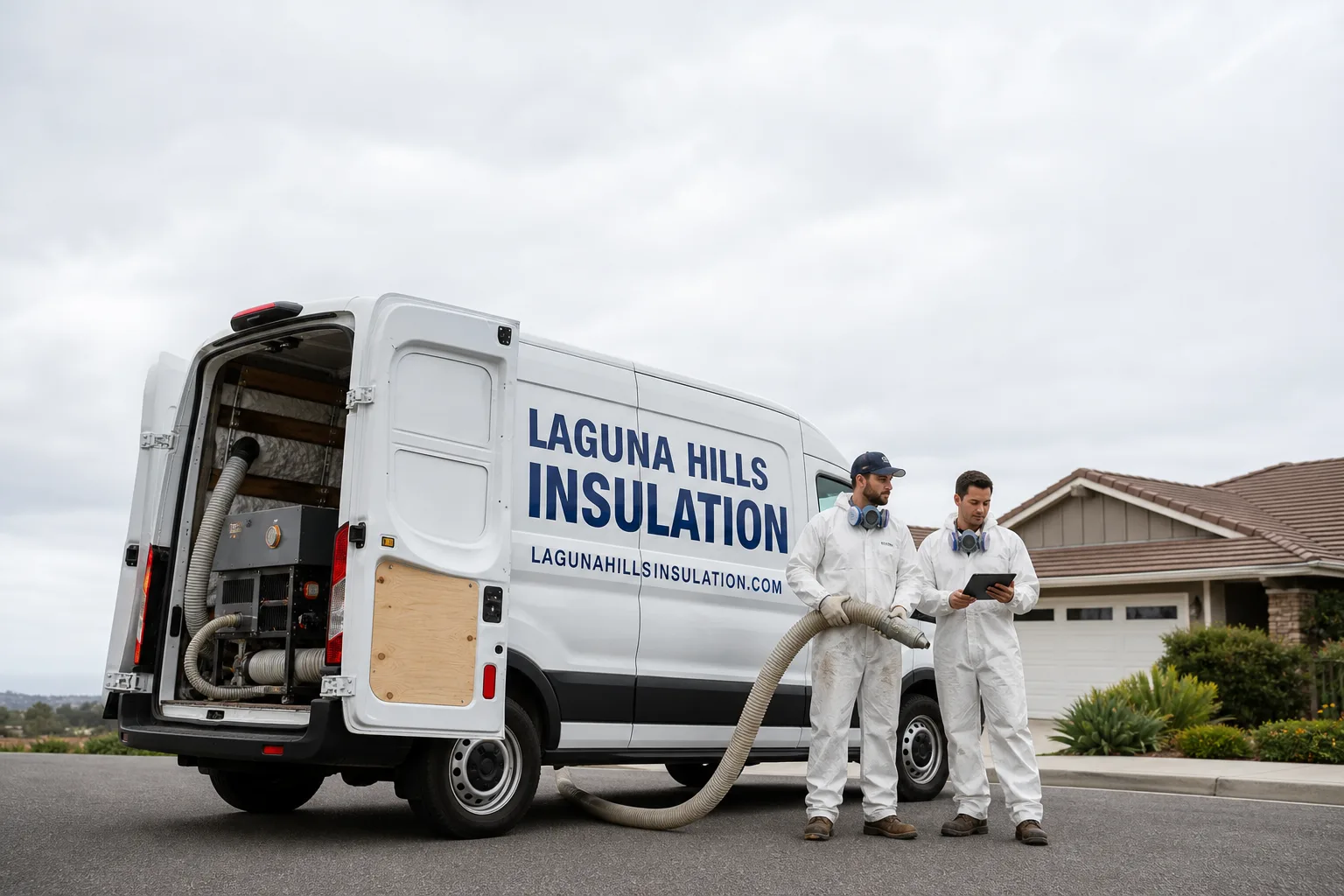
Fast, Reliable Spray Foam Insulation Across Midway City
Spray foam insulation in Midway City costs $2.80 to $6.90 per board foot installed, which translates to roughly $3,400 to $8,600 for a typical 1950s tract home attic. We get crews to Midway City homes within 48 hours in most cases, often faster for urgent moisture or wiring-related problems. If you’re dealing with sagging attic insulation, condensation on interior walls, or knob-and-tube wiring that’s never been properly addressed, call us at (866) 393-6041 and we’ll walk you through what your home actually needs.
Midway City’s housing stock is specific. Most of these homes were built between 1955 and 1965, they’re single-story, and they have very little original insulation. The coastal marine layer that rolls in off Huntington Beach tends to sit over the area until late morning, and that moisture gets into attics and wall cavities in ways you simply don’t see in Westminster or Garden Grove. We plan every Midway City job around that reality.
Why Laguna Hills Insulation Is Midway City’s Preferred Spray Foam Insulation Company
Garrett Lund started Laguna Hills Insulation with a straightforward approach: work with every major material and manufacturer so the house gets what it actually needs, not whatever happens to be on the truck. That matters in Midway City, where the right answer is rarely the same from one block to the next. A house near Bolsa Avenue with a vented attic needs a different foam strategy than a house on the west side of Beach Boulevard that catches more morning fog.
We work across three installation methods, attic, spray foam, and blown-in, and we stock materials from eight manufacturer brands including Owens Corning, Johns Manville, and Knauf. That breadth means we can be honest about tradeoffs. Closed-cell foam from Icynene creates an air barrier and a thermal barrier in a single application, which is useful in tight Midway City attics. Open-cell foam is more forgiving in wall cavities that still have old framing movement. Mineral wool from Rockwool handles moisture differently than fiberglass. We’ll tell you which fits.
Because we’re based in Laguna Hills and run calls up and down the 405 corridor, a Midway City job doesn’t require a special trip. We know the ZIP 92655 housing patterns, and we know which inspectors and permit requirements apply. That local familiarity avoids surprises on install day.
Spray Foam Attic Insulation in Midway City
Spray Foam Attic Insulation in Midway City homes usually means sealing the roofline and turning the attic into conditioned space, or applying foam to the attic floor and air-sealing the penetrations. For a 1,000 to 1,400 square foot attic in Midway City, expect to pay $3,100 to $6,200 for open-cell and $4,800 to $8,600 for closed-cell. The fog belt is the real driver here. When attic surfaces stay damp from marine-layer condensation, fiberglass batts saturate, lose R-value, and start growing things you don’t want in your ceiling. Closed-cell foam at the roof deck stops that moisture cycle entirely.
Roof Deck Applications
Applying closed-cell foam directly to the underside of the roof deck turns the attic into semi-conditioned space. This works well in Midway City because the foam moves the thermal boundary to the roofline, away from ducts and wiring. The roof deck stays warm enough that marine-layer moisture doesn’t condense on it. R-value per inch runs around 6.5 to 7 for closed-cell, so 3 inches gives you an effective R-20 plus an air seal.
One caution: if the roof has an existing leak or the sheathing is already water-damaged, the foam will hide it. We check sheathing condition before spraying and will flag any rot at the eaves, which happens more often on the west-facing exposures near the coast.
Attic Floor and Air Sealing
In vented attics where the owner wants to keep the space accessible, we spray open-cell foam on the attic floor and seal every penetration: plumbing vents, electrical drops, recessed lights, and the gap where the chimney passes through. This approach costs less and still cuts the stack effect that pulls conditioned air out of the house. For Midway City’s 1950s tract homes, this is often the practical choice when knob-and-tube wiring is present in the attic and needs to remain accessible.
Spray Foam Wall Insulation in Midway City
Spray Foam Wall Insulation in Midway City is almost always a retrofit job on exterior walls that were built with nothing in the cavities. Midway City homes from the late 1950s typically have 2×4 framing with no wall insulation at all. Expect to pay $2,200 to $4,800 for the exterior walls of a single-story tract home, depending on access and whether the siding needs to be pulled. Because most Midway City homes have stucco over wood framing, we can inject from the interior or drill-and-fill from the exterior with minimal disruption.
Injection and Cavity Fill
For closed wall cavities, we use a slow-rise open-cell foam that fills without bowing the drywall. It air-seals the cavity and provides about R-3.6 per inch. The bigger benefit in Midway City’s humid air is the air and moisture sealing: foam stops the warm, wet exterior air from entering the wall and condensing on the back side of the drywall. That’s a real problem here, especially on walls that catch afternoon fog off the Seal Beach wetlands.
Rim Joist and Band Board Sealing
The rim joist, the band board where the floor framing meets the foundation, is one of the leakiest areas in any Midway City crawlspace home. We spray two inches of closed-cell foam at the rim joist, which seals the air leaks and doubles as a termite inspection point. Cost runs $800 to $1,900 for a typical Midway City footprint. This is also where coastal salt air does damage inside the wall: mild steel fasteners rust, and the spray foam pairing with corrosion-resistant hardware matters more here than inland.
Trusted Brands We Service in Midway City
We install and service spray foam systems from multiple manufacturers, not one house brand. For Midway City homeowners that means we can match the product to the specific moisture, wiring, and ventilation conditions of your home. Owens Corning provides reliable closed-cell and open-cell options for standard retrofits. Johns Manville offers a full line of open-cell foam well suited to wall cavities in older homes. Knauf rounds out our fiberglass and mineral wool options when foam is not the right call, which happens more often than some contractors will admit. We stock parts and materials for fast turnaround on Midway City jobs, we don’t wait on a distributor that’s two weeks out.
Common Spray Foam Insulation Problems We See in Midway City Homes
- Knob-and-tube wiring buried in foam. Midway City’s 1950s tract homes still carry original knob-and-tube circuits in attics and walls. Spray foam applied directly over live knob-and-tube is a fire hazard and a code violation. We map every circuit before spraying and reroute or wrap what we find.
- Marine-layer moisture condensing under the roof deck. Homes near Bolsa Avenue and Beach Boulevard catch heavy morning fog that condenses on cold attic surfaces. If foam goes down without addressing roof ventilation, that trapped moisture attacks the foam bond and the framing. We inspect the ventilation path first.
- Saturated fiberglass from years of condensation. Older Midway City attics often have fiberglass that’s soaked through from the persistent humidity. That insulation is doing nothing and holding moisture against the ceiling. Removing it and switching to closed-cell foam at the roofline fixes the R-value loss and the musty smell.
- Salt air corroding fasteners and penetrations in wall cavities. The coastal breeze carries chlorides that attack mild steel. Inside the wall, that means rusted plumbing straps, electrical boxes, and drywall screws. When we foam a wall, we pair it with stainless or coated hardware so we’re not sealing corrosion in place.
Pricing for Spray Foam Insulation in Midway City, CA
Here’s what Midway City homeowners actually pay in 2026:
- Open-cell attic floor: $3,100 to $5,400 for a 1,000 to 1,400 sq ft single-story tract home
- Closed-cell roof deck: $4,800 to $8,600, depending on roof slope, access, and whether the attic needs sheathing repairs
- Wall cavity injection: $2,200 to $4,800 for exterior walls on a typical 1950s rambler
- Rim joist sealing: $800 to $1,900 for a standard Midway City crawlspace home
- Knob-and-tube mapping and remediation before foam: $400 to $1,800, based on circuit count and access
The knob-and-tube remediation is a wildcard most Midway City homeowners don’t see coming. If your attic still has active knob-and-tube, the foam job cannot legally or safely proceed until those circuits are addressed. Call (866) 393-6041 for a free estimate, and we’ll tell you at the walkthrough whether that applies to you.
We Also Serve Cities Near Midway City
In addition to our daily work around the 92655 ZIP and the full Midway City area, our crews cover Westminster, Garden Grove, Fountain Valley, and Huntington Beach. If you’re just over the line on Bolsa Avenue or closer to the Westminster Mall side, we’re already working nearby and can usually schedule within the same week. Our Spray Foam Insulation team handles the same material range everywhere we go, so you’re not getting a different lineup depending on which city you’re in.
Serving Midway City, CA — Our Local Coverage Area
We’re based in the Midway City area and know this community well. Use the map below to see our service coverage — if you’re nearby, we can almost certainly help.
FAQs About Spray Foam Insulation in Midway City
No. You cannot legally or safely spray foam over live knob-and-tube wiring. The foam traps heat against the conductors and the surrounding insulation can ignite. In Midway City’s 1950s tract homes, we map every circuit in the attic and wall cavities before touching the foam gun. Where knob-and-tube is found, we either reroute the circuit or wrap the conductors in an intumescent barrier that chokes fire before it spreads. Only then do we spray. Call (866) 393-6041 and we’ll check your attic before you commit to anything.
The marine layer creates condensation on any cold surface it touches, and in Midway City those surfaces are usually the underside of your roof deck and the backside of your drywall. If foam is applied without fixing ventilation, that moisture gets trapped and the foam’s bond degrades over time. We apply closed-cell foam at the roofline so the surface stays above the dew point, which stops condensation from forming in the first place. That’s the correct solution for Midway City’s fog belt, and we adjust the thickness based on where your house sits relative to the coast.
Closed-cell foam is usually the best fit for Midway City tract homes because it acts as a vapor barrier in a climate where moisture is the primary enemy. It also adds structural rigidity to 2×4 walls that have 60-plus years of settling. Open-cell is a better choice in wall cavities where you want the wall to breathe slightly and where budget is a factor. We’ll assess your attic ventilation, wall framing, and existing wiring before recommending one or the other. Call (866) 393-6041 for a straight answer.
Usually yes. In Midway City homes that still have original 1950s fiberglass, that material is often saturated from decades of marine-layer condensation and needs to come out. Leaving wet fiberglass under foam guarantees mold and odor problems. In some attics where the old insulation is dry and the owner is simply adding an air seal, we can foam over it, but that’s the exception. We’ll tell you at the walkthrough what your attic actually needs.
Salt air doesn’t attack cured spray foam directly, but it corrodes the metal components around it: the fasteners, the flashing, the plumbing straps, and the electrical boxes inside the wall cavity. If we seal those in place with foam without addressing the corrosion, we’re locking in a problem. On Midway City jobs, we pair foam with corrosion-resistant hardware and check every wall penetration before spraying. That’s a step most inland contractors never think to take.
Written by Garrett Lund, Owner at Laguna Hills Insulation, serving Midway City’s tract homes and the surrounding coastal Orange County area.