
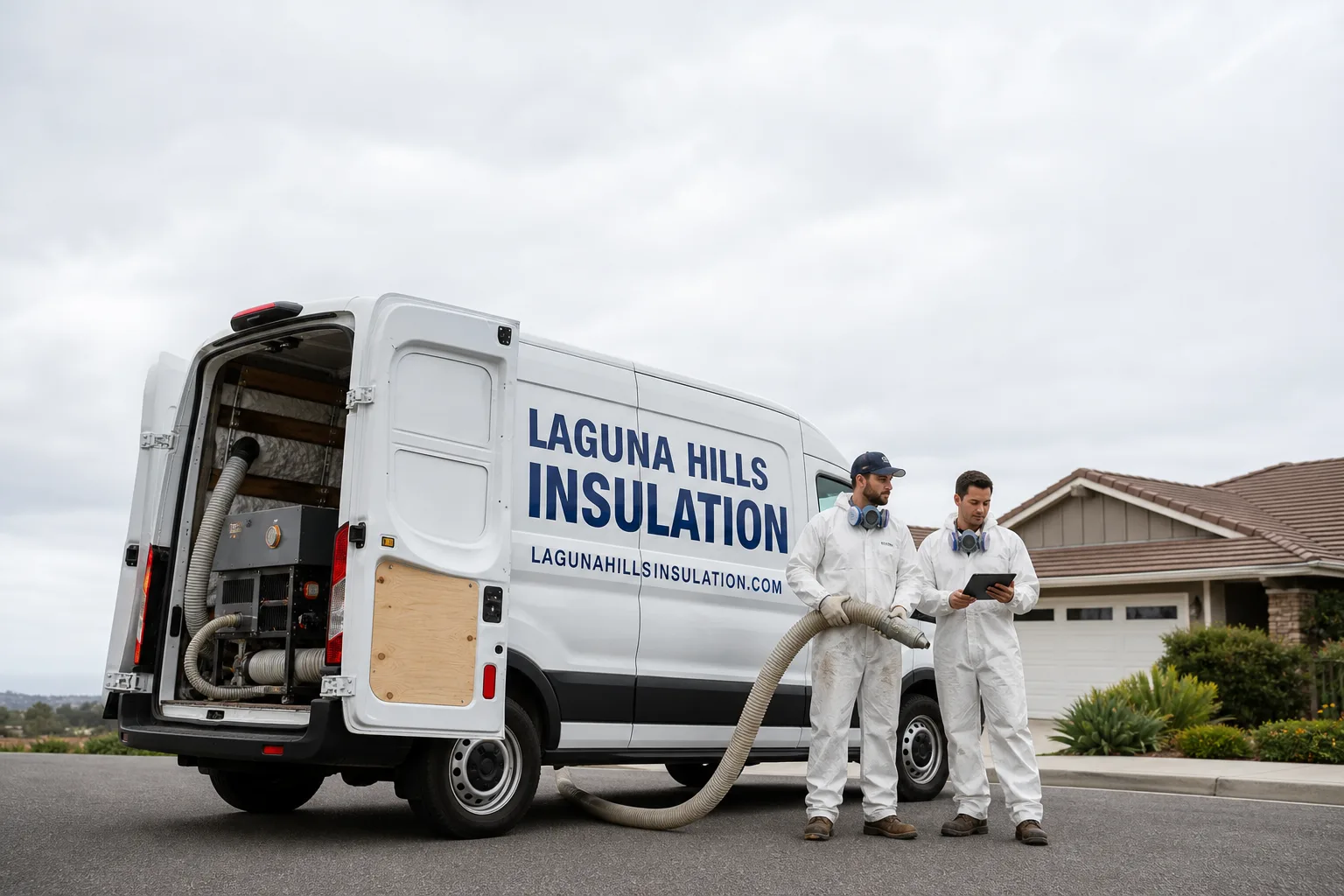
Fast, Reliable Spray Foam Insulation Across Garden Grove
Spray foam insulation in Garden Grove typically runs $2.50 to $6.50 per board foot depending on whether you choose open-cell or closed-cell, with most attic jobs in the city’s postwar tract homes landing between $4,800 and $9,500. We get calls from Garden Grove every week about bedrooms that won’t hold temperature and attics that hit 140°F by noon. If you’re dealing with a shallow attic, a converted garage, or original 1960s batts that have collapsed to nothing, call (866) 393-6041 and we’ll give you an honest read on whether spray foam is actually your best option.
Why Laguna Hills Insulation Is Garden Grove’s Preferred Spray Foam Insulation Company
We’ve spent years working the tract-block neighborhoods between Garden Grove Boulevard and Chapman Avenue, and we know what those houses hide behind the stucco. Most Garden Grove homes built between the late 1940s and the 1970s went up with bare minimum insulation – often R-7 batts in the attic and nothing in the walls. Add decades of Santa Ana dust and marine air moving through open rafter vents, and you get attics that are hotter than the roof itself and framing that’s coated in a fine salt film.
That’s the context we bring to every Spray Foam Insulation job here. Garrett Lund and our crews have pulled collapsed batts out of attics in the 92843 ZIP near Garden Grove Boulevard more times than we can count, and we’ve untangled more than a few unpermitted garage conversions along the way. We’re not the crew that shows up, sprays, and disappears. We’re the ones who tell you when foam will solve your problem and when a different approach makes more sense.
Spray Foam Attic Insulation in Garden Grove
Spray Foam Attic Insulation in Garden Grove usually means sealing and conditioning a shallow, vented attic that was never designed for the heat we get now. The typical job involves either spraying closed-cell foam directly onto the roofline to create an unvented attic, or spraying open-cell into the floor of the attic to seal every gap and add R-value. In Garden Grove’s 1,200 to 1,600-square-foot ranch houses, a full roofline spray runs $6,800 to $11,500, while an attic floor application typically lands between $4,800 and $8,200.
Closed-Cell Roofline Spray for Shallow Attics
If your attic has 4 feet of clearance at the peak and 18 inches at the eaves, closed-cell foam on the roofline turns that dead, superheated space into semi-conditioned air. It stops radiant heat from penetrating in the first place. For Garden Grove’s cooling-dominant climate, that matters more than winter heat loss ever will.
Open-Cell Attic Floor Sealing
When the attic is genuinely just storage and the living space below is what’s suffering, open-cell foam on the attic floor gives you air sealing plus R-value without the extra cost of closed-cell. It’s a smart middle ground on Garden Grove houses where the roof deck is solid and the problem is heat bleeding through the ceiling.
Spray Foam Wall Insulation in Garden Grove
Spray Foam Wall Insulation in Garden Grove almost always comes up during a remodel, a garage conversion, or a re-side job. Most of the city’s original stucco tract homes have empty wall cavities – no insulation at all between the studs. Spraying open-cell foam into those walls from the interior or exterior runs $2,800 to $5,400 for a typical 1,400-square-foot house, depending on access and how much drywall or siding has to come off.
Retrofit Wall Injection on Empty Cavities
If you’re pulling off drywall anyway during a kitchen or bath remodel, that’s the moment to spray the open bays. Open-cell foam fills every irregular gap in old framing, something batts never do. For Garden Grove homeowners chasing comfort, the wall cavities are usually the missing piece after the attic gets done.
Garage Conversion and Rear Addition Walls
This is where it gets tricky in Garden Grove. A lot of rear additions and garage conversions went up without permits, and the wall framing often doesn’t meet current code. We’ll tell you what we’re seeing before we spray – and sometimes the right move is to address the framing or drywall first. Closed-cell foam adds structural strength, but it can’t fix a wall that was never built right.
Trusted Brands We Service in Garden Grove
We spray Icynene and Demilec foam systems, and we stock both open-cell and closed-cell product for Garden Grove jobs so we’re not waiting on a shipment when your attic is already torn open. We also work with Owens Corning, Johns Manville, and Rockwool when the job calls for batts or mineral wool instead of foam – and in this city, sometimes it does. That’s the point of working with a crew that isn’t married to one material: you get the product that actually fits your house, not the one sitting in our warehouse.
Common Spray Foam Insulation Problems We See in Garden Grove Homes
- Foam over open rafter vents: The classic mistake on 1950s-70s tract homes. Spraying closed-cell directly over the original open rafter vents and soffit chases traps moisture and blocks the only drying path the roof deck ever had. In Garden Grove’s marine air, that’s a recipe for rot. The vents have to be blocked and sealed properly first, not just foamed over.
- Salt film adhesion failures: Decades of open-vent airflow through shallow attics leaves a fine salt and dust film on the framing. Foam that goes down without surface prep won’t bond right, and Garden Grove’s Santa Ana cycles make the failures show up fast. We prep the wood before we spray.
- Unpermitted garage conversions: The foam might be the easy part. When the back unit was framed without permits and the ceiling isn’t rated for fire separation or the added weight of closed-cell, spraying it creates a code problem you’ll have to untangle later. We flag this before any material goes in.
- Collapsed original batts: The R-7 fiberglass put in when these houses were built has usually settled to R-4 or less. You can’t just foam over dead insulation. It has to come out first, which means an attic we can actually crawl through – and Garden Grove’s shallow roofs make that its own challenge.
Pricing for Spray Foam Insulation in Garden Grove, CA
Open-cell spray foam in Garden Grove runs $2.50 to $3.90 per board foot. Closed-cell runs $4.00 to $6.50 per board foot. A typical attic floor sealing job on a 1,300-square-foot ranch house lands around $5,500 to $7,800. A full roofline spray on the same house runs $7,500 to $10,500. Wall injection jobs run $2,800 to $5,400 depending on access. The biggest cost drivers here are attic accessibility – shallow roofs mean slower work – and whether we’re dealing with unpermitted space that needs framing or ventilation work before we touch the foam. Call (866) 393-6041 for a free estimate and an honest read on what your house actually needs.
We Also Serve Cities Near Garden Grove
Garden Grove sits right in the middle of our service area, and we run crews through Stanton, Westminster, Midway City, and Cypress every week. If you’re right on the city line – say, off Beach Boulevard or down near the 22 – you’re still in our normal routing. Call and ask how soon we can get to your neighborhood.
Serving Garden Grove, CA — Our Local Coverage Area
We’re based in the Garden Grove area and know this community well. Use the map below to see our service coverage — if you’re nearby, we can almost certainly help.
FAQs About Spray Foam Insulation in Garden Grove
Usually not, and we’ll tell you that before you spend money. The problem isn’t the foam – it’s what happens after. A ceiling that was never framed to carry closed-cell foam’s weight, and never built with the fire separation the city requires for living space, becomes a code problem the moment the foam goes in. We’ve seen this on garage conversions all over Garden Grove, especially in the 92840 and 92843 ZIPs. The right sequence is to address the framing and drywall first, then spray. Call (866) 393-6041 and we’ll walk you through what your specific setup needs.
Garden Grove sits close enough to the coast that marine air moves through the city regularly, especially during Santa Ana wind reversals. That salt-laden air leaves a fine corrosive film on framing, fasteners, and any exposed metal in the attic. If you’re adding spray foam, that means the substrate has to be clean before foam will bond properly – and any hardware we install, from fasteners to vent covers, needs to be stainless or coated. We factor this into every Garden Grove job because skipping it is how you get adhesion failures.
Yes, but only if the vents are sealed and blocked correctly before the foam goes down. You cannot spray over open rafter vents in a shallow tract-house attic and walk away. The original vents were the roof deck’s only drying path, so closing them means the foam has to become the air and moisture control layer – and it has to be installed as a complete system, not a patch job. In Garden Grove’s hot, dry climate, a properly sealed roofline works well. A badly vented one rots. We do it right or we don’t do it.
That depends on what your attic actually looks like, but here’s the honest framework: if you have an open attic with plenty of clearance and no garage conversion underneath, blown-in cellulose or fiberglass at R-38 to R-49 often gets you 80 to 90 percent of the comfort benefit for a third of the foam cost. If you have a shallow attic, air leakage problems, a converted garage, or rooms that won’t hold temperature no matter what, foam starts making real sense. We install both – foam and blown-in – so we’re not going to push you toward the more expensive option if your house doesn’t need it. Call (866) 393-6041 and we’ll give you a straight answer.
We install Icynene and Demilec spray foam systems – open-cell and closed-cell from both manufacturers. We also keep Owens Corning, Johns Manville, and Rockwool batts on hand for Garden Grove jobs where foam isn’t the right material. The point is having options. Your house gets the product that actually fits, not the one we happen to stock.
What Sets This Page Apart: An Honest Look at Garden Grove Spray Foam Work
On Garden Grove’s tight postwar tract blocks, the marine air and Santa Ana wind cycles push salt-laden dust through open rafter vents into shallow attics, so spray foam here is usually chosen to seal and condition a hot attic – not just add R-value. The combination of unvented spray foam and the city’s many unpermitted garage conversions means our first task on most jobs is deciding what’s actually living space and what’s attic before we spray anything.
On a 1,400-square-foot ranch in the 92843 ZIP near the Garden Grove Boulevard corridor, we found the original batts collapsed to about R-7 and the roofer’s old open rafter vents pulling salty marine air and dust straight into a 145°F attic. We sealed the penetrations and sprayed Icynene in the sloped ceiling bays, then built a code-compliant thermal and ignition barrier over the closed-cell foam rather than leaving it exposed. The homeowner reported the back bedroom – the one over the converted garage – finally holding temperature through the Santa Ana season.
That’s the reality of spray foam in Garden Grove. It’s not a product you order out of a catalog and slap into any house. It’s a system decision that has to account for the city’s shallow attics, its unpermitted conversions, its salt-air exposure, and its 90-degree summer days. If you want a crew that thinks about all of that before the foam ever comes off the truck, call (866) 393-6041 for a free estimate. Garrett and the team will give you the straight version of what your house needs – even if it means telling you foam isn’t the answer.
Written by Garrett Lund, Owner at Laguna Hills Insulation, serving Garden Grove and surrounding Orange County cities.