
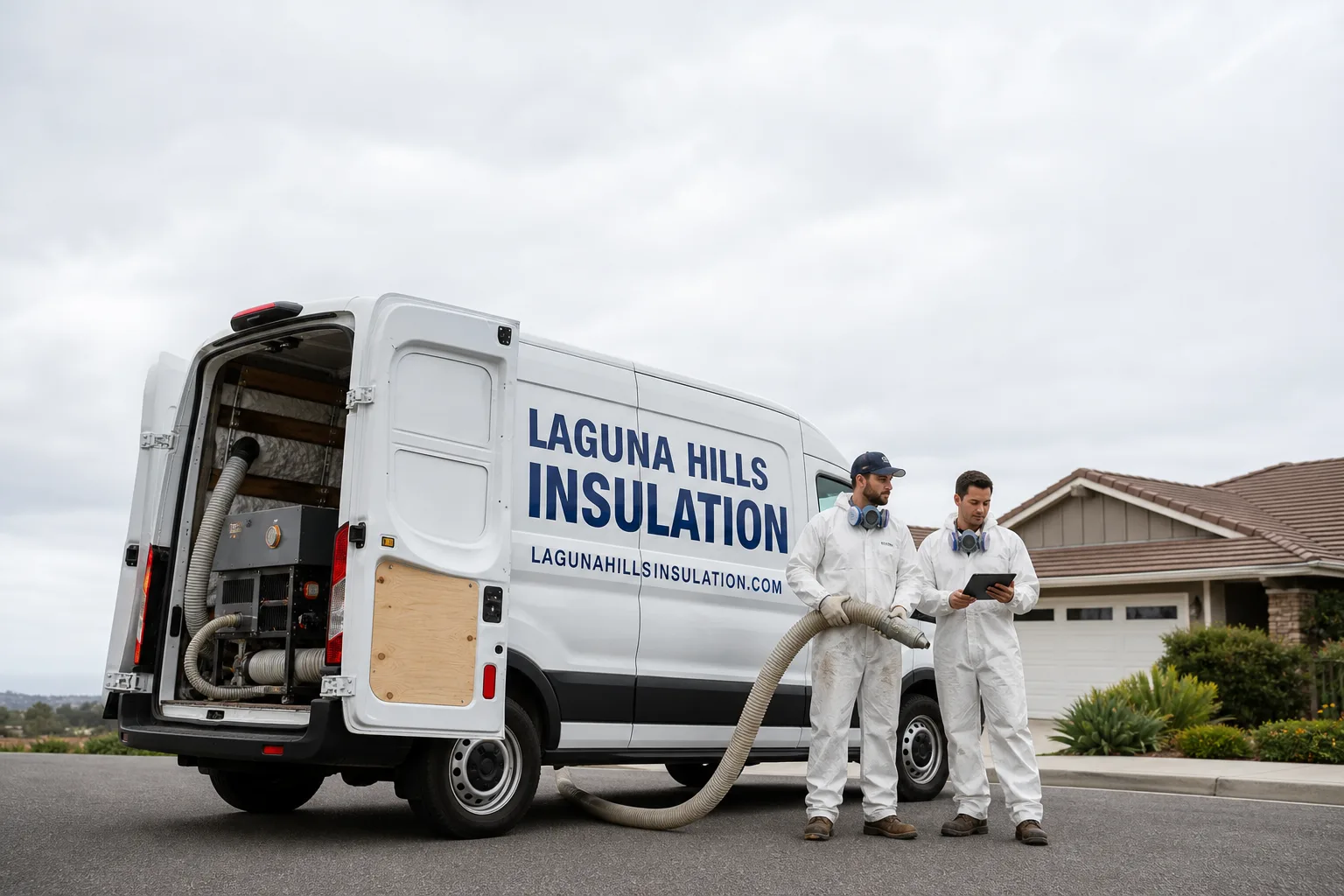
Fast, Reliable Spray Foam Insulation Across March Air Force Base
Spray foam insulation in March Air Force Base typically runs $2.50 to $6.50 per square foot installed, depending on whether you need open-cell or closed-cell foam, and most base-area homes can be completed in one to two days. That’s the honest range for the 92551 market, where 1950s-1970s tract homes dominate and attic insulation has usually been flattened by decades of 100°F inland summers. Our crews work throughout the March Air Force Base community regularly, and we schedule free estimates with same-week availability for most projects. Call us at (866) 393-6041 to get a specific number for your home.
Why Laguna Hills Insulation Is March Air Force Base’s Preferred Spray Foam Insulation Company
Base-adjacent housing presents insulation challenges you won’t find in newer Inland Empire developments. We’ve worked on enough 1960s tract homes near the perimeter to know exactly what’s behind those stucco walls and under those original roof decks. Garrett Lund built this company around material-agnostic installation: we stock and install eight manufacturer lines including Icynene and Demilec spray foam systems, Owens Corning batts, and GreenFiber cellulose. If a home near March Air Force Base needs air sealing more than bulk insulation, we tell you that. If closed-cell foam is overkill for a garage ceiling, we say so.
That approach matters in a community where federal housing guidelines and base housing authority coordination sometimes come into play. We’re familiar with the paperwork and approval steps that can apply to retrofit work on base-adjacent properties, and we factor that into scheduling so you aren’t caught off guard. We don’t push a single product line because we don’t have to. Eight brands and three installation methods under one roof means the right material wins the job, not the easiest upsell. Homeowners in March Air Force Base call us because we answer material questions directly, with real R-values and real performance expectations, not vague promises about energy savings.
Spray Foam Insulation Cost in March Air Force Base
Here’s what spray foam insulation actually costs in the 92551 market, based on the homes we see along Van Buren Boulevard and the neighborhoods surrounding the base. Closed-cell spray foam runs $4.50 to $6.50 per square foot installed. Open-cell runs $2.50 to $4.00 per square foot. A typical attic encapsulation project in a 1,400-square-foot base-era ranch home lands between $6,500 and $9,500 complete. Rim joist work in those same homes runs $900 to $1,800 for a standard crawl space perimeter. Garage ceiling spray foam, common on converted garage spaces, typically costs $1,400 to $2,800 depending on size and depth.
Two factors drive cost here more than anywhere else in the Inland Empire. First is prep work: decades of degraded blown-in insulation leaves fine dust that must be removed before foam adheres properly. Second is the heat itself: summer installs require us to manage foam temperature and cure time carefully, which can add labor on the hottest days. Call (866) 393-6041 and tell us your square footage. You’ll get a line-item range, not a mystery number.
Closed Cell Spray Foam Insulation in March Air Force Base
Closed cell spray foam insulation is the workhorse for March Air Force Base homes because it solves three problems at once: it adds R-value, it creates a true air barrier, and it adds structural rigidity to aging roof decks. For a 1960s tract home where the ceiling joists are 2×6 and the roof sheathing has been baking for sixty summers, closed-cell foam with an R-value around R-7 per inch is the only product that can bring a vented attic up to code-level performance without a full roof rebuild. We use Icynene and Demilec closed-cell systems, applied by crews who understand that foam in a hot attic cures fast and must be applied in passes to avoid shrinkage.
Where We Use It Most
Roof deck encapsulation is our most common closed-cell application in March Air Force Base. On one 1960s tract home near the base perimeter in ZIP 92551, we found the original attic insulation flattened to less than R-5 after decades of 100°F summers. We removed the collapsed batts and applied closed-cell spray foam (Icynene) to the underside of the roof deck and gable walls, sealing the envelope and bringing the attic to R-22 while cutting afternoon cooling loads. The homeowner reported the upstairs bedrooms held temperature within 2°F of the thermostat setpoint for the first time.
Rim joist and crawl space walls are the second application. The stucco-on-frame construction common to 92551 leaves the rim joist as a direct thermal bridge between outdoor air and floor cavities. Closed-cell foam at 2 inches solves that in a single pass, and it does not support mold or wick moisture, which matters in a region with monsoon-season humidity spikes even amid the dry heat.
Open Cell Spray Foam in March Air Force Base
Open cell spray foam costs less per board foot and does a better job absorbing sound, which is why we recommend it for interior wall cavities, cathedral ceilings, and garage ceiling applications in March Air Force Base homes. It expands aggressively to fill voids, which makes it ideal for the irregular framing you find in base-era tract homes where stud spacing is inconsistent. Open-cell foam is not a vapor barrier, so it works well in vented attics where the roof is designed to breathe, and it handles the thermal movement of single-pane window framing without cracking the way rigid boards do.
When Open Cell Is the Better Call
For homeowners who mainly want a quieter home and better temperature stability without paying for closed-cell performance, open-cell is the right material. We typically specify it at 5.5 inches in 2×6 walls to reach R-21. In 2×4 walls, 3.5 inches gets you to R-13. We’re careful to let open-cell foam cure fully before the space is reoccupied. The off-gassing concern with low-density foam is real, and in the poorly ventilated attics of 1950s-1970s homes where the soffit vents have been painted over or blocked by decades of debris, we address ventilation before we spray. That’s the kind of sequencing that separates a correct install from a callback.
Trusted Brands We Service in March Air Force Base
We install Icynene and Demilec spray foam systems, which are the two product lines we trust most for the heat and humidity swings of the Inland Empire corridor. For blown-in and batt work in March Air Force Base homes, we stock Owens Corning and GreenFiber. We keep material on hand for the common specs in 92551, which means we can quote and schedule a base-area retrofit without waiting on a distributor shipment. When a manufacturer releases a new formulation or application guideline, we’re briefed on it before it hits the supply house. That access matters when federal or base housing specs call for a specific product line.
Common Spray Foam Insulation Problems We See in March Air Force Base Homes
- Foam shrinkage around single-pane window frames. The 40°F day-night temperature swings at March Air Force Base make materials move. Cheap foam or foam applied too quickly will pull away from window frames within a few seasons, leaving air gaps exactly where you can feel them. We use slow-cure application techniques and trim the bead before it sets.
- Adhesion failure on dusty attic decking. In base-era homes where blown-in insulation has degraded over five or six decades, the decking builds up a fine dust that prevents foam from bonding. We vacuum and pre-treat those surfaces before spraying. Skipping that step is why some foam retrofits fail within a year.
- Lingering odor from under-cured open-cell foam. In the tightly framed, poorly ventilated attics common to 1950s-1970s construction, open-cell foam that hasn’t cured properly can off-gas for weeks. We control humidity and temperature during cure, and we won’t hand the house back until the material has fully set.
- Attic bypasses nobody fixed first. Recessed lights, bath fan vents, and plumbing chases in old tract homes leak air straight through the ceiling. Spray foam on the attic floor won’t fix that unless the bypasses are sealed first. We identify and seal those penetrations before the foam goes down, because the foam is the air barrier, not a patch over a leak.
Local Strip Mall and Mixed-Use: A March Air Force Base Code Reality
A note that only applies here: if you own a small storefront or mixed-use building off Van Buren Boulevard, your spray foam insulation project may require a commercial permit and a meeting with the base-adjacent planning district, not just a residential inspection. Base housing authority coordination can introduce document requests that a typical Inland Empire retrofit never faces. We’ve shepherded those approvals before. Tell us the property type when you call, and we’ll tell you straight whether your project has a federal review angle before you spend a dollar on materials.
Because March Air Force Base is an active military installation, spray foam projects in the surrounding 92551 community often require coordination with base housing authorities and adherence to federal energy and safety guidelines that don’t apply to typical Inland Empire retrofits. That includes specific fire-rating requirements on foam in shared-wall buildings and documentation of product testing data for federal energy compliance. We stay current on those requirements and we’re used to working with property managers and housing offices on the paperwork.
Serving March Air Force Base, CA — Our Local Coverage Area
We’re based in the March Air Force Base area and know this community well. Use the map below to see our service coverage — if you’re nearby, we can almost certainly help.
FAQs About Spray Foam Insulation in March Air Force Base
Private single-family homes in 92551 generally do not need federal approval for spray foam insulation, but properties that fall under base housing authority management or certain federally-assisted programs may require documentation and pre-approval before retrofit work begins. We can tell you in one phone call whether your specific property has a review angle. Call (866) 393-6041 and describe the property type, and we’ll give you a straight answer.
Older tract homes in March Air Force Base were built when R-19 attic insulation was considered generous, and most now perform at half that because the material has settled, compressed, or degraded. Spray foam restores the thermal performance in a single application and air-seals the gaps that fiberglass never addresses. For base-era homes specifically, the air sealing is usually worth more than the R-value alone.
March Air Force Base summers push 100°F regularly, and the diurnal swing between afternoon high and pre-dawn low is often 40°F or more. Closed-cell foam handles that thermal cycling better because it doesn’t shrink or crack as the structure moves. Open-cell is fine for interior applications, but roofs and exterior walls in 92551 should lean closed-cell when the budget allows.
Yes. The evening heat retention problem in March Air Force Base comes from attics that hit 140°F by 4 PM and radiate that heat into living spaces until midnight. Closed-cell spray foam on the roof deck keeps the heat out of the attic entirely. Our customers often tell us their air conditioner finally shuts off in the evening for the first time in years.
We install Icynene and Demilec spray foam systems for both open-cell and closed-cell applications in March Air Force Base. We also stock Owens Corning and GreenFiber for blown-in and batt work. Garrett Lund has built relationships with eight manufacturers so we’re never forced to sell you whatever is on the truck. Call (866) 393-6041 for an exact quote. Estimates are free, and we’ll tell you which material actually fits your home rather than which one is easiest for us to install.
We Also Serve Cities Near March Air Force Base
Our crews work throughout the Inland Empire corridor. Beyond March Air Force Base, we regularly install spray foam insulation in Moreno Valley, Woodcrest, Perris, and Good Hope. If you’re in any of those communities, the same material-agnostic approach applies. Call (866) 393-6041 and we’ll schedule a walkthrough. Check our main Spray Foam Insulation page for a full breakdown of our foam methods, or read more about our work in Spray Foam Insulation in March Air Force Base across the base-adjacent neighborhoods of 92551.
Written by Garrett Lund, Owner at Laguna Hills Insulation, serving March Air Force Base and the surrounding Inland Empire with material-agnostic insulation installation.