
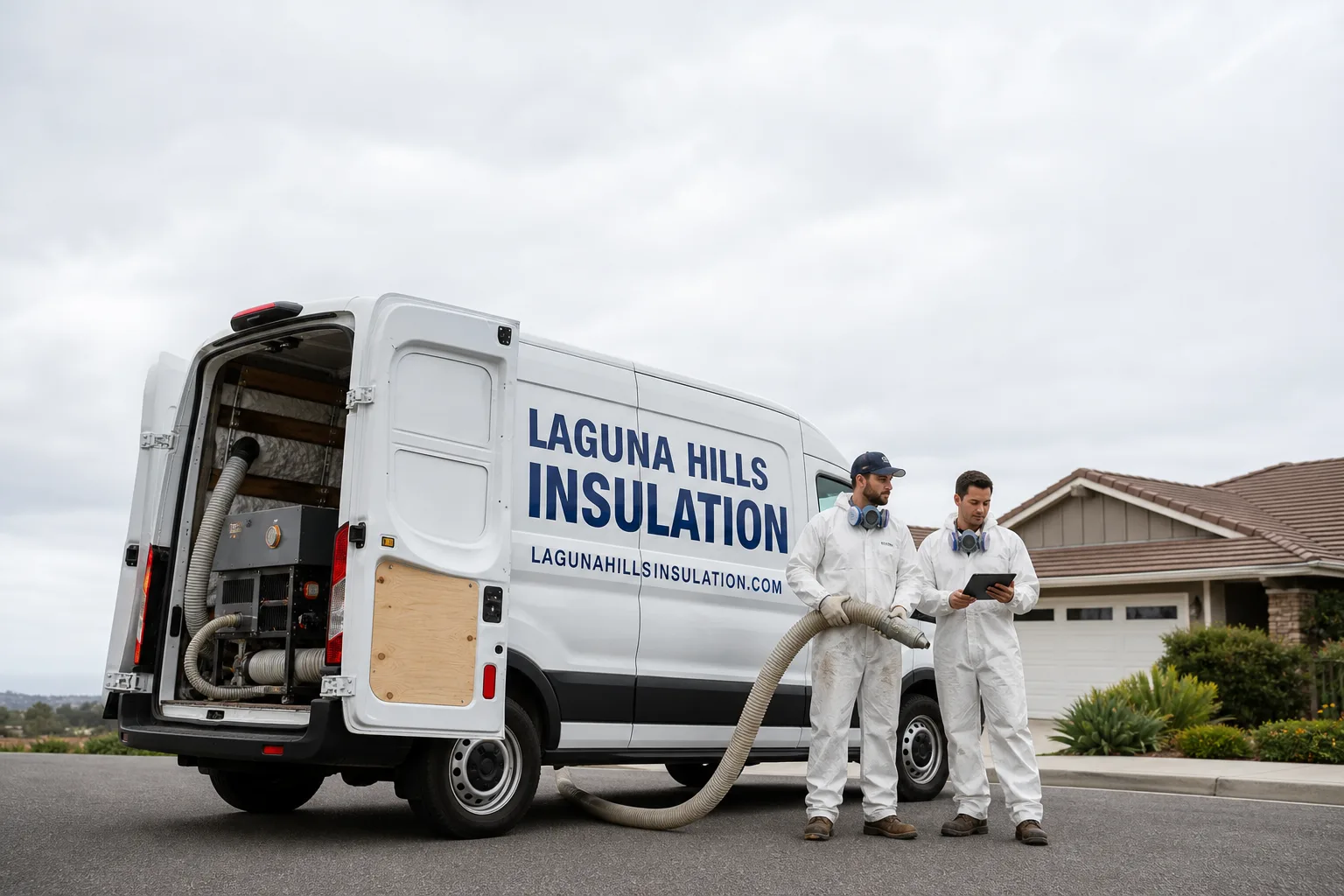
Fast, Reliable Attic Insulation Across Rancho Cucamonga
Attic insulation in Rancho Cucamonga costs $1,800 to $6,500 for a typical removal-and-replace job on a 1,500 to 2,400 square foot tract home, with the final number driven by whether you need a simple top-up or full material replacement plus ventilation work. Most Rancho Cucamonga jobs take one to two days on site. We run crews into every ZIP from 91701 through 91739 on a regular schedule, and we know the tile-roof stucco tracts here well enough to tell you before we lift the attic hatch what we’re likely to find up there: compressed builder-grade batts, clogged baffles, and temperatures that make a standard fiberglass top-up the wrong call. Call (866) 393-6041 and we’ll put a time on the calendar that works around your commute into Ontario or down the 15.
If you’re reading this because west-facing bedrooms never cool down in August, or your AC runs nonstop from June to October, you’re not imagining it. The homes here were built fast during the 1980s through 2000s boom, and the attics were insulated to minimum code at the time, not to Inland Empire heat loads. We’ll walk you through what’s actually going on up there and what fixes it.
Why Laguna Hills Insulation Is Rancho Cucamonga’s Preferred Attic Insulation Company
We work across the full attic insulation spectrum: blown-in, batts, spray foam, radiant barrier, and the unglamorous but critical baffle-and-ventilation corrections that make all the other materials actually perform. Our Attic Insulation team is led by Garrett Lund, who has built the company around a material-agnostic approach. That means we stock fiberglass from Owens Corning and Johns Manville, cellulose from GreenFiber, and spray foam from Demilec, so we’re not trying to steer your Rancho Cucamonga home into whatever product we happen to have the deepest margin on this month. You get the material that matches the problem.
Rancho Cucamonga customers tend to be comparison shoppers. They’ve gotten three quotes before we arrive, and they ask sharp questions about R-value, air sealing, and whether a radiant barrier actually does anything. We like that. It means we’re talking to people who want the technical truth, not a sales pitch. We’ve spent years answering those questions in the foothill tracts, the flatland neighborhoods around the 91730 core, and the newer communities east of Milliken Avenue.
When a homeowner in Rancho Cucamonga calls us about a west-side room that won’t cool, we don’t start by selling insulation. We start by asking about the attic temperature, the age of the roof, and whether the baffles have ever been inspected. That’s the difference between a contractor who wants to blow in a truckload of fiberglass and one who wants to fix your house.
Attic Insulation Removal in Rancho Cucamonga
Attic Insulation Removal in Rancho Cucamonga is not a luxury add-on. On the 1980s and 1990s stucco tract homes that dominate the 91730, 91737, and 91739 ZIP codes, the original builder insulation has been baking under concrete tile roofs for twenty to forty summers. Batts that were rated R-30 at installation are often sitting at R-16 or worse, compressed, dust-saturated, and full of rodent droppings or blown-in dirt from Santa Ana wind intrusion. Full removal runs $1.50 to $2.75 per square foot for a typical Rancho Cucamonga attic, which means a 1,500 square foot attic lands between $2,250 and $4,125 before new material goes in. We recommend full removal, not top-up, when the existing insulation is compressed, water-stained, pest-contaminated, or has settled to less than half its rated depth.
Signs Your Builder-Grade Insulation Needs Removal
If your attic insulation is original to the home and the house predates 2005, it’s almost certainly underperforming under Rancho Cucamonga’s 150°F attic conditions. You’ll notice the upstairs rooms feel substantially hotter than the rest of the house by mid-afternoon, or your summer SCE bill is creeping upward year over year even though the AC is only a few years old.
An infrared inspection tells the story quickly. We aim the camera at the ceiling and see thermal voids where batts have slumped away from the roof deck or been pushed aside by past contractors running electrical and plumbing. That’s when we know removal and replacement is the only honest fix.
What Removal Actually Involves on a Rancho Cucamonga Home
We use a commercial-grade HEPA vacuum system that runs from the attic to a sealed canister outside the house, so no insulation dust gets into your living space. The process takes four to six hours on an average tract home. After the old material is out, we can inspect the ceiling plane, air-seal penetrations, and see exactly what’s happening with your baffles and roof deck before anything new goes in.
Insulation Contractors in Rancho Cucamonga
Choosing among Insulation Contractors in Rancho Cucamonga means separating material installers from insulation diagnosticians. Most companies in the Inland Empire will happily blow fiberglass over whatever is already up there and call it done. That’s not always wrong, but it’s not right for a 1990s tile-roof tract home with compressed batts and choked ventilation. We approach every job as a removal, inspection, and correction project first. New material goes in only after we’ve verified the attic can actually breathe. For a full-scope job (removal, air sealing, baffle correction, and new insulation) expect $3,500 to $8,500 depending on square footage and material choice, with radiant barrier adding $1.50 to $3.00 per square foot of roof deck.
What to Ask Any Insulation Contractor in Rancho Cucamonga
Ask whether they’ll inspect your existing ventilation before recommending material. If the answer is no, you’re talking to someone who doesn’t understand how attics work in this specific climate. Ask whether they install radiant barrier. Many local companies don’t because it requires working against the roofline, not just the attic floor. And ask what R-value they’re quoting for the material they’re recommending, then compare that against the reality that R-value is meaningless if the attic can’t exhaust heat.
Material Breadth Matters Here
We install every major attic material category in-house. Fiberglass batts where access is tight, blown-in cellulose from GreenFiber where coverage depth is the priority, spray foam from Demilec where air sealing is critical, and radiant barrier systems for the tile-roof heat trap that defines so much of Rancho Cucamonga. Having all of these under one roof means the recommendation you get is based on your home’s construction and orientation, not our inventory levels.
Garrett Lund built the company specifically so that no customer would have to listen to a sales pitch for a single product line. We’d rather tell you your attic just needs better ventilation than sell you insulation that won’t solve the problem.
Trusted Brands We Service in Rancho Cucamonga
We stock and install materials from Owens Corning, Johns Manville, Demilec, and GreenFiber, among others. For Rancho Cucamonga customers, that means we can match the right brand to the right problem without special-ordering anything. Owens Corning fiberglass for standard batt replacement, Johns Manville for blown-in depth coverage on flatland ranch homes, GreenFiber cellulose for eco-conscious homeowners who want recycled material, and Demilec spray foam for attics that need serious air sealing against Inland Empire heat and Santa Ana dust. We keep local inventory staged for quick turnaround on Rancho Cucamonga jobs, so a quote on Tuesday doesn’t turn into a three-week waiting game for material.
Common Attic Insulation Problems We See in Rancho Cucamonga Homes
- Compressed builder-grade batts under tile roofs. The low-pitch concrete tile roofs common across Rancho Cucamonga’s 1980s to 2000s tracts absorb heat all day and radiate it into the attic until well after sunset. Attic temperatures above 150°F accelerate batt settling, and after twenty-plus summers, original R-30 material is often performing at half that.
- Santa Ana-driven debris clogging ventilation baffles. The foothill neighborhoods in Alta Loma and Deer Canyon, along with much of the 91737 and 91739 ZIP codes, get sustained wind that pushes dust, leaves, and fine debris into attic intake vents. We find baffles completely blocked, leaving the attic with no way to exhaust heat no matter how much insulation is sitting on the ceiling plane.
- West-facing wall heat gain that R-value can’t fix. Homes built against the foothills get hammered by afternoon sun on west-facing walls. Insulation on the attic floor does nothing for that. Radiant barrier plus wall insulation is the only combination that actually cools these rooms down.
- Thermal bridging through stucco and roof framing. The Mediterranean and Spanish-style stucco construction that defines Rancho Cucamonga’s housing stock creates direct thermal pathways through framing members that bypass insulation entirely. That’s a problem we address with air sealing and full-coverage installation techniques, not just more material.
Pricing for Attic Insulation in Rancho Cucamonga, CA
Rancho Cucamonga attic insulation pricing breaks down like this: a basic blown-in top-up over existing functional insulation runs $1,200 to $3,000 for a 1,500 to 2,400 square foot home. Full removal plus new blown-in fiberglass or cellulose lands between $3,500 and $7,500. Add radiant barrier to the roof deck and expect another $1.50 to $3.00 per square foot, meaning a 2,000 square foot attic adds $3,000 to $6,000 to the project total. If your 1990s home needs ventilation correction, full attic insulation replacement, and radiant barrier, budget $6,000 to $12,000. We provide free estimates with written scope-of-work descriptions so you can compare bids apples to apples. Call (866) 393-6041 to schedule a walkthrough.
We Also Serve Cities Near Rancho Cucamonga
Our crews run routes through San Antonio Heights, Upland, Ontario, and Fontana on a regular basis, which means we know the construction patterns and attic conditions of the whole west Inland Empire corridor. If you’re in a neighboring city, the same Rancho Cucamonga team that covers the foothill tracts and flatland neighborhoods serves your area too. We schedule by ZIP, not by enthusiasm, so a Fontana job next to a Rancho Cucamonga job gets the same crew and the same material. Call (866) 393-6041 and ask about our schedule for your specific neighborhood.
Serving Rancho Cucamonga, CA — Our Local Coverage Area
We’re based in the Rancho Cucamonga area and know this community well. Use the map below to see our service coverage — if you’re nearby, we can almost certainly help.
FAQs About Attic Insulation in Rancho Cucamonga
Almost certainly yes, especially if the home has a concrete tile roof. In Rancho Cucamonga’s 150°F-plus attic conditions, original 1990s fiberglass batts have typically compressed to 50 to 70 percent of their rated R-value. The degradation is invisible from the attic hatch but shows up clearly on an infrared inspection and in rooms that never cool down. If the insulation is original, we recommend removal and replacement, not a top-up. Call (866) 393-6041 for an inspection.
The foothill neighborhoods experience sustained Santa Ana wind pressure that the flatland areas don’t get. That wind drives heat through west-facing and north-facing walls all afternoon, pushes debris into ventilation baffles, and makes wall insulation and radiant barrier matter far more than simple attic floor R-value. In the 91730 core, where older ranch homes have different construction and less wind exposure, a quality blown-in upgrade often solves the problem. The right material depends on which ZIP you’re in. We price and spec each job accordingly.
For most Rancho Cucamonga homes, radiant barrier plus baffle-clearing ventilation beats adding more R-value, because the problem isn’t a lack of insulation depth, it’s heat trapped under the roof deck and wall heat gain. Adding R-value to an attic that can’t vent heat doesn’t solve the problem. Radiant barrier reflects radiant heat before it gets into the attic space in the first place. If you can only afford one upgrade, do the radiant barrier first. Call (866) 393-6041 and we’ll explain the physics on your specific roof orientation.
We run a HEPA vacuum line from the attic to a sealed container outside, then extract all existing insulation down to the ceiling plane. On a stucco tract home, the process takes four to six hours. After removal, we inspect and clear ventilation baffles, air-seal penetrations, and assess the roof deck condition. Only then do we install new material. Expect removal alone to cost $1.50 to $2.75 per square foot in Rancho Cucamonga.
Yes, and that’s the specific problem a radiant barrier solves. West-facing rooms in Rancho Cucamonga stay hot because afternoon sun heats the walls and roof simultaneously. A radiant barrier installed against the roof deck reflects that solar gain before it becomes attic heat. Combined with wall insulation and proper ventilation, west-facing rooms typically drop five to ten degrees on August afternoons. It won’t solve a failing AC system, but it will stop the attic from fighting the AC. Call (866) 393-6041 for a free assessment and exact pricing for your attic.
The Rancho Cucamonga Heat Problem Most Insulation Companies Don’t Address
Here’s what we see repeatedly in Rancho Cucamonga attics, and it’s something the flatland cities and inland metros without Santa Ana wind exposure simply don’t share. The low-pitch concrete tile roofs on 1980s through 2000s Mediterranean and Spanish-style stucco tracts soak up Inland Empire sun all day, and by mid-afternoon the attic air temperature is north of 150°F. That’s not unusual, but it means the original builder-grade batts, which were code minimum when the home was built, have been cooking in that heat for two or three decades. Fiberglass doesn’t degrade chemically from heat, but it settles, compresses, and loses loft, which means it loses R-value. The result is a thermal ceiling that’s performing at a fraction of its installed spec, even when the material looks fine from the hatch.
But add the second local factor: the Santa Ana winds that howl through the foothill canyons from the northeast. In the Alta Loma and Deer Canyon areas, and throughout the 91737 and 91739 ZIP codes, those winds don’t just push heat through west-facing and north-facing walls all afternoon. They also drive fine dust, leaves, and debris into the attic ventilation baffles, gradually choking the intake airflow until the attic can’t exhaust any of that 150°F air. That’s the Rancho Cucamonga insulation problem in a sentence: trapped heat, degraded batts, and blocked ventilation all happening at once. More R-value alone doesn’t fix it.
An Alta Loma homeowner on a 1990s tile-roof tract near the foothills called us because the west-facing bedrooms never dropped below 80°F in August despite a newer AC. Our crew found the original builder-grade batts compressed and wind-blown debris clogging the ventilation baffles from years of Santa Ana gusts, so we pulled the degraded material, cleared and reset the baffles, and installed an Owens Corning radiant barrier with upgraded attic ventilation. Interior temps came down and the HVAC stopped running past design conditions. That’s the complete fix, and it’s the reason we push radiant barrier plus ventilation twice as hard as we push raw R-value in this city.
The takeaway for a Rancho Cucamonga homeowner is this: if your home has a tile roof, was built before 2005, and sits anywhere near the foothills, the correct upgrade sequence is almost always radiant barrier plus baffle-clearing ventilation first, then whatever insulation material makes sense for your specific ceiling plane. Do that, and your attic stops working against your AC. Skip it, and you’re just piling new material on top of a broken system.
Written by Garrett Lund, Owner at Laguna Hills Insulation, serving Rancho Cucamonga and the Inland Empire with full-spectrum attic insulation, spray foam, and blown-in installation.
Key Takeaways for Rancho Cucamonga Homeowners
- Original builder-grade attic insulation in 1980s to 2000s Rancho Cucamonga tract homes is typically compressed to 50 to 70 percent of its rated R-value.
- Tile roofs and Santa Ana wind exposure mean radiant barrier plus ventilation correction matters more in 91737 and 91739 than adding R-value.
- Full attic insulation removal runs $1.50 to $2.75 per square foot; complete projects range from $3,500 to $12,000 depending on scope.
- We stock Owens Corning, Johns Manville, Demilec, and GreenFiber material options so the material choice fits your home, not our inventory.
- Same-week scheduling is available across all Rancho Cucamonga ZIP codes: 91701, 91730, 91737, and 91739.
Get a Free Attic Insulation Estimate in Rancho Cucamonga
If your upstairs rooms won’t cool, your summer electric bills keep climbing, or you suspect the original insulation in your tract home has seen better days, call (866) 393-6041. We’ll schedule a walkthrough, run an infrared inspection if needed, and give you a written quote that explains exactly what we’d remove, what we’d replace it with, and why. No pressure, no single-product pitch. Just the straight answer on what your Rancho Cucamonga attic actually needs.