
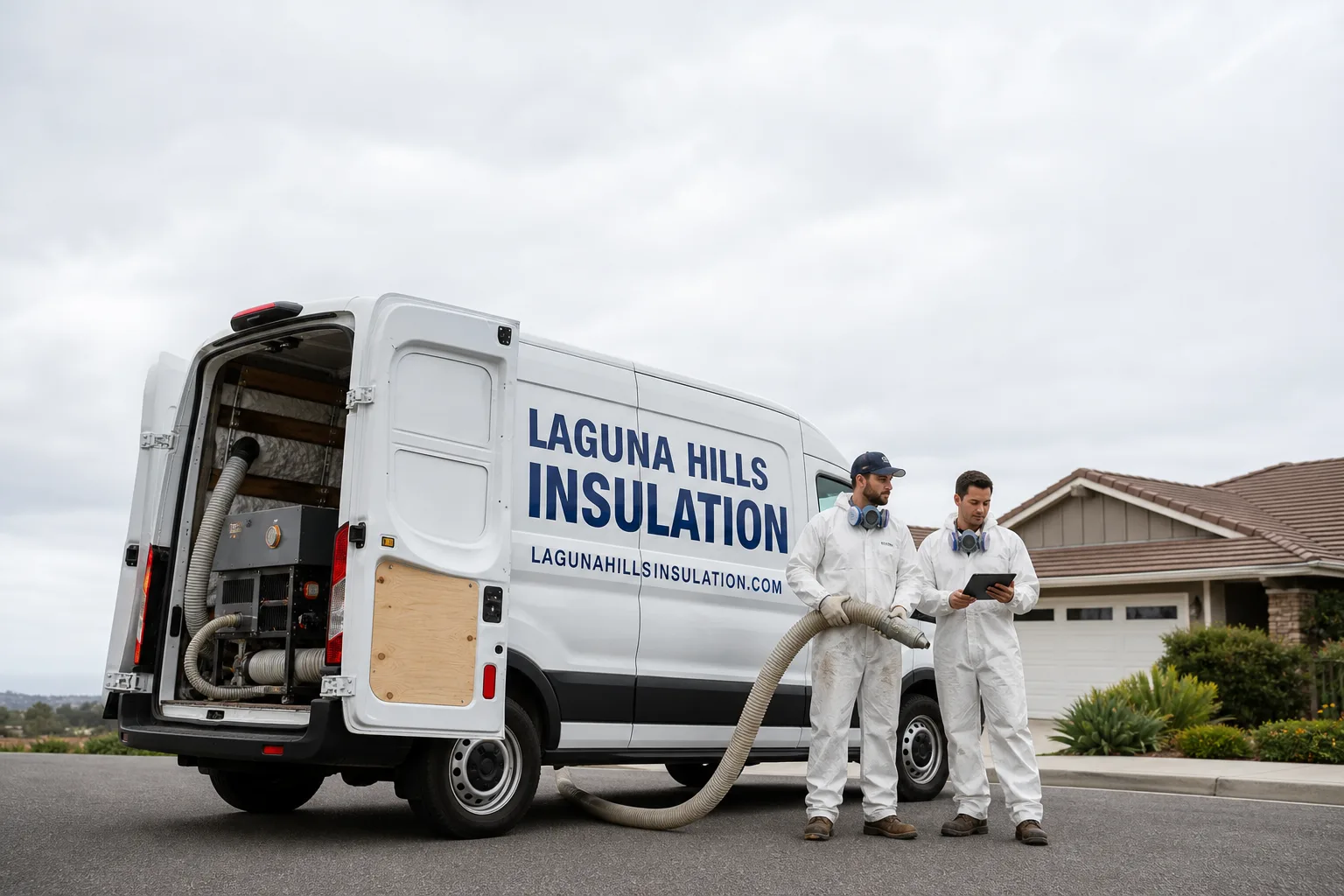
Fast, Reliable Attic Insulation Across Ontario
If you live in Ontario and your upstairs feels 15 degrees hotter than your living room by 4 p.m., your attic is the problem. We pull hatches all over Ontario, from the 1940s citrus-era ranches near Euclid to the 1990s two-story stucco homes on the newer east edge, and the pattern is consistent: original insulation that stopped doing its job decades ago. Attic insulation in Ontario pays back faster than almost anywhere else in Southern California because your attic hits 150°F on a standard July afternoon. That heat doesn’t stay up there. It pushes straight through your ceiling, and your AC burns electricity fighting it. Laguna Hills Insulation handles Attic Insulation work the right way, starting with a real inspection of what’s actually sitting above your drywall. Call us at (866) 393-6041 and we’ll schedule a look.
Why Laguna Hills Insulation Is Ontario’s Preferred Attic Insulation Company
We’re not the closest insulation contractor to Ontario geographically, but we’re the one homeowners call when the first quote didn’t explain anything. People in Ontario want to understand what they’re buying. They want to know whether their 1962 rock-wool batts can be topped off or need full removal. They want someone who will name the material we’re proposing and tell them why.
Our crew has spent enough time in Ontario attics to recognize the exact failure pattern of a 1950s ranch off Holt or a 1970s tract house in 91762. We know those homes because we’ve crawled through dozens of them. That matters when you’re deciding between blown-in cellulose and a radiant barrier, or whether your garage conversion needs dense-packing before the next Santa Ana event. Garrett Lund, who leads our team, set the standard early: we stock eight manufacturer brands so the right material wins every job, not the easiest one to install. That’s why homeowners across Ontario keep our number.
Insulation Contractors in Ontario
Insulation Contractors in Ontario are not all working from the same playbook, and the difference shows up in the attic. A proper insulation job here starts with identifying what’s already in place, because so many Ontario homes have legacy material that’s misleading to the untrained eye. Rock-wool batts from the 1950s can look intact until you lift one and find it’s shed half its volume. Thin fiberglass from the early 70s compresses to R-6 or worse under decades of dust settling. The work should include an honest assessment, top-plate and can-light air sealing where needed, and then the right installation method for your specific home. Expect a quality attic insulation project in Ontario to run $1,800 to $4,200 for a typical 1,200 to 1,800 square foot ranch, depending on whether you need removal or just added coverage.
Top-Plate Air Sealing
Before any material goes in, the gaps where framing meets drywall need closing. In Ontario’s postwar homes, these seams were never sealed. Conditioned air leaks into the attic year-round, and in summer the superheated attic air drives back down through the same gaps.
Blown-In Coverage
For most Ontario ranches, blown-in fiberglass or cellulose is the practical answer. It fills the irregular framing bays you find in older homes, covers existing settled batts, and brings the whole attic up to a uniform R-value without tearing out ceilings.
Attic Ventilation in Ontario
Attic Ventilation in Ontario is not a nice-to-have. When your roof deck hits 150°F day after day through July and August, trapped heat shortens the life of your shingles and makes every insulation upgrade less effective. Proper ventilation gives that heat a way out: intake at the eaves, exhaust at or near the ridge. Many Ontario ranchers have only a handful of passive vents, or none at all in original construction. We check this on every job because blowing in R-38 without addressing a 140°F attic is half a fix. Attic baffle installation and ventilation prep in Ontario typically runs $400 to $900, depending on how many rafter bays need work and whether the existing vents are obstructed.
Baffles and Rafter Bay Prep
Baffles keep insulation from blocking your soffit intake vents. In Ontario homes from the 50s and 60s, soffits are often too narrow or entirely closed. We install baffles to restore the airflow path before the material goes in.
Passive Exhaust Upgrades
If your roof has no ridge or turbine vents, adding passive exhaust lowers attic temperatures by 20 to 30 degrees on peak days. That’s a difference you’ll feel in your hallway ceiling, and it extends the life of whatever insulation you have up there.
Trusted Brands We Service in Ontario
We don’t push one brand in Ontario. Your house decides what makes sense. For blown-in work, we run GreenFiber cellulose because it dense-packs well in older framing cavities and holds up in high-heat attics. For batt jobs where mineral wool is the better call, we carry Owens Corning and Johns Manville product lines. And when a home needs the air-sealing performance of spray foam, we install closed-cell systems from Icynene and Demilec, two of the most technically demanding product lines in the industry. Parts and materials are stock items for us, not special orders, so your Ontario project doesn’t stall while a distributor ships from Riverside.
Common Attic Insulation Problems We See in Ontario Homes
- Sagged and compacted legacy batts. That 1950s rock-wool or early fiberglass has been baking in Ontario heat for 60-plus years. It sheds, it compresses, and what’s left is maybe R-6, sitting on bare drywall in the middle of the field. You can’t fix that with a top-off alone.
- Never-insulated garage conversions. Ontario’s 91761, 91762, and 91764 tracts are full of garages turned into living space with zero insulation in the walls or ceiling. The room bakes in summer and freezes on winter nights, and no HVAC adjustment will fix it.
- 150°F attic heat driving ceiling loads. On a 100°F afternoon with Santa Ana winds, your attic can spike past 150°F. That radiant load pushes through the ceiling drywall continuously, which is why an upstairs bedroom never cools down even with the AC running.
- Knob-and-tube-era framing complications. Many Ontario ranches still have the original electrical layout. Insulating around knob-and-tube requires care and often an electrician’s assessment first. We flag it when we see it, not after the material is in.
Pricing for Attic Insulation in Ontario, CA
A typical attic insulation project in Ontario runs $1,800 to $4,200. That covers a standard ranch or two-story home from 1,200 to 1,800 square feet. Attic insulation top-up work, where you have existing coverage that just needs more depth, starts around $1,100 to $1,800. Full removal and replacement of old rock-wool or degraded fiberglass adds labor and disposal, which pushes the range to $3,500 to $5,500 depending on access. Attic baffles and ventilation prep run $400 to $900 on top. Garage conversion dense-packing is usually $700 to $1,400 for the cavity work. We quote exact numbers after we inspect the attic, and estimates are free. Call (866) 393-6041 and we’ll match your house to the right scope, not the biggest one.
We Also Serve Cities Near Ontario
Our crews work throughout the Inland Empire, and we’re regularly in Montclair, Upland, Chino, and San Antonio Heights. If you’re just outside Ontario and wondering whether your attic insulation is doing its job, call us at (866) 393-6041. We’ll tell you honestly what’s up there and what it would take to fix it.
Serving Ontario, CA — Our Local Coverage Area
We’re based in the Ontario area and know this community well. Use the map below to see our service coverage — if you’re nearby, we can almost certainly help.
FAQs About Attic Insulation in Ontario
Yes, in most cases. Blown-in cellulose or fiberglass will settle into the gaps where the old batts have compacted and restore a uniform R-value across the attic. If the rock-wool has degraded to the point of breaking down into dust, we recommend removal first. We’ll know which way to go once we open the hatch. Call (866) 393-6041 for an inspection.
Because it was almost certainly never insulated. Most garage conversions in Ontario’s older tracts were framed and drywalled without insulation in the walls or ceiling, so the room is effectively open to the outside. We dense-pack those cavities with GreenFiber cellulose and the difference is immediate.
Both have a role, but they do different things. Insulation slows conductive heat transfer through the ceiling. Radiant barrier reflects radiant heat off the roof deck before it becomes a load. In Ontario, where attics hit 150°F regularly, we often recommend a combination: insulation first, then a radiant barrier if your roof geometry supports it. Call (866) 393-6041 and we’ll walk you through the trade-off.
Yes. Those homes were built to older code minimums, often R-19 or less, and two-story attics on the newer Ontario edge get every bit as hot as the old ranch tracts. A quick attic inspection tells us if you’re under-insulated, and a blow-in top-up is one of the lowest-cost energy fixes available. Estimates are free.
Yes, we inspect them carefully. Knob-and-tube wiring in the attic means we coordinate with a licensed electrician before insulating around it. We won’t blow material over live knob-and-tube, and we’ll tell you what needs addressing first. Call (866) 393-6041 and we’ll schedule a look.
Written by Garrett Lund, Owner at Laguna Hills Insulation, serving Ontario since day one.