
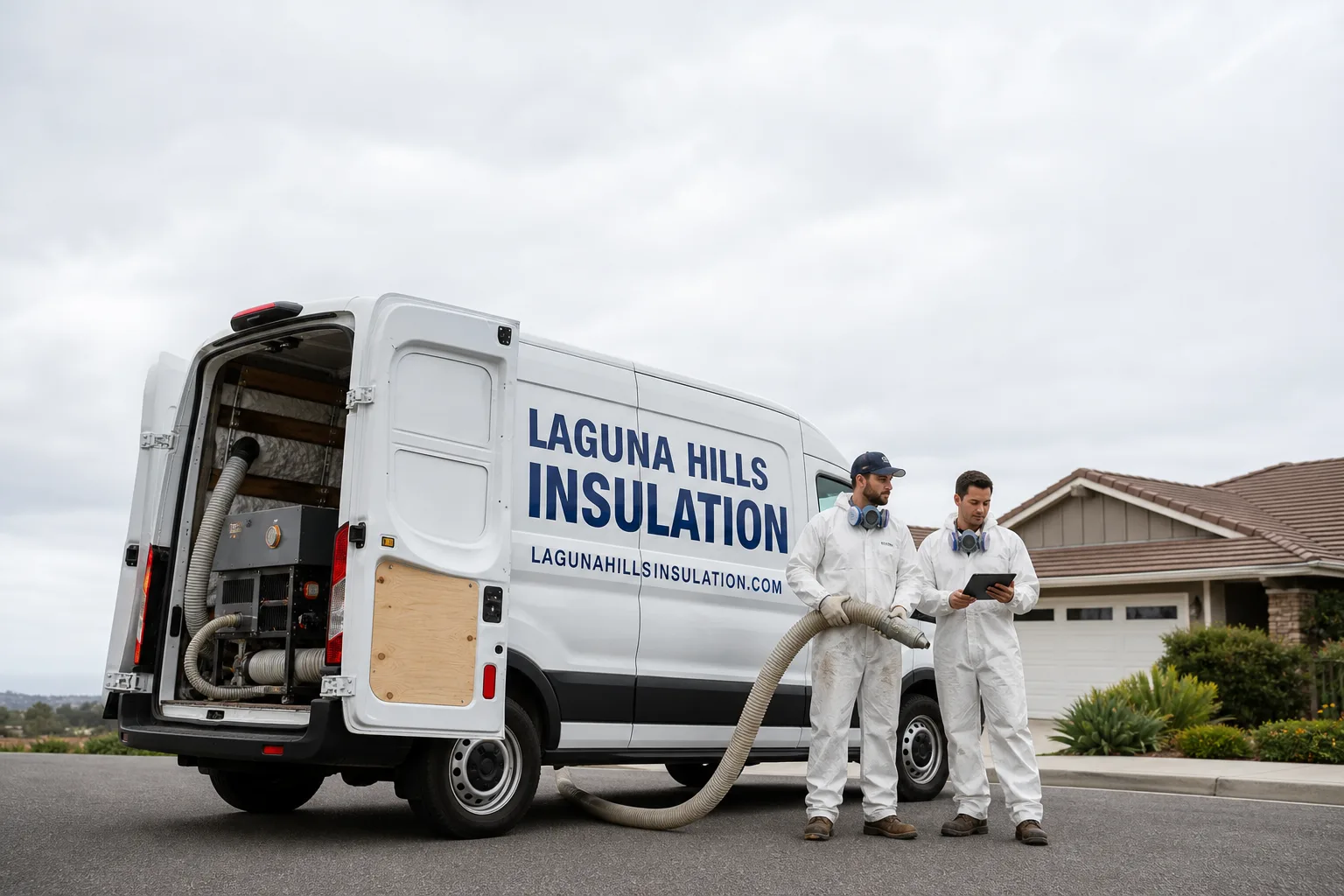
Fast, Reliable Attic Insulation Across March Air Force Base
Attic insulation in March Air Force Base usually costs $1,800 to $4,200 for a full removal-and-replacement job on a mid-century tract home, and $950 to $2,600 for a blown-in top-up. Most of our work here happens on 1950s – 1970s base-era houses where the original insulation has compacted under decades of Inland Empire heat. We know the housing stock off Cactus Avenue, around the March ARB gates, and throughout the 92551 corridor. Call (866) 393-6041 for a free attic inspection and a real number based on your home’s R-value, not a guess.
Why Laguna Hills Insulation Is March Air Force Base’s Preferred Attic Insulation Company
Most insulation contractors in this part of Riverside County work with one or two product lines. We stock eight: Owens Corning, Johns Manville, Knauf, Rockwool, CertainTeed, Icynene, Demilec, and GreenFiber. That means when we look at a base-era home in March Air Force Base, we recommend the material that actually fits the house, not the one sitting in our warehouse. Garrett Lund built the company around that principle. We’ll tell you which product performs for your attic, even when it’s not the most expensive option.
Our crews are in March Air Force Base weekly. We know the tract layouts, the roof pitches, and the way afternoon sun loads the west-facing attics on the older streets. That local familiarity means we show up with the right equipment the first time and don’t waste a trip figuring out your neighborhood on the job clock.
Attic Insulation Removal in March Air Force Base
Attic Insulation Removal in March Air Force Base is often the first real step, because so much of the 92551 housing stock still carries original insulation from the 1950s through the 1970s. That material has flattened, compacted, and in many cases absorbed decades of fine desert dust. Removing it costs $1.50 to $3.00 per square foot here, including bagging and disposal. The job involves vacuuming out old batts, loose-fill, or degraded cellulose, clearing the joist bays, and prepping the attic floor for an air-sealing pass before new insulation goes in.
When Removal Beats Top-Up
If the existing insulation has compressed to under an inch, adding new material on top just buries the problem. We see this constantly in March Air Force Base homes where original mineral wool or fiberglass batts have sagged into the joist cavities. Removal gives a clean substrate so the new R-value actually performs.
What Gets Hauled Out
Old blown-in cellulose from the 1960s and 70s settles into a dense mat that stops trapping air. Vermin droppings, debris from old roof leaks, and construction dust accumulate too. We bag all of it, seal the attic access, and prep the space for whatever material we’re installing next.
If you’re unsure whether your attic needs full removal or just a top-up, call (866) 393-6041. We’ll measure what’s there and tell you straight.
Insulation Contractors in March Air Force Base
Insulation Contractors in March Air Force Base fall into two camps: those who push a single brand and those who’ll tell you the truth about what your attic needs. We’re in the second camp. On a typical base-era project in 92551, our scope includes attic baffle installation, air-sealing around top plates and can lights, removal of compromised material, and a fresh blown-in or batt application sized for the Inland Empire heat load. Labor and material packages for this work run $1,700 to $3,900 depending on attic size and access.
What a Full-Scope Crew Actually Does
We check the soffit vents first. Base-era homes often have undersized or blocked venting, which is why the attic bakes like an oven by mid-afternoon. Then we air-seal the thermal bypasses, install baffles where needed, and only then measure insulation depth against the R-value target for this climate zone.
Material-Agnostic Estimating
We’ll quote you blown-in GreenFiber cellulose, fiberglass from Owens Corning or Johns Manville, and Rockwool batts side by side if the job calls for it. You pick based on performance and budget. No contractor in March Air Force Base should make that decision for you without showing you the numbers.
Trusted Brands We Service in March Air Force Base
We work across eight manufacturer lines, so March Air Force Base customers aren’t locked into whatever a single-line shop stocks. Owens Corning and Johns Manville fiberglass cover the value end of blown-in and batt work. GreenFiber gives us a cellulose option with recycled content and excellent coverage for odd-shaped attics. Knauf serves as another reliable fiberglass line when supply or lead time matters. Because we run all three installation methods in-house, we can pair the right brand with the right technique instead of forcing a square peg into a round hole.
Common Attic Insulation Problems We See in March Air Force Base Homes
- Compacted legacy batts. Original 1950s – 1970s insulation in 92551 homes has been squeezed flat by decades of 100°F+ afternoons. The joist cavity ends up with almost no trapped air, which drops your effective R-value to a fraction of what the label says.
- Settled blown-in material. Loose-fill from the 1960s and 70s flattens into a dense mat across the attic floor. The thermal blanket thins exactly where the afternoon sun drives the most heat gain through the roof deck.
- Radiant load on thin stucco construction. Post-war base housing runs single-pane windows and thin stucco walls. That radiant heat loads the attic plane from below and above, so insulation that was never sized for this climate can’t keep up.
- Blocked or missing venting. Many base-era attics have soffit vents painted over, blocked by old insulation, or simply absent. Without airflow, the attic turns into a heat trap and any new insulation underperforms from day one.
Pricing for Attic Insulation in March Air Force Base, CA
A blown-in top-up on a March Air Force Base attic typically runs $950 to $2,600. Full removal and replacement lands between $1,800 and $4,200 depending on square footage, access, and the R-value you’re targeting. Attic baffle and venting prep adds $300 to $800 on most 1,200 – 1,800 square foot base-era homes. If you want spray foam instead of blown-in, budget $3,500 to $7,000 for an open-cell application on a typical 92551 attic. Every estimate includes a written material and labor breakdown before we start. Call (866) 393-6041 and we’ll measure your attic the same week.
We Also Serve Cities Near March Air Force Base
Most of our March Air Force Base jobs come from the base-adjacent communities along the 215 and 60 corridors. We run crews regularly to Moreno Valley, Woodcrest, Perris, and Good Hope. If you’re in one of those areas, Attic Insulation in March Air Force Base pricing applies zone-wide since we’re already working the same housing stock and climate.
Serving March Air Force Base, CA — Our Local Coverage Area
We’re based in the March Air Force Base area and know this community well. Use the map below to see our service coverage — if you’re nearby, we can almost certainly help.
FAQs About Attic Insulation in March Air Force Base
Decades of Inland Empire heat cycles compress fiberglass and mineral wool batts until they lose their air-trapping loft. The material isn’t defective; it has simply exhausted its effective lifespan under the thermal stress of 100°F+ summers and wide day-to-night temperature swings. When insulation compresses, its R-value collapses because trapped air is what slows heat transfer. Removal and replacement is the only real fix.
Most do. If your home still carries original insulation from the 1950s – 1970s, that material has compacted, accumulated dust and debris, and often absorbed moisture from old roof leaks. Blowing new insulation over the top creates a false sense of performance without fixing the underlying failure. We recommend removal whenever the existing layer has compressed below half its original depth. Call (866) 393-6041 for an honest read on whether removal is warranted in your attic.
Strong diurnal swings mean your attic insulation needs to resist heat gain during the afternoon and slow heat loss after sunset. For March Air Force Base, we recommend R-38 to R-49 in attic floors, depending on the home’s age and existing venting. The older the house, the more important the air-sealing component becomes, because single-pane windows and thin walls transfer radiant heat into the attic plane faster than the insulation spec alone can compensate for.
Almost certainly. Building codes from that era called for far less attic insulation than modern standards, and whatever was installed has degraded over 40 – 70 years of thermal cycling. We routinely find R-11 or R-19 batts where R-38 is the minimum for this climate zone. A quick attic inspection confirms what you’re working with, and the fix usually pays for itself within a few summers of reduced cooling load.
Yes, and we’ve done it on dozens of March Air Force Base homes with original knob-and-tube remnants or aging Romex. The key is sequencing: we inspect the attic for electrical hazards before insulating, install baffles where needed to keep airflow moving, and keep insulation clear of heat-producing fixtures. Older venting gets addressed at the same time, because adding insulation without fixing soffit or ridge venting just creates a hotter, damper attic. Call (866) 393-6041 and we’ll walk you through the scope on your specific house.
Contact Our Attic Insulation Team in March Air Force Base
We work on Attic Insulation projects throughout March Air Force Base every week. If your attic is baking the upstairs bedrooms, if your insulation looks flattened and dead against the joists, or if your cooling bills keep climbing every Inland Empire summer, call us at (866) 393-6041 for a free estimate. We’ll climb into the attic, measure what’s there, and give you a straight answer on what your home actually needs.
Written by Garrett Lund, Owner at Laguna Hills Insulation, serving March Air Force Base and the surrounding Inland Empire communities.