
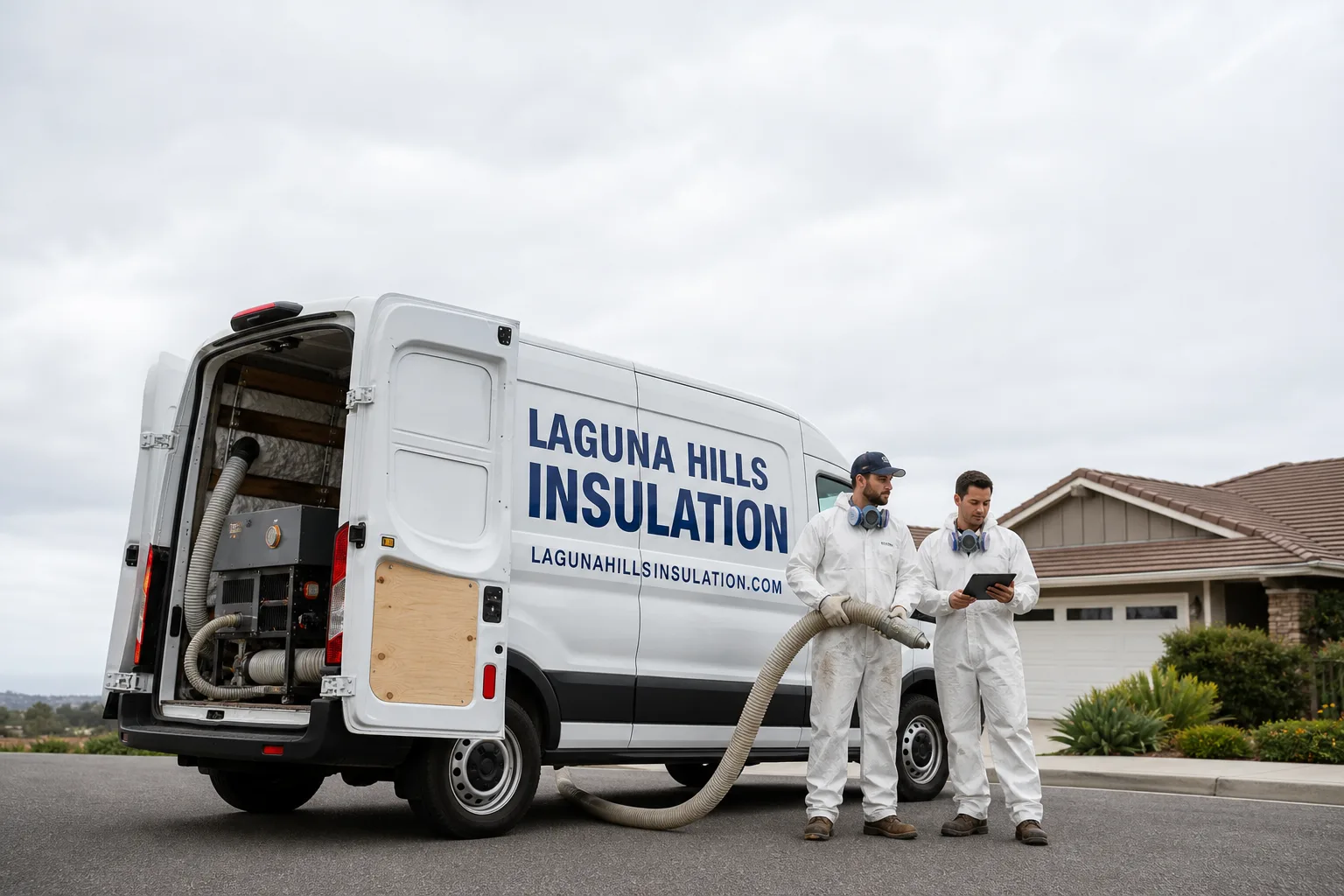
Spray Foam Insulation in San Joaquin Hills: What It Costs and How It Works in Hillside Homes
Spray foam insulation in San Joaquin Hills typically runs $2.50 to $7.50 per square foot depending on whether you need open-cell or closed-cell, with most whole-home retrofits landing between $8,500 and $24,000. Homes in this canyon community rarely fit standard pricing models because of sloped lots, cantilevered floors, and angled ceilings that require access-panel work or injection foam from the exterior. Our Spray Foam Insulation team knows exactly what those hillside conditions demand, and we quote the job for what it actually is, not what a flat-lot formula says it should be. Call (866) 393-6041 for a free estimate tailored to your specific San Joaquin Hills home.
Why Laguna Hills Insulation Is the Right Fit for San Joaquin Hills
Most insulation contractors in Orange County stock one product line and make every home fit it. We don’t work that way. Garrett Lund built Laguna Hills Insulation around the idea that the right material should win the job, not the easiest upsell. That means we arrive at a San Joaquin Hills job with eight manufacturer brands behind us, including open-cell and closed-cell spray foam systems from Icynene and Demilec, plus blown-in and batt options from Owens Corning, Johns Manville, Knauf, and GreenFiber. In a housing stock as varied as San Joaquin Hills, from 1980s split-levels off Laguna Canyon Road to newer custom builds on Ridge Route, that material breadth actually matters.
We’ve worked enough hillside homes here to know what the floor plans hide. Cantilevered floor sections over garages, vaulted ceilings with no attic access, canyon-facing walls that bake in afternoon sun while shaded lower levels stay damp from marine air. These aren’t problems you solve by blowing in more fiberglass and calling it done. They’re handled cavity by cavity, often from the exterior, with injection foam and careful access-panel work. That’s the work we do routinely in San Joaquin Hills, and it’s work most flat-lot insulators never see.
Spray Foam Wall Insulation in San Joaquin Hills
Spray foam wall insulation in San Joaquin Hills is often the only reliable way to insulate homes where original fiberglass batts have failed in stucco-sided, hillside construction. The first sentence tells you what matters: this is a retrofit technique that reaches wall cavities behind drywall without tearing the house apart, which is exactly what older custom homes here need when canyon drafts and afternoon heat make interior temperatures swing hard. On south and west facing walls, closed-cell foam from Demilec or Icynene creates both a thermal barrier and an air barrier in a single pass, something batts never did well even when they were new.
We see this need most often in two-story and split-level homes along the ridgelines, where west-facing stucco walls absorb intense afternoon sun from about 2 PM onward. An uninsulated wall cavity can sit at 120 degrees on the interior surface by late afternoon. Closed-cell spray foam at two inches adds roughly R-13 and stops the heat before it gets through the sheathing. For homes in shaded canyon pockets, open-cell foam often makes more sense because it handles vapor differently and costs less where heat rejection isn’t the primary concern.
Access-Panel Work on Angled Ceilings
Angled ceilings are beautiful until you need to insulate above them. In San Joaquin Hills, that’s most homes. We cut and patch access panels through drywall or plywood sheathing to reach those voids, then spray directly into the cavity. The panel goes back, the seam is finished, and you’d never know we were there. It’s invisible work that makes a remarkable difference in how the upstairs holds temperature.
Injection Foam Behind Existing Drywall
For wall cavities we can reach from inside, injection foam through small drill holes gets the job done without opening walls. This is the standard approach for exterior walls in finished homes. We spray closed-cell or open-cell depending on the wall’s orientation and the home’s moisture profile, then plug and patch the holes cleanly. Most homeowners can’t find the access points after paint.
Rim Joist Spray Foam in San Joaquin Hills
Rim joist spray foam in San Joaquin Hills fixes a problem every canyon home shares: the band board where floor framing meets the foundation is a highway for outside air. That’s especially true on hillside lots where the downhill side of the house has the rim joist fully exposed to canyon breezes and marine-layer damp. Sealing that band with spray foam stops the stack effect that pulls cold air through the garage, up through walls, and into living spaces above.
We recently sprayed open-cell foam in the rim joists of a 1990s split-level home off Laguna Canyon Road, where the cantilevered floor over the garage had left a 12-inch void exposed to canyon drafts. After sealing with Icynene injection foam from the exterior, the homeowner reported a 10-degree drop in upstairs bedroom temperature and no more marine-layer dampness in the garage. That’s the kind of result rim joist work delivers when the cavity actually gets filled, which doesn’t happen with batts stuffed loosely into an irregular opening.
Cantilevered Floor Sealing
Cantilevered floors extend past the foundation wall, which means the underside faces open air. In hillside homes, that often means a bedroom or living area hanging over the slope with nothing but plywood and a little stucco between the floor and the canyon below. Rim joist spray foam seals the entire box, including the underside of the cantilever, killing drafts and making those rooms usable year round.
Garage-to-Living-Space Air Sealing
The rim joist runs along the top of foundation walls in garages too. Sealing that line cuts off the air exchange between garage and home, which matters when marine-layer humidity sits in garages for months at a stretch. Closed-cell foam here also stops moisture wicking, which open-cell can absorb if the area stays constantly damp. We’ll tell you which product actually fits, even if it’s not the more expensive option.
Trusted Brands We Service in San Joaquin Hills
We spray and service Icynene and Demilec foam systems, and we also carry Owens Corning, Johns Manville, Knauf, and GreenFiber products when the job calls for blown-in, batt, or cellulose work alongside foam. For San Joaquin Hills customers, that means no waiting on special-order materials when a mixed-material retrofit makes sense. Having eight brands stocked means we choose based on R-value needs, moisture exposure, and fire-rating requirements, not on whatever happens to be on the truck. Garrett Lund has always stocked competing product lines on purpose. It keeps the advice honest.
Common Spray Foam Insulation Problems We See in San Joaquin Hills Homes
- Inaccessible voids above angled ceilings. Hillside construction leaves triangular dead spaces above vaulted rooms that never got insulated when the house was built. Heat pours through them in summer, and thermal bridging shows up as warm walls at 6 PM. We open these from inside or outside and fill them properly.
- Marine-layer moisture wicking into failed foam. In shaded canyon pockets, improper flashing around cantilevered floor penetrations lets damp air reach foam, degrading adhesion and eventually pulling it away from the sheathing. Correcting this means re-flashing, then re-spraying with a moisture-appropriate product.
- Shrinkage in older spray foam over original batts. Some San Joaquin Hills homes got partial spray foam jobs years ago, sprayed directly over original fiberglass without surface prep. That foam shrinks and pulls away, leaving gaps that defeat the air barrier. The fix is careful removal and a clean re-spray.
- Uninsulated cantilevered floor boxes. Rooms that hang over the slope lose heat through the floor in winter and gain it back in summer. The underside is almost never insulated from the factory. Rim joist and floor box sealing solves it, but it requires exterior access that flat-lot crews aren’t set up for.
Pricing for Spray Foam Insulation in San Joaquin Hills, CA
Open-cell spray foam in San Joaquin Hills runs $2.50 to $4.50 per square foot for typical wall and rim joist applications. Closed-cell runs $4.50 to $7.50 per square foot and delivers roughly R-7 per inch versus open-cell’s R-3.7. A rim joist package for a two-story hillside home typically lands between $1,800 and $4,200. Wall cavity injection for two or three exterior walls usually runs $4,000 to $9,000 depending on access. Whole-home retrofits with mixed open-cell and closed-cell applications fall between $8,500 and $24,000. San Joaquin Hills hillside access adds labor when we need ladders, scaffolding, or exterior injection work, and that’s reflected in these ranges. Call (866) 393-6041 for a free estimate that accounts for your home’s actual layout, not a square-footage shorthand.
We Also Serve Cities Near San Joaquin Hills
Our San Joaquin Hills work puts us in the neighborhood to serve nearby communities as well. We handle spray foam insulation, rim joist sealing, and wall cavity injection in Aliso Viejo, Newport Beach, Laguna Beach, and Irvine on a regular schedule. If you’re just down the hill or across the canyon, the same crew and the same eight-brand material stock apply to your job.
Serving San Joaquin Hills, CA — Our Local Coverage Area
We’re based in the San Joaquin Hills area and know this community well. Use the map below to see our service coverage — if you’re nearby, we can almost certainly help.
FAQs About Spray Foam Insulation in San Joaquin Hills
We cut and patch access panels through the ceiling or through the exterior sheathing to reach the void, then spray directly into the cavity and close it back up cleanly. In some homes, injection foam from the outside is the better route, and that’s something we determine during the estimate walkthrough. Call (866) 393-6041 if you have vaulted or angled ceilings and you’re not sure what’s above them.
Yes, but the product choice matters. In shaded San Joaquin Hills canyons where marine-layer moisture lingers, closed-cell foam acts as a vapor barrier and stops that damp air from reaching wall cavities and rim joists. Open-cell foam breathes more and can absorb moisture if the area stays wet for long stretches, so we don’t blindly spec it in damp canyon pockets.
Closed-cell foam, usually from Demilec or Icynene, handles ridgeline sun exposure best because of its higher R-value per inch and its air-sealing strength. On west and south facing walls that take direct afternoon heat, two inches of closed-cell gives you roughly R-13 plus a complete air barrier. It’s the right material for heat rejection, not just temperature regulation.
Hillside construction means irregular framing, cantilevered floor boxes, and impossible attic access on many homes. That adds labor for ladders, scaffolding, and cavity-by-cavity work, and it changes how we approach the job entirely. Flat-lot insulation methods simply don’t apply here, which is why we quote San Joaquin Hills homes based on actual conditions, not average square footage.
Yes, and it’s one of the most common jobs we do in the Laguna Canyon Road corridor. Cantilevered floors over garages and slopes often have 12-inch or larger voids that batts can’t fill, so injection foam from the exterior is the only way to seal them completely. We’ve fixed dozens of these, and the difference in upstairs comfort is immediate.
Contact Laguna Hills Insulation for Spray Foam in San Joaquin Hills
If your San Joaquin Hills home has rooms that won’t hold temperature, drafts along the floors, damp garages, or upstairs bedrooms that bake all summer, spray foam insulation is likely part of the answer. We’ll walk the house with you, show you where the air leaks are, and tell you which product actually fits, even if it’s not the most expensive option. Call (866) 393-6041 today for a free estimate and a straight answer about what your home needs.
Written by Garrett Lund, Owner at Laguna Hills Insulation, serving San Joaquin Hills and surrounding Orange County communities.