
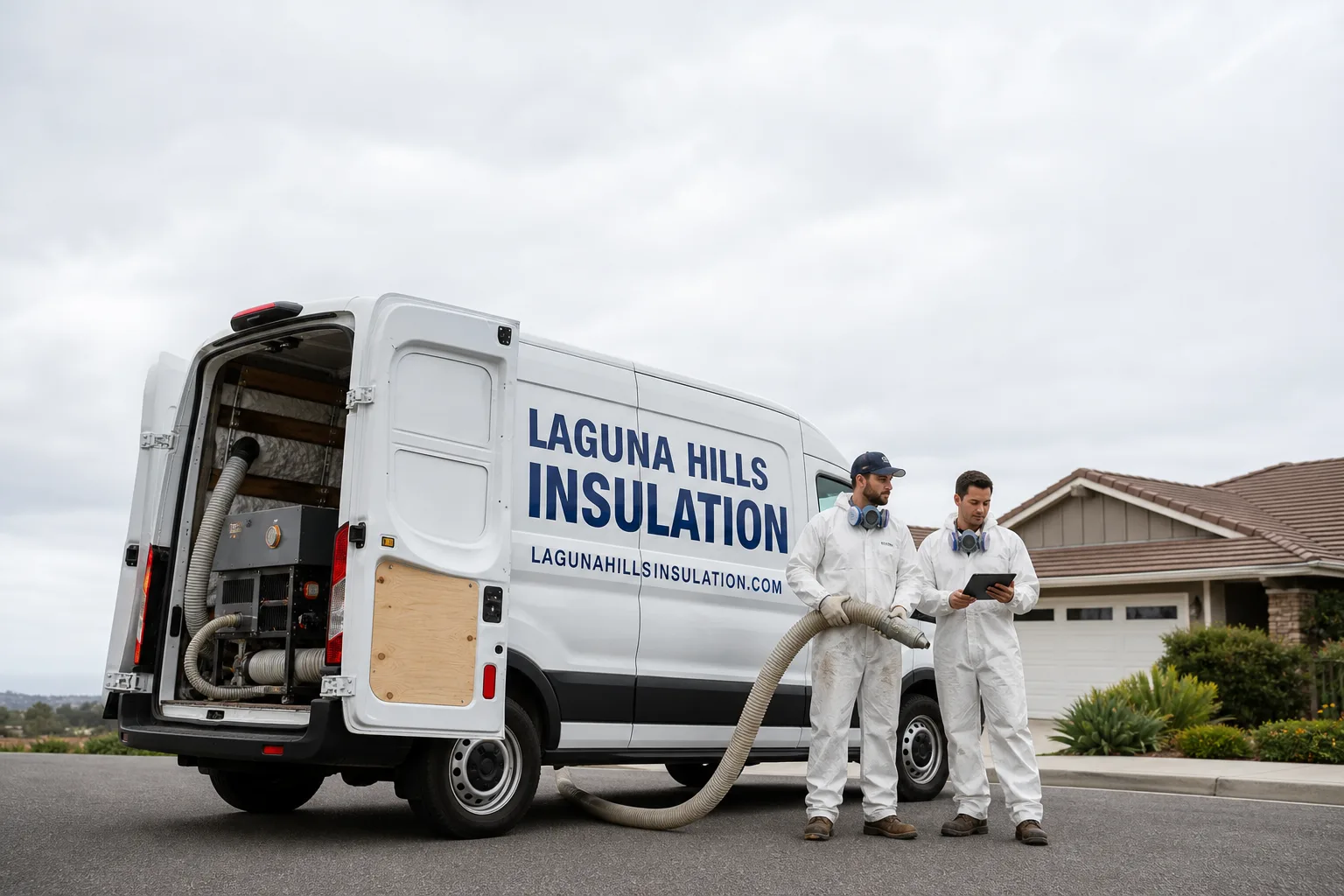
Fast, Reliable Spray Foam Insulation Across Rowland Heights
Spray foam insulation in Rowland Heights costs between $2,200 and $6,800 for a typical attic application, depending on whether you choose open-cell or closed-cell foam and how much of the roof deck needs coverage. Most homes here see the work finished in a single day, and if you’re dealing with a 150°F attic in July, you want it done right the first time. We know the hillside tracts off Pathfinder and Fullerton Roads, the 1960s ranch homes with sagging R-11 batts, and the two-story stucco builds from the 1990s that never got enough insulation to begin with. When the heat is radiating through your ceiling by mid-afternoon, call us at (866) 393-6041 and we’ll give you a straight answer about what your attic actually needs.
Most Rowland Heights homeowners don’t realize their attic is the single biggest lever on their cooling bill. In this part of the eastern San Gabriel Valley, summer heat is relentless, and the sun beats down on south-facing roof slopes all day. The insulation you have up there right now is probably decades old, compressed, or missing entirely in spots. Spray foam changes that equation because it air-seals and insulates at the same time. No more 150°F air baking down through your ceiling into the living room.
Why Laguna Hills Insulation Is Rowland Heights’s Preferred Spray Foam Insulation Company
We’re not the only insulation contractor who’ll pick up the phone in Rowland Heights, but we’re one of the few who’ll tell you when spray foam isn’t the right call. Garrett Lund started this company around a simple idea: eight brands, three methods, one specialist. That means we show up with access to Owens Corning, Johns Manville, Icynene, Demilec, Rockwool, and more, so the material gets matched to your home instead of whatever we happen to have in the truck.
Rowland Heights customers write to us most often about two things: we showed up when we said we would, and we didn’t try to upsell them into a product their home didn’t need. That matters in a city where homeowners are comparing multiple bids and want to understand exactly what they’re buying. We explain R-value, air sealing, vapor control, and thermal bridging in plain English, because you should know why closed-cell foam costs more than open-cell and when that extra cost actually earns its keep.
Serving Rowland Heights means understanding what the heat does to insulation on these hillside lots. South-facing roof decks off Fullerton Road hit 150°F regularly in August. That kind of thermal cycling degrades fiberglass batts fast, and it’s exactly why spray foam, applied correctly, holds its performance for decades. We’ve been in enough Rowland Heights attics to know what’s up there before we even climb through the access hatch.
Spray Foam Insulation Contractors in Rowland Heights
Spray foam insulation contractors in Rowland Heights do more than spray foam, honestly. The job starts with substrate prep, and that’s where a lot of crews cut corners. In the older hillside homes off Pathfinder Road, we routinely find sagging batts, debris, and gaps at the eaves that have to be cleaned out before any foam goes down. Skip that step and the foam won’t adhere properly, or worse, it’ll off-gas because the surface was too hot. Rowland Heights attic temperatures on south-facing slopes hit 150°F, and that requires temperature monitoring and slow-rise formulations, not just pulling the trigger on whatever’s in the hopper. Expect to pay $3,000 to $6,000 for a full attic spray foam job here, more if you’re doing the roof deck and gable walls.
Prep Work and Adhesion Standards
Before we spray anything, we remove the old degraded insulation, clean the sheathing, and air-seal the top plates and penetrations. In a 1970s ranch off Fullerton Road, that prep step is the difference between foam that bonds for the life of the home and foam that peels away in sheets after two summers. We’ve seen the failure mode too many times to skip it.
High-Temperature Formulations for Local Conditions
Rowland Heights attics demand foam rated for high substrate temps. Standard formulations can off-gas or lose adhesion when sprayed onto a roof deck that’s been cooking under the sun since morning. We use the right product for the condition, not the one that’s easiest to spray. That’s a technical distinction most contractors never raise with you, because they don’t have the brand depth to offer an alternative.
Spray Foam Attic Insulation in Rowland Heights
Spray foam attic insulation in Rowland Heights solves a problem that’s written on every hillside roof in this city: heat gain through the ceiling that your air conditioner fights from noon to midnight. On the south-facing slopes off Pathfinder and Fullerton Roads, attic temps routinely hit 150°F, and original R-11 batts sag and separate from the eaves after decades of thermal cycling. Spray foam replaces that failure with an air barrier and a thermal barrier in one shot. In the hillside tracts, a typical attic runs $3,200 to $6,800 for closed-cell foam on the roof deck, and the work is usually done by late afternoon.
Making Attics Unvented and Sealed
Spray foam’s biggest advantage here isn’t the R-value, it’s the air sealing. Rowland Heights homes from the 1960s through the 1990s leak like sieves at the top plates and around penetrations. Closed-cell foam from Icynene applied to the roof deck stops the air movement, so the attic stops being a solar oven. The unvented attic stays closer to indoor temperature, and your cooling load drops immediately.
Garage Ceiling and Rim Joist Work
Rowland Heights has plenty of attached garages and detached workshops with nothing above them but a hot roof. Insulating the garage ceiling with spray foam brings that over-garage bedroom back to comfortable, and rim joist spray foam seals the air leaks that pull hot air into the house every afternoon. These are smaller jobs, but they’re where the comfort complaints come from in the first place.
Trusted Brands We Service in Rowland Heights
We stock and install spray foam from Icynene and Demilec, two of the most recognized names in open- and closed-cell performance, because Rowland Heights homeowners deserve materials that have third-party verified R-values and decades of field performance behind them. When mineral wool from Rockwool fits the job better, we’ll say that. When Owens Corning fiberglass makes more sense, we’ll install that. Eight manufacturer lines across three installation methods means the right product wins, not the easiest upsell. That’s the whole point of working with us, and it’s why Rowland Heights customers don’t get a one-size-fits-all quote.
Common Spray Foam Insulation Problems We See in Rowland Heights Homes
- Foam applied over sagging, separated batts. South-facing hillside attics off Pathfinder Road have thermal-cycled for decades, leaving gaps and debris under the old insulation. Spraying over that layer means the new foam bonds to junk, not sheathing.
- Inadequate thickness that lets thermal bridging win. Older 1960s – 1990s tract homes need more than a thin flash coat to stop heat transfer, especially in winter when cold snaps create condensation risk on the roof deck. Too little foam is a wasted spend.
- Off-gassing and adhesion failure on hot decking. Spraying standard foam onto a 150°F roof deck without monitoring substrate temperature causes chemical and bond problems. This is the failure we get called to fix after another contractor walked away.
- Ignoring the eave line. In Rowland Heights hillside homes, the gap where the roof meets the walls is the single biggest air leak in the building. We see foam jobs that leave the eave line open, and the homeowner is still sweating in August.
Pricing for Spray Foam Insulation in Rowland Heights, CA
Open-cell spray foam in a Rowland Heights attic typically runs $2,200 to $4,200. Closed-cell foam, which is what we recommend for the south-facing hillside homes where attic temps hit 150°F, runs $3,200 to $6,800 depending on square footage and roof pitch. Rim joist spray foam jobs are smaller, usually $800 to $1,800, and garage ceiling work ranges from $1,500 to $3,000. What drives the final number: how much old insulation has to be removed, how much prep the substrate needs, and whether you’re doing the roof deck or just the attic floor. Call (866) 393-6041 and Garrett’s team will give you a walk-through of your home and a written estimate. Free, no obligation, and you’ll actually understand what you’re paying for.
We Also Serve Cities Near Rowland Heights
We work in Rowland Heights every week, and we cover the neighboring communities too: South San Jose Hills, Walnut, Valinda, and Hacienda Heights. Same crews, same material-access, same straight answers. If you’re within a short drive of the 60 corridor, we’re likely already scheduling jobs in your area. As a full-service Spray Foam Insulation contractor, we’d be glad to take a look at your attic, no matter which of these neighborhoods you call home.
Serving Rowland Heights, CA — Our Local Coverage Area
We’re based in the Rowland Heights area and know this community well. Use the map below to see our service coverage — if you’re nearby, we can almost certainly help.
FAQs About Spray Foam Insulation in Rowland Heights
Closed-cell spray foam is the only insulation that maintains its R-value when the roof deck hits 150°F, because it air-seals the attic and stops the heat at the source instead of slowing it down the way fiberglass does. Fiberglass batts lose effectiveness as they age, but closed-cell foam keeps performing at R-6.5 to R-7 per inch for the life of the home. On the hillside tracts where the sun pounds the roof all day, that’s the difference between an air conditioner that cycles and one that runs nonstop. Call (866) 393-6041 and we’ll measure your attic temp and show you what’s actually happening up there.
Yes, but only if the old batts are removed and the substrate is prepped first. We clean the sheathing, air-seal the top plates and penetrations, and then apply foam that bonds directly to the roof deck and rafter bays. Spraying over sagging batts would leave the same gaps behind the foam, so the fix is in the prep. In the 1970s ranch homes off Fullerton Road, this is the single most effective upgrade we do.
It is, when applied with the right prep and the right product. Older tract homes here have roof decks that have absorbed decades of heat, and the substrate often needs cleaning and temperature monitoring before foam goes on. We use high-temperature-tolerant formulations for south-facing slopes, and we check the decking for condition and moisture before recommending closed-cell or open-cell. Some older homes are better served by an open-cell solution at lower cost, and we’ll tell you if that’s the case.
Spray foam is an air barrier, so it dramatically cuts the smoke that seeps into your home through the attic, the top plates, and the rim joists during wildfire season. Fiberglass batts filter very little smoke-bearing air, but closed-cell foam stops the air movement almost entirely. For Rowland Heights homeowners with allergies or respiratory concerns, that smoke-season air sealing is often the deciding factor in choosing foam over blown-in insulation. Call (866) 393-6041 and we’ll walk you through the air-sealing benefits that matter most in this valley.
For detached workshops and oversized garages on the acreage properties in Rowland Heights, we recommend closed-cell spray foam on the roof deck and rim joists, because those structures get brutally hot in summer and you want them usable year-round. The air-sealing alone makes the space 20 to 30 degrees cooler in the afternoon, and if you work out there, that’s not a luxury. Expect a detached two-car garage to run $2,500 to $4,500 depending on whether you do just the ceiling or the walls too.
Written by Garrett Lund, Owner at Laguna Hills Insulation, serving Rowland Heights and the surrounding San Gabriel Valley.
If your Rowland Heights attic is hot enough to bake bread, you already know the problem. Call (866) 393-6041 today, and we’ll schedule a free estimate, inspect your current insulation, and show you exactly what a properly air-sealed spray foam attic looks like. We’ll tell you which product actually fits, even if it’s not the most expensive option. That’s the whole point.