
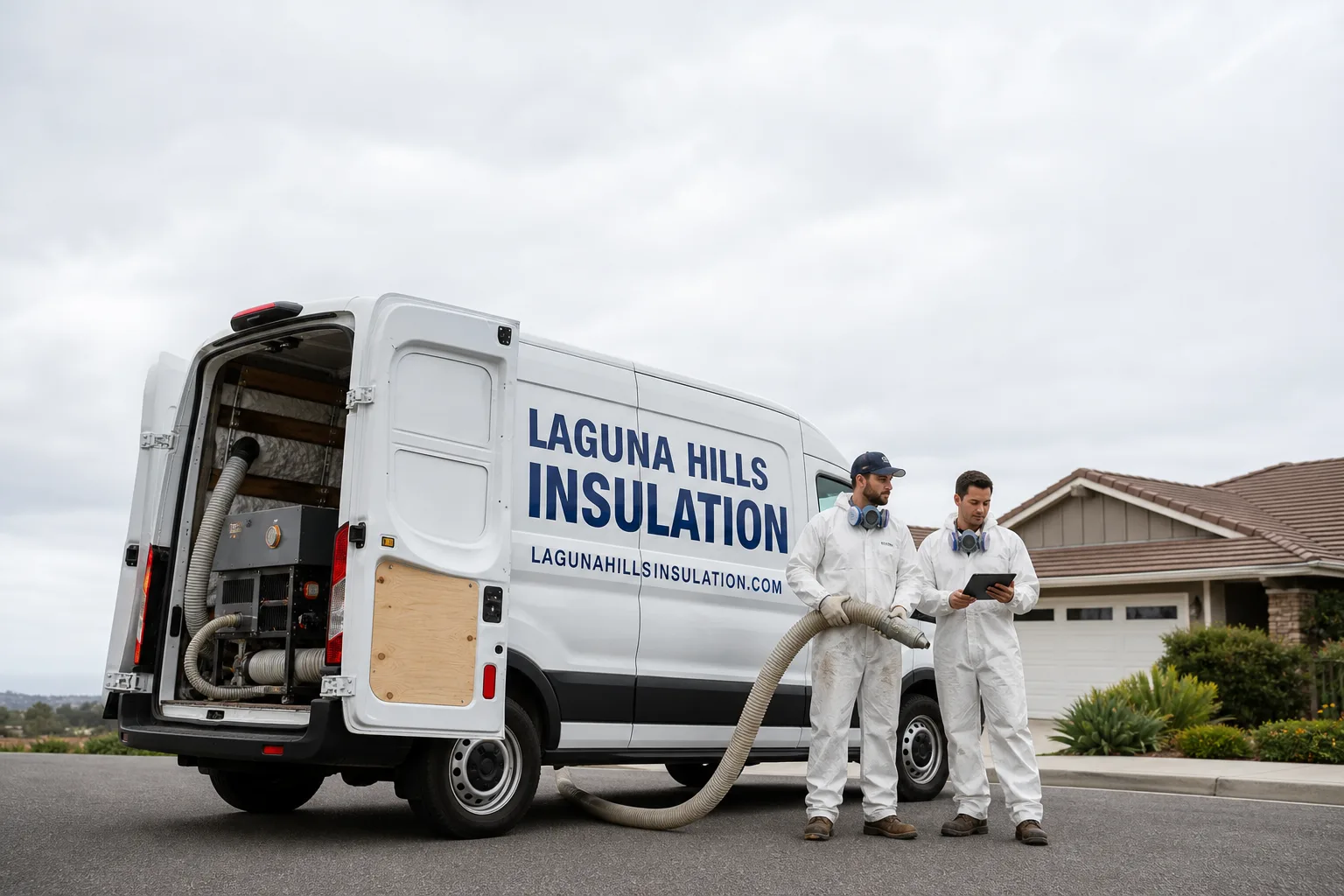
Fast, Reliable Spray Foam Insulation Across Covina
Spray foam insulation in Covina typically costs $2.50 to $6.50 per board foot depending on whether you choose open-cell or closed-cell, with most garage or attic projects landing between $1,800 and $6,200 total. We’re Laguna Hills Insulation, and we’ve worked inside enough Covina attics to know exactly what you’re dealing with: settled fiberglass, hot summer ceilings, and air leaks that show up on your SMUD bill every month between June and October. Call (866) 393-6041 and we’ll give you an honest assessment of whether spray foam actually makes sense for your home, or whether a different material does the job better for less.
We know the housing stock here, from the 1950s ranches off Citrus Avenue to the newer two-story stucco homes climbing up toward South Hills. That local familiarity means we show up knowing what to look for before we even open the attic hatch.
Why Laguna Hills Insulation Is Covina’s Preferred Spray Foam Insulation Company
Homeowners in Covina keep calling us for one reason: we carry eight manufacturer brands and three installation methods under one roof, so we don’t have to stretch a single product line to fit every job. That’s a real advantage when you’re dealing with the mix of old and new construction that defines Covina’s 91722, 91723, and 91724 ZIP codes. A 1958 ranch near downtown needs something very different from a 1990s build in Charter Oak. We tell you which product actually fits, even if it’s not the most expensive option.
Garrett Lund runs our spray foam division and has spent years diagnosing the specific problems we see in eastern San Gabriel Valley homes. When we send a crew to Covina, they’re familiar with the low-pitch attics, the old three-tab roofs, and the way Santa Ana winds push air through eave vents. Our Covina customers consistently mention that we showed up when we said we would and explained the work in plain English before anything was sprayed.
Typical response time to Covina is same-week for estimates and one to two weeks for installation, though we reserve room for urgent jobs. If you’ve got a garage ceiling that’s been baking all summer or an attic that’s letting in dust and wind-washing, we’ll work to get you scheduled quickly.
We’re fully licensed and insured, and our crews carry Icynene and Demilec spray foam credentials along with experience installing Rockwool, Owens Corning, and GreenFiber products. That breadth is what lets us recommend based on your house, not our inventory.
Garage Spray Foam Insulation in Covina
Garage spray foam insulation in Covina is most commonly installed on the ceiling and shared wall between the garage and the living space, and a typical single-car garage ceiling runs $900 to $2,200 depending on square footage and foam type. The reason it matters here is simple: Covina’s 1950s and 1960s tract homes were built before garage-to-house air sealing was standard practice, which means the garage ceiling often acts as a giant heat exchanger against your conditioned living space. Closed-cell foam seals it. We’ve done this on dozens of homes in the neighborhoods radiating out from downtown Covina, and the difference in master bedroom comfort directly above the garage is immediate.
Sealing the Shared Wall and Band Joist
The shared wall between your garage and kitchen or laundry room typically gets open-cell foam, which fills the stud cavities and cuts the heat that bleeds through from a car baking in the hot Covina sun. We also check the band joist where the garage ceiling meets the house framing. That junction is a common path for hot, dusty air to enter wall cavities.
When a Covina Homeowner Actually Needs It
If your attached garage regularly hits 100 degrees during a Covina summer and the room above or beside it stays uncomfortable no matter what the AC does, the garage ceiling is usually the culprit. We see this constantly in the post-WWII ranches north of the 10 where the garage shares a full wall with the living room. Spray foaming the ceiling plane and sealing penetrations usually solves it faster than adding attic insulation alone.
Closed Cell Spray Foam Insulation in Covina
Closed cell spray foam insulation in Covina runs $3.50 to $6.50 per board foot and typically totals $2,400 to $7,500 for an attic roof deck or rim joist project. It’s the right choice when you need both an air barrier and a thermal barrier in a single application, which describes a lot of older Covina attics where air leakage is the primary problem. Closed-cell foam from Demilec or Icynene stops air movement dead, which matters here because Covina’s Santa Ana events push wind into vented attics and through every gap in the ceiling plane.
Rim Joist and Crawlspace Sealing
In Covina homes built on raised foundations, the rim joist where floor meets foundation is a major air leak point. We spray two inches of closed-cell foam along the rim, which seals air and adds R-value in one pass. It’s a targeted fix, not a full-house project, and it usually pays for itself through reduced cooling load during Covina’s long hot season.
Roof Deck Applications on Older Homes
On some of Covina’s older low-pitch roofs, applying closed-cell foam directly to the underside of the roof deck converts the attic into a semi-conditioned space. We’re careful with this application on three-tab shingle roofs. Closed-cell foam applied too thickly to an older roof deck can trap moisture and contribute to premature shingle failure. We evaluate each roof individually before recommending it, and we’ll tell you if a vented attic with blown-in insulation makes more sense.
Trusted Brands We Service in Covina
We install and service spray foam from Demilec and Icynene, plus blown-in and batt options from Owens Corning, Johns Manville, and GreenFiber. That means when we show up to a Covina job, we’re not trying to convince you that one product fits every scenario. For most Covina homeowners, the conversation goes like this: we inspect what’s already in your attic, measure the air leaks, then recommend the material that solves the actual problem. We keep a stock of spray foam components and accessories for quick turnaround, so a Covina garage or rim joist project doesn’t stall waiting on parts.
Common Spray Foam Insulation Problems We See in Covina Homes
- Foam applied over rodent-contaminated batts. In older Covina attics, decades of rodent activity leave batts soiled and tunneled. Spraying foam directly over them seals in the contamination and won’t adhere properly to the framing below. The fix is removal of the affected material first, which we do safely before any foam goes down.
- Poor adhesion on dusty or oily attic wood. In a 1950s Covina attic, the roof decking and top plates carry 70 years of dust, soot, and sometimes oily residue. Spray foam that’s applied without proper surface prep peels and fails. We clean and prep the substrate before spraying, which is standard practice on our Covina jobs and not always done by the low bidder.
- Wind-washing at eave and ridge vents. Santa Ana events drive air into the attic through poorly sealed vent openings, which compromises the insulating value of any foam system. The fix is addressing the venting design before adding spray foam. We see this on Covina homes along the wind corridors that run through the San Gabriel Valley.
- Shingle failure from over-thick closed-cell foam on roof decks. On older three-tab roofs common in Covina’s post-war tracts, applying closed-cell foam too thickly to the underside of the deck can trap heat and moisture. The result is premature shingle failure within a few years. We size the foam thickness conservatively and will not oversell a roof deck application if the roof itself is nearing replacement.
Pricing for Spray Foam Insulation in Covina, CA
Open-cell spray foam in Covina runs $2.50 to $4.00 per board foot installed. Closed-cell runs $3.50 to $6.50 per board foot. A standard Covina garage ceiling falls between $900 and $2,200. A full attic air-seal with foam at the ceiling plane plus selected penetrations generally runs $1,800 to $4,800. What moves the number: total square footage, foam thickness, access difficulty in older low-pitch attics, and whether we need to remove existing degraded material first. We quote these jobs in writing, upfront, with no charge for the estimate. Call (866) 393-6041 and we’ll walk your Covina home and give you an exact number before you commit to anything.
We Also Serve Cities Near Covina
Laguna Hills Insulation handles Spray Foam Insulation in Covina and the surrounding communities, including Irwindale, Azusa, Citrus, and West Covina. If you’re in any of those cities, our Spray Foam Insulation team can schedule an estimate the same way we do for Covina homeowners. Same material options, same transparent pricing, same local familiarity with the eastern San Gabriel Valley.
Serving Covina, CA — Our Local Coverage Area
We’re based in the Covina area and know this community well. Use the map below to see our service coverage — if you’re nearby, we can almost certainly help.
FAQs About Spray Foam Insulation in Covina
It can be, but only after specific conditions are met. In a 1950s ranch off downtown Covina, we found the original fiberglass batts compressed to less than half their rated R-value, with visible rodent tunnels and gaps around ceiling penetrations. The right sequence is to remove any rodent-contaminated material, then air-seal the top plates and penetrations with closed-cell foam, and finally decide whether a thin layer over the remaining batts makes sense. In that Covina home, we air-sealed the top plates and recessed lights with closed-cell spray foam, then applied a thin layer over the existing batts to restore thermal performance without a full removal. The homeowner reported a noticeable drop in attic heat gain during the next Santa Ana wind event. Call (866) 393-6041 and we’ll tell you if your Covina attic qualifies for this approach or needs full removal.
Covina’s climate strongly favors closed-cell foam in roof deck and rim joist applications because it creates an air barrier and vapor control in a single pass. With summers routinely topping 95 to 100 degrees and Santa Ana winds pushing dry air through building cavities, the higher R-value per inch and the air-sealing capability of closed-cell foam directly address Covina’s dominant energy problem, which is cooling load, not heating. Open-cell foam still has a place in interior shared walls and garage ceiling cavities where cost and sound damping matter more than maximum thermal performance. We’ll show you the actual difference in performance and price for your specific Covina house rather than pushing one material.
Spray foam should never be applied directly over live knob-and-tube wiring. It can trap heat around the conductors and create a fire hazard. In Covina’s older 1920s and 1930s homes near the downtown core, we encounter this regularly. The correct sequence is to have the wiring evaluated and either replaced or decommissioned before any spray foam is applied in those cavities. We will not spray over live knob-and-tube, period. If you’re unsure what’s inside your Covina attic or walls, we’ll inspect first and coordinate with an electrician if needed.
Yes, it’s one of the most effective fixes we make in Covina’s post-WWII tract housing. The open garage ceiling in a 1950s ranch often has no air barrier between the garage and the living space above or beside it. Open-cell foam sprayed directly against the garage ceiling drywall, plus closed-cell foam at the band joist, stops the heat transfer that makes those bedrooms and kitchens uncomfortable all summer. Call (866) 393-6041 for a free estimate and we’ll tell you what your specific garage ceiling needs.
Spray foam performs better than any other insulation type during Santa Ana wind events because it eliminates the air movement that fibrous insulation can’t stop. In Covina, the problem isn’t just heat; it’s wind-washing, where high-pressure air enters at eave vents and pushes through the insulation, effectively erasing its R-value. Closed-cell foam seals the gaps that allow wind-washing, so your attic insulation keeps performing at its rated level even during sustained Santa Ana events. That’s a specific benefit for Covina homes that sit in the wind corridors along the foothills.
Written by Garrett Lund, Owner at Laguna Hills Insulation, serving Covina and the eastern San Gabriel Valley.