
Attic Insulation in Downey, CA: What It Costs, What Actually Works, and Why Most 1950s Tract Homes Need a Different Approach
Attic insulation in Downey is not a one-size-fits-all job. Most homes here were built between 1948 and 1965 for North American Aviation and Rockwell workers, which means stucco-over-wood-frame construction, slab foundations, and low-pitch attics with original R-2 to R-4 insulation, if any. The dominant problem in Downey is heat, not cold: attics routinely hit 130°F to 150°F in July and August, pushing heat through ceilings into 900-square-foot living rooms that were never designed for modern comfort. A proper retrofit here usually costs $2,100 to $5,800 for attic insulation in Downey, with blown-in cellulose or fiberglass the most common method because batts physically will not fit through most original scuttle holes. Call (866) 393-6041 for a free estimate, and we will tell you what your specific attic actually needs.
Key Takeaways for Downey Homeowners
- Attic insulation in Downey typically costs $2,100 – $5,800, with most 1950s – 1960s tract homes falling in the $2,800 – $4,200 range.
- Blown-in is the standard method here. Low-pitch attics and tiny scuttle openings make batt installation impractical or impossible in most original Downey construction.
- Cooling, not heating, drives the work. Attic radiant heat and duct losses matter more than R-value in Downey’s inland-adjacent Basin climate.
- Attic mold removal and attic insulation removal are frequent prerequisites in older Downey homes with decades of trapped moisture or degraded material.
- Stucco exteriors affect wall-cavity work. Any wall insulation retrofit requires drilled holes and matched stucco patch, which most crews in neighboring cities rarely handle well.
Fast, Reliable Attic Insulation Across Downey
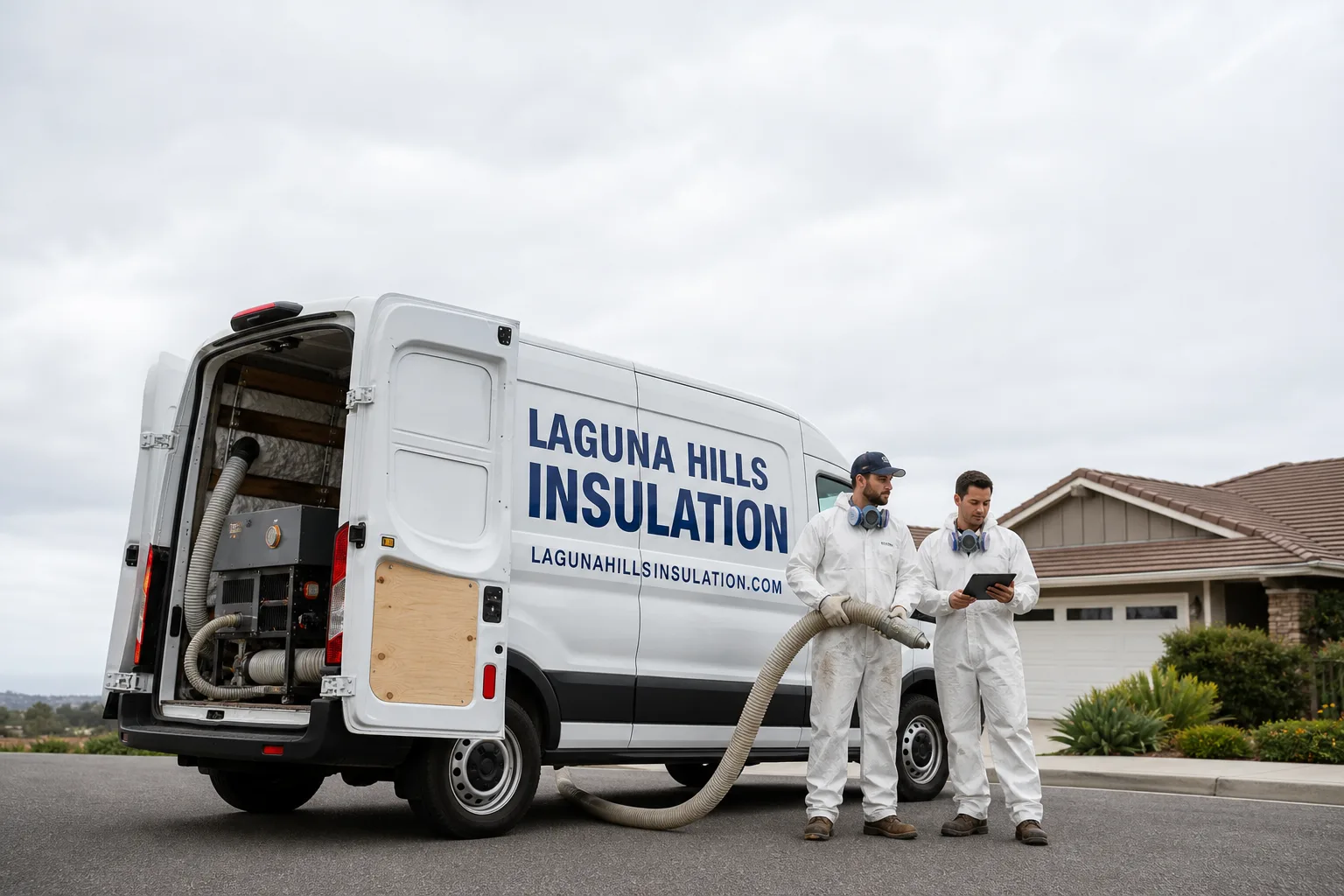
We know Downey’s streets, not just its ZIP codes. From the 1950s tract homes south of Firestone Boulevard to the post-war pockets around Stonewood Center and the original bungalows near the downtown core, our crews work here regularly. When you call us for attic insulation in Downey, you get a team that understands what a 1958 three-bedroom with a low-pitch roof actually looks like from the inside, the tight scuttle, the knee walls, the original mineral wool mat that has turned to dust. We respond to Downey homes and properties within a standard scheduling window, and we carry the equipment to work with the access constraints these houses create. If your attic needs help this week, call (866) 393-6041 and ask for Garrett.
Why Laguna Hills Insulation Is Downey’s Preferred Attic Insulation Company
Downey homeowners call us because we stock a material range most local insulation contractors do not. We are not pushing one product line. Our Attic Insulation team works with Owens Corning fiberglass, Johns Manville batts, Knauf blown-in material, and Rockwool mineral wool, and we carry GreenFiber cellulose for homes that benefit from a recycled-content fill. That means the solution gets matched to your attic, not to our inventory sheet.
We have also learned what Downey’s housing stock demands. A crew that mostly works newer subdivisions will not know how to feed a hose from the eave line on a 1957 ranch, but our people do it routinely. The same goes for attic mold removal in Downey, so many of these homes have decades-old bathroom fan exhaust venting into the attic, and we see the results often enough that it is part of our standard inspection checklist.
Garrett Lund runs the work personally. He has spent enough time in Downey attics to quote accurately before we even open the scuttle, and he will tell you honestly when a cheaper top-up will work and when you need full attic insulation removal first.
Attic Mold Removal in Downey
Attic mold removal in Downey is a recurring need in homes built before bathroom exhaust fans were actually vented to the exterior. In the 1950s and 1960s tracts around the 90241 and 90242 ZIP codes, builders often terminated bathroom fans directly into the attic cavity, which pushes warm, humid air into an already hot space. Over 30 or 40 years, that trapped moisture feeds mold on the underside of the roof sheathing, particularly in the shaded north-facing roof planes that never fully bake dry. We handle attic mold removal as a physical removal process, not a chemical fog-and-hope job. Moldy insulation and contaminated surfaces get pulled, disinfected, and treated before new insulation goes back in. In Downey, attic mold removal combined with insulation replacement typically runs $3,200 – $6,400 depending on attic size and severity.
Heavy Mold on Roof Sheathing
When mold has penetrated the wood sheathing, surface cleaning is not enough. We remove the affected insulation, treat the sheathing with a proper fungicidal process, and address the moisture source, which in Downey is almost always a vented fan, an unsealed scuttle, or a missing attic vent.
Mold in Old Fiberglass Batts
Fiberglass itself does not feed mold, but the paper facing on old batts does. Once moisture gets into the facing, the whole batt becomes a contamination source. In a low-pitch Downey attic, pulling those batts through the scuttle is often more labor-intensive than blowing new material in, and that affects the price. Expect batt removal in tight-clearance attics to add $400 – $900 to the job scope.
Attic Insulation Removal in Downey
Attic insulation removal in Downey is not just about mold. Many original attics here have degraded mineral wool or cellulose that has settled to R-2 or worse, and in some of the older 1920s – 1940s bungalows near downtown, the original insulation is so compacted or pest-damaged that adding new material on top simply hides the problem. We recommend full attic insulation removal when the old material is wet, moldy, infested, or so settled that it is no longer performing. In Downey, full attic insulation removal and replacement on a standard 1,000-square-foot attic typically runs $2,900 – $5,200, with larger attics or difficult access pushing toward the upper end.
Rodent and Pest Soiling in Older Downey Homes
Rodents love attics in older tracts, especially the ones with gable vents or gaps at the eave line. If your Downey attic has visible droppings or urine staining in the insulation, removal is the correct call. Leaving it and blowing over it does not fix the problem, and it keeps contaminant particles circulating through your HVAC system.
Replacing Settled and Compressed Material
Some Downey attics have original insulation that is still dry but so compressed it is effectively a thin mat. Topping those attics can work if the material is clean, but if the old layer blocks airflow or hides duct leaks, removal gives you a clean start. We will tell you which path makes sense for your specific attic.
Trusted Brands We Service in Downey
We install materials from Owens Corning, Johns Manville, Knauf, Rockwool, and GreenFiber, and our techs are trained across all of them. For Downey homeowners, that means we can compare a Rockwool mineral wool batt upgrade against a GreenFiber blown-in cellulose fill and give you a straight answer on which performs better in your attic. We do not stock one brand and force it onto every job. We also work with Icynene and Demilec for open-cell and closed-cell spray foam when an attic has complex geometry or the homeowner wants air sealing and insulation in a single application. The right insulation for your Downey home, not just the easiest one to install.
Common Attic Insulation Problems We See in Downey Homes
- Batts compressed into a low-pitch attic. In Downey tract homes, the roof deck is close to the ceiling joists. When someone shoves unfaced batts into that space, the batts compress against the deck and lose their rated R-value. We see attics where a stated R-30 is really performing at R-15 because the material is pinched into a 4-inch cavity.
- Original R-2 or R-4 mineral wool doing almost nothing. Most of these houses were built before Title 24 energy rules existed. The original material is thin, settled, and often looks like dust. Topping it without addressing duct leaks and radiant-heat paths keeps the house hot regardless of added depth.
- Uneven eave-fed blown-in coverage. When installers feed blown-in material from the eave line in a low-pitch attic, coverage near the knee walls and the scuttle can be thin. Over the hottest part of a slab tract home’s ceiling, that thin spot becomes a hot strip running through the middle of the living room.
- Stucco wall cavities with no insulation at all. Many 1950s Downey homes were built with empty wall cavities. The stucco skin makes retrofitting wall insulation more involved, because it requires drilling through the stucco from the exterior or cutting from the interior and patching. It is not impossible, but it is a different method than a wood-siding city like Norwalk would need.
Pricing for Attic Insulation in Downey, CA
Here is what we actually charge in the Downey market. A standard 900 – 1,200 square foot attic with blown-in fiberglass or cellulose runs $2,100 – $3,400. Attic insulation top-up, where the old material is clean and we are adding depth, runs $1,300 – $2,200. Full attic insulation removal and replacement runs $2,900 – $5,200, and that range includes the disposal and access work these low-pitch attics need. Attic mold removal combined with insulation replacement runs $3,200 – $6,400 depending on severity. Attic baffles and ventilation prep, which we recommend on most Downey retrofits, adds $350 – $800. The factors that move your price: attic square footage, access clearance, whether old material needs removal, and whether you want air sealing at the same time. Call (866) 393-6041 for a free estimate; we quote before we schedule, and we do not add surprise line items after we open the scuttle.
We Also Serve Cities Near Downey
Our crews work throughout the area around Downey, including Bell Gardens, Santa Fe Springs, Paramount, and Pico Rivera. If you are in one of those cities and need attic insulation, we bring the same material range and the same understanding of mid-century Southern California construction to your job.
Serving Downey, CA — Our Local Coverage Area
We’re based in the Downey area and know this community well. Use the map below to see our service coverage — if you’re nearby, we can almost certainly help.
FAQs About Attic Insulation in Downey
Because the attic is not the only heat path. In a Downey post-war tract home, the ceiling is only one surface that radiates heat into the rooms. Uninsulated duct runs running through a 140°F attic add heat directly to the air you are paying to cool, and unsealed gaps around can lights, wiring penetrations, and the scuttle let that hot air filter down. Adding insulation depth without sealing ducts and air leaks is like putting a lid on a pot that has three holes in the bottom. We find this pattern on nearly every 1950s home we inspect in the 90241 and 90242 areas. The fix is insulation plus air sealing plus duct work in the attic, and that combination typically brings the afternoon temperature in upstairs rooms down by 5°F to 10°F. Call (866) 393-6041 and we will tell you what is actually going on in your attic.
Usually not, and we will tell you that honestly. In most original low-pitch Downey attics, the scuttle opening is 22 inches by 30 inches at best, and the area near the eave line has too little vertical clearance to maneuver a 48-inch batt into position without compressing it. Compressed batts lose R-value, so you end up paying for an R-30 that performs like an R-15. Blown-in material, either fiberglass or cellulose, gets delivered through a hose and fills the space evenly, and that is why blown-in is the standard method for these houses. If you have a larger, newly built attic with full clearance, batts can work well. We stock both methods and will tell you which fits your attic.
The stucco matters when the project extends beyond the attic itself. Downey’s post-war housing is largely stucco-over-wood-frame on slab, and most of those wall cavities were built empty. If you want to insulate the walls as well as the attic, we have to drill through the stucco from the exterior at each stud bay, blow in the insulation, then match the stucco patch to the existing texture. A wood-siding home in a neighboring city does not have that same patching constraint. It is not a reason to skip wall insulation, but it is a reason to choose a crew that has done the stucco drilling and matching work before. We have.
Remove it when it is wet, moldy, infested, or so settled it has stopped performing. In Downey, we see all four. Wet or moldy material usually traces back to a bathroom fan vented into the attic or a roof leak. Rodent-soiled insulation is common in older tracts with gable vents or eave gaps. And in the 1920s – 1940s bungalows near the downtown core, original insulation is often so compacted it is doing almost nothing. If the old material is dry, clean, and just under-depth, a top-up works fine and costs less. We will tell you which path fits your attic, even when the cheaper option is not removal.
It affects the method more than the timeline. A tight scuttle means we cannot carry a full stack of batts into the attic, so we feed material through a hose from the eave line or the scuttle itself. That does not add much time to the job, but it does require the right equipment and a team that has done it before. Alley access in some of the 1950s tracts can limit where we stage the insulation machine, and we have learned to work around that by using longer hose runs and smaller staging footprints. A typical Downey attic insulation job runs one full day, start to finish, and we schedule around your availability.
Written by Garrett Lund, Owner at Laguna Hills Insulation, serving Downey since day one with material-agnostic insulation work across all three methods.