
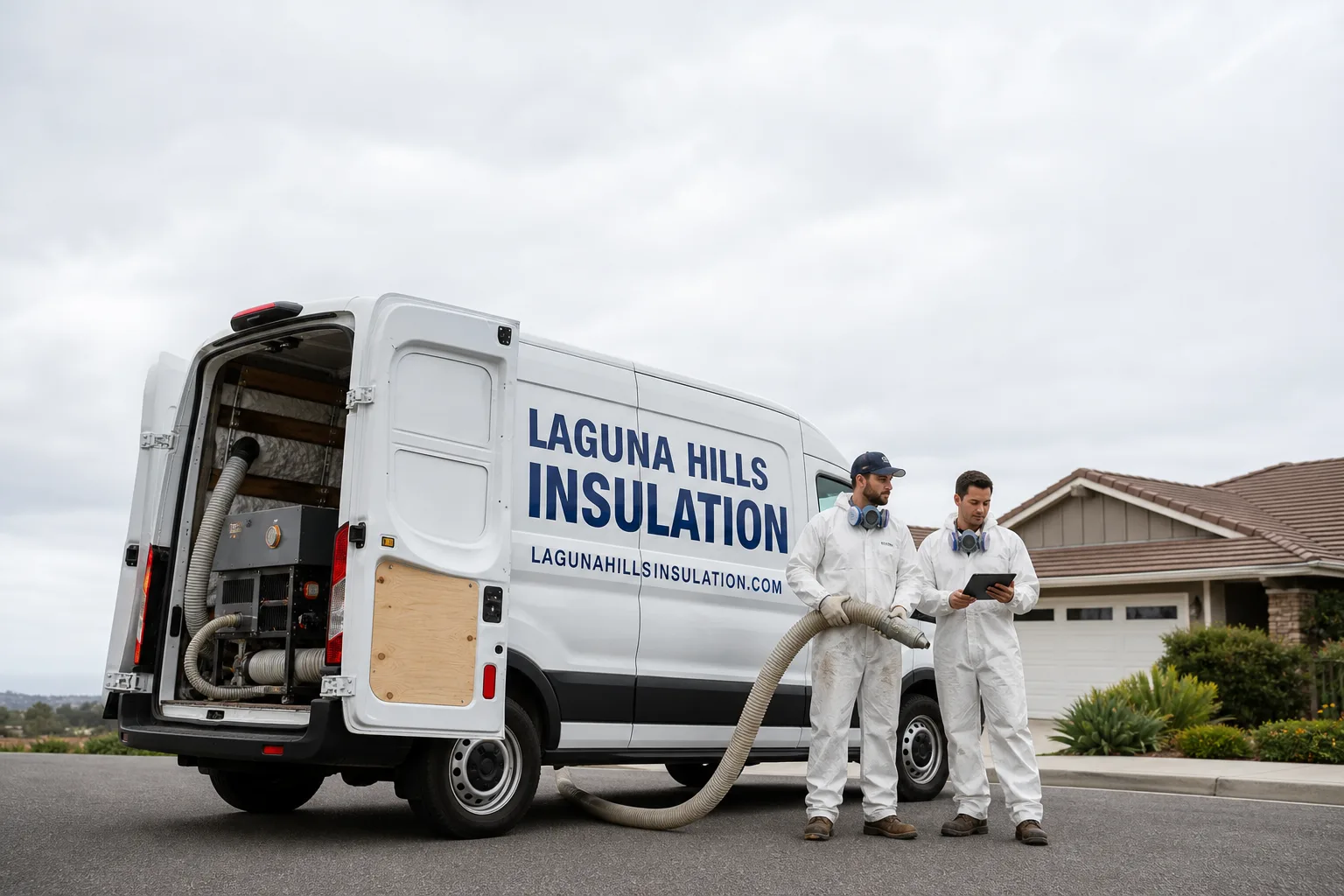
Fast, Reliable Attic Insulation Across Pico Rivera
Attic insulation in Pico Rivera costs between $1,800 and $4,600 for a full retrofit, and most jobs take one to two days when you’re working with a crew that knows the older tract stock here. We’re not talking about a quick batt toss in a new build. Pico Rivera’s 1950s and 1960s stucco homes have specific failure points that newer suburbs never see, and diagnosing them correctly is the difference between a house that finally cools down and one that keeps baking every August. Call us at (866) 393-6041 and we’ll walk the attic with you, find exactly what’s wrong, and quote the repair honestly.
Why Laguna Hills Insulation Is Pico Rivera’s Preferred Attic Insulation Company
We’ve spent enough time in Pico Rivera attics to know the housing stock block by block. The tract homes near the Whittier Boulevard corridor, the postwar stucco boxes off Rosemead Boulevard, the mid-century ranches west of the San Gabriel River – they all share the same original sins: thin legacy batts that have collapsed to near zero R-value, uninsulated frame walls behind the exterior stucco, and undersized aluminum attic vents that choke airflow. Homeowners here tell us the same story: the AC runs all afternoon, the east-facing bedrooms still swelter, and the attic feels like an oven by 2 p.m. We’ve fixed hundreds of these attics, and the solution is rarely just blowing in more fiberglass.
When you call, you talk to people who’ve actually worked in Pico Rivera’s attics, not a call center routing a generic crew. Garrett Lund runs our insulation work, and he’s the one making material calls on the ground – which is why you’ll get a straight answer about whether your home needs air sealing, wall-cavity blow-in, or an attic vent upgrade before we ever quote a batt. That matters on older tract homes where skipping one step means you’ll still feel the heat bleeding through the walls at 4 p.m.
Insulation Contractors in Pico Rivera
Insulation contractors in Pico Rivera are doing predominantly retrofit work, not new construction. The 1950s through 1970s tract homes that dominate this city were built when energy was cheap and building codes barely mentioned insulation. What that means for you: the original attic insulation, if it exists at all, has likely settled, collapsed, and lost most of its R-value, and the exterior stucco walls are often empty cavities with no thermal barrier whatsoever. We don’t just patch what’s there – we diagnose the full envelope and fix the whole problem.
Retrofit Specialists, Not New-Construction Subs
A fair number of insulation companies in the basin spend their week on new housing tracts in the Inland Empire. We spend ours in Pico Rivera’s existing attics, where the access is tight, the framing is 2×4, and the existing vents are low aluminum units that were undersized even in 1962. That’s a different skill set. It means knowing how to drill and patch stucco without leaving a visible scar, how to navigate a trussed attic with limited headroom, and how to seal a ceiling plane that’s full of old can lights and bathroom fan penetrations. If a contractor’s quote assumes a clean, empty attic, you’re getting a number that won’t hold once they open the hatch.
Attic Assessments That Look at the Whole House
We won’t quote insulation without looking at the full picture: the attic floor, the wall cavities, the existing vent placement, and the condition of the ceiling plane. On a Pico Rivera tract home, that usually means identifying where the original batt ends and the empty wall cavity begins. A full attic assessment with thermal imaging and a written scope of work is part of our free estimate. If you’re comparing bids, ask the other contractor whether they’re including air sealing and wall-cavity blow-in – if they’re not, the numbers aren’t comparable.
Attic Ventilation in Pico Rivera
Attic Ventilation in Pico Rivera is often the missing piece when an older tract home gets new insulation and still doesn’t cool down. The low aluminum-framed attic vents that came standard on these 1950s and 1960s homes were built to a different standard – one that didn’t account for 100-degree inland summer days or the Santa Ana wind events that push heat into every gap. If your attic can’t move air, the new insulation just traps the heat and bakes the ceiling below. We regularly see homes where the attic temperature is 40 degrees hotter than it needs to be purely because the venting is undersized or blocked.
Vent Replacement and Airflow
Many Pico Rivera attics we enter have vents that are simply too small for the square footage, or so old that the screens have clogged with dust and the louvers have seized. We can replace those with properly sized ridge and soffit venting, or add powered ventilation where the roof design calls for it. The goal is to move enough air through the attic that the roof deck stops radiating heat into the living space by mid-afternoon. On east-facing tract homes, where the sun hits the roofline hardest from morning through afternoon, this is usually the single highest-return fix you can make alongside insulation.
Baffles and Ceiling Plane Sealing
Before we blow in new insulation, we check that vent air actually flows from the soffit areas up to the roof vents. In older Pico Rivera homes, insulation has often been pushed into the soffit spaces, completely blocking intake airflow. We install baffles in every rafter bay that needs them, then air-seal the ceiling plane – all the can lights, wall top plates, chase penetrations, and bathroom fan housings – before adding insulation. Skipping that step is how you end up with a well-insulated attic that’s still hot and humid. We don’t skip it.
Trusted Brands We Service in Pico Rivera
We don’t push a single product line. That’s the whole point of working with us. We install Owens Corning and Johns Manville fiberglass, GreenFiber cellulose, and Demilec spray foam – three fundamentally different material strategies that solve different problems in a Pico Rivera attic. For a collapsed legacy batt that needs a full replacement, blown-in GreenFiber gives you even coverage and a higher R-value per inch than fiberglass batts, plus it’s made from recycled material if that matters to you. For wall cavities behind stucco, closed-cell Demilec foam gives you air sealing and a thermal break in a single application. For a straightforward top-up over existing insulation, we’ll use the product that makes sense for your existing depth and venting. We stock the local Pico Rivera jobs and can usually start within a few days of your quote.
Common Attic Insulation Problems We See in Pico Rivera Homes
- Collapsed legacy batts in the attic floor. The original 1950s fiberglass batt insulation on these tract homes has settled to less than half its installed R-value. We regularly find dust-filled fiberglass mats that have compressed to R-4 or less when they should be R-38 or higher. The fix is a full removal or a dense blown-in top-up over what’s there.
- Uninsulated frame walls behind exterior stucco. This is the signature Pico Rivera problem – the stucco looks fine from the street, but the 2×4 wall cavities behind it are empty. Heat pours through all afternoon. The fix is drill-and-blow wall-cavity retrofitting, patched and color-matched so you can’t tell we were there. Without it, attic insulation alone won’t solve your cooling problem.
- Low aluminum attic vents restricting airflow. The original vents on these homes were undersized and often face the wrong direction. They plug with dust, the louvers seize, and the attic turns into a solar oven. We see temperature differences of 30 to 40 degrees between properly vented attics and the old aluminum-vent setups on the same block.
- East-facing ceiling planes absorbing afternoon sun. The east side of a Pico Rivera tract home takes morning to mid-afternoon sun straight on the roofline, and the heat works its way down through the ceiling by dinner. The fix is usually a combination of air sealing, better venting, and a higher-density insulation layer directly over the hottest rooms.
Pricing for Attic Insulation in Pico Rivera, CA
A straightforward attic top-up over existing insulation on a 1,200-square-foot Pico Rivera tract home typically runs $1,200 to $2,200. Full removal of collapsed legacy batts and replacement with blown-in GreenFiber or fiberglass runs $2,400 to $4,000 depending on attic access and ceiling plane complexity. Drill-and-blow wall-cavity retrofitting for those uninsulated stucco walls runs $4 to $8 per square foot of wall area, and a vent replacement package with baffles and air sealing runs $800 to $1,900. If you’re getting a quote that’s dramatically lower than those ranges, ask what’s being skipped – usually it’s the air sealing or the wall cavities. Call (866) 393-6041 for a free assessment and a line-item quote based on your actual attic, not a phone estimate.
We Also Serve Cities Near Pico Rivera
Our Attic Insulation crew covers the full Pico Rivera area and the surrounding communities. If you’re in West Whittier-Los Nietos, Montebello, Santa Fe Springs, or Bell Gardens, we work there regularly and know the same mid-century tract stock well. Attic Insulation in Pico Rivera is our core coverage area, but the same crew and the same material-agnostic approach extend to nearby zip codes without any change in pricing or response time.
Serving Pico Rivera, CA — Our Local Coverage Area
We’re based in the Pico Rivera area and know this community well. Use the map below to see our service coverage — if you’re nearby, we can almost certainly help.
FAQs About Attic Insulation in Pico Rivera
Your Pico Rivera attic needs air sealing and proper venting before insulation works, because the 1950s and 1960s tract homes were built with unsealed ceiling planes and undersized aluminum vents. New batts alone will trap heat and push cooling load into your living space. A complete job includes baffles at the soffits, ceiling plane air sealing around every penetration, and vent replacement where the original units are too small. Call (866) 393-6041 for a full assessment.
Yes, drill-and-blow retrofitting is a routine part of our Pico Rivera work. We drill small holes through the exterior stucco at each wall stud bay, blow in dense-pack insulation, and patch the holes with color-matched stucco repair compound. Done correctly, the house looks untouched from the street, and the wall cavity goes from zero R-value to an R-13 or better. This is the most common retrofit we do on Pico Rivera tract homes, because most were built with empty wall cavities behind the exterior stucco.
In most cases, yes. Those original low-profile aluminum vents are undersized and often blocked with years of dust, which is why the attic bakes in the summer sun. Replacing them with properly sized ridge and soffit vents, or adding powered ventilation, drops attic temperatures by a measurable 30 to 40 degrees. It’s one of the highest-return fixes you can make on a Pico Rivera tract home before or alongside insulation.
Because the east-facing roofline takes direct sun from early morning through mid-afternoon, and in Pico Rivera’s inland basin climate the radiant heat works straight through the roof deck into the attic and then down through the ceiling. If the attic insulation is collapsed and the walls are uninsulated, the heat has no resistance. The fix is a combination of dense insulation over those rooms, better attic venting, and air sealing the ceiling plane. Give us a call at (866) 393-6041 and we’ll pinpoint the exact issue.
Yes, and it’s typically the highest-payback energy improvement you can make on a 1960s tract home in Pico Rivera. Most of these houses have collapsed legacy batts and empty wall cavities, which means they’re losing heated and cooled air through the entire envelope. A full retrofit – attic insulation plus wall-cavity blow-in plus venting – typically cuts cooling costs noticeably in the first summer and makes the east-facing bedrooms livable again. For an exact quote on your home, call (866) 393-6041.
Written by Garrett Lund, Owner at Laguna Hills Insulation, serving Pico Rivera and the surrounding basin communities.