
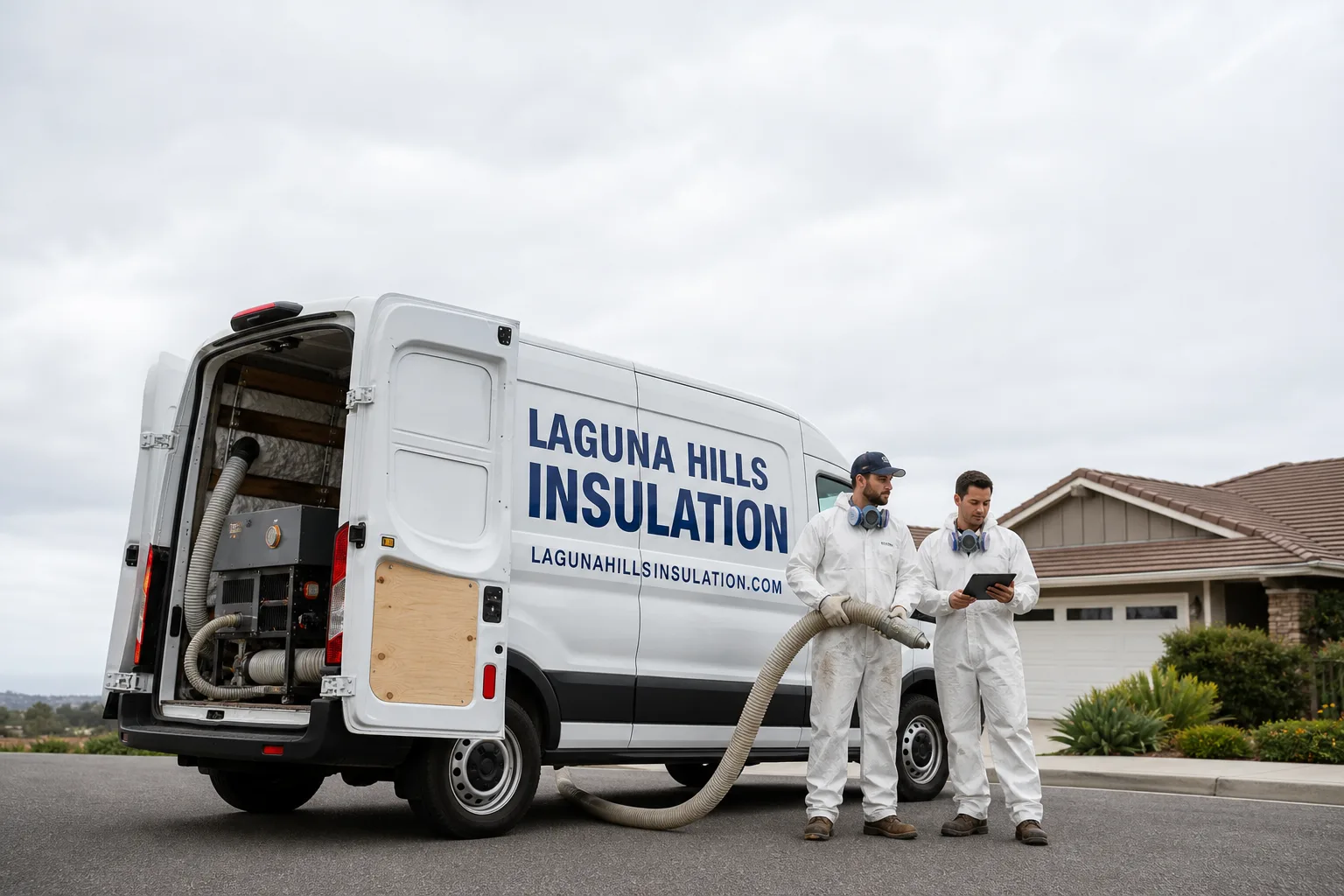
Fast, Reliable Attic Insulation Across Costa Mesa
Attic insulation in Costa Mesa runs $1.45 to $3.90 per square foot for blown-in fiberglass or cellulose, and $2.80 to $6.50 per square foot for spray foam. Most homes in the 92626, 92627, and 92628 ZIP codes are done in a single day. Call (866) 393-6041 and we’ll be straight about what your attic actually needs – which in Costa Mesa is often venting and moisture correction before more R-value.
We know the split personality of Costa Mesa’s housing stock. On the west side, we’re working in 1950s bungalows with shallow attics and decades of marine-layer damp. East of the 55, we’re retrofitting 1970s tract homes with low-slope ceilings that make conventional batt work a headache. Different houses, different approaches – same goal of an attic that stays dry and performs year-round.
Why Laguna Hills Insulation Is Costa Mesa’s Preferred Attic Insulation Company
Costa Mesa homeowners call us because we carry eight manufacturer brands instead of pushing one product line. That matters here. A 1956 Westside bungalow with a damp decking problem needs a different solution than a 1974 tract home off Baker Street with cathedral ceilings. We install Owens Corning and Johns Manville fiberglass, Rockwool mineral wool, GreenFiber cellulose, and Icynene or Demilec spray foam – and we’ll tell you honestly which one fits your roof geometry and moisture profile.
Garrett Lund built this company around a simple idea: the right material wins the job, not the easiest upsell. That’s why our crews show up in Costa Mesa with full-method capability – Attic Insulation by blown-in, batt, or spray foam, all performed in-house. When you call (866) 393-6041, you talk to someone who can explain the difference between R-38 fiberglass and closed-cell foam’s air-sealing benefits without glossing over the trade-offs.
Our response time to Costa Mesa runs same-day in most cases and next-day at the latest for 92627 and 92626. We’re not down the street, but we’re close enough that the marine layer hasn’t burned off before we’re on site. And because we stock materials across eight brands, we don’t need to quote you on something we don’t actually have in the warehouse.
Insulation Contractors in Costa Mesa
Insulation Contractors in Costa Mesa handle a specific set of challenges that inland cities don’t deal with, starting with marine-layer moisture that keeps attic decking damp from late spring into July. The job here isn’t just about heat retention – it’s about air sealing, vapor management, and venting correction before insulation goes in. A typical attic insulation project in Costa Mesa runs $1,850 to $6,400 depending on square footage, access, and whether existing material needs removal first.
Blown-In Retrofits for Older Attics
On the Westside’s 1950s tracts, blown-in fiberglass or cellulose goes in fast over existing decking once we’ve cleared the venting. Attics here are shallow and tight, so we work with hose-fed systems that reach where batt rolls can’t. Expect $1.55 to $2.80 per square foot.
Cathedral and Low-Slope Ceiling Work
East side 92626 homes with vaulted or low-slope ceilings leave almost no attic cavity. Spray foam from Icynene or Demilec is often the only viable material for these geometries because it expands into the cavity and air-seals in one pass. That work runs $3.50 to $6.50 per square foot. Costa Mesa has enough of these ceilings that we keep foam crews scheduled here weekly.
Attic Ventilation in Costa Mesa
Attic Ventilation in Costa Mesa deserves more attention than the insulation itself in many homes, particularly west of the 55 in 92627. The June Gloom keeps outdoor humidity pinned above 80 percent for weeks, and without proper soffit-to-ridge airflow, that damp air condenses against the decking and saturates whatever insulation is sitting on it. Soffit chute correction, ridge vent installation, and passive air channel retrofits typically run $950 to $3,800 depending on roof size and how much remediation is needed.
Soffit and Ridge Vent Correction
On mid-century bungalows with original plywood soffits, the intake vents are often blocked or painted over. We open the soffits, install baffled chutes, and confirm ridge or gable exhaust before any new insulation goes in.
Vapor Barrier and Air Sealing Prep
Before blowing insulation over a Westside attic, we air-seal top plates, can lights, and plumbing penetrations. That step cuts the damp-air chimney effect that turns batts into soggy mats by late June. It adds $400 to $1,200 depending on the number of penetrations.
Trusted Brands We Service in Costa Mesa
Through our work in Costa Mesa, we’ve built direct relationships with the manufacturers whose products actually hold up to this climate: Owens Corning and Johns Manville fiberglass, Rockwool mineral wool, GreenFiber cellulose, and Demilec spray foam. We keep local inventory staged for Costa Mesa jobs so a crew can pull material same-day without waiting on a distributor. The fiberglass and cellulose handle most vented-attic retrofits. The Rockwool earns its keep on Westside homes where fire resistance and moisture tolerance matter. Demilec closed-cell foam solves the cathedral-ceiling problem on the east side.
Common Attic Insulation Problems We See in Costa Mesa Homes
- Damp, compressed batts on Westside 92627 homes. The marine layer keeps decking wet from May through early July, and original 1950s batts settle into a thin crust that reads near-zero R-value despite the label still saying R-19. The fix is usually removal, air sealing, venting correction, and fresh blown-in material. On a 1956 bungalow off the 92627 grid, our crew pulled original mineral wool that had collapsed into a damp mat over furring strips. We air-sealed the top plates and can lights, rebuilt the soffit chutes, and blew in GreenFiber over a corrected vapor strategy. The decking dried out within two weeks and the homeowner’s summer cooling swings flattened out.
- Cathedral ceilings in 92626 leaving no venting path. When a 1970s tract home has insulation trapped against the underside of the roof deck with no air channel, marine-layer humidity condenses right inside the assembly. Spray foam from Icynene applied directly to the decking turns the roof into an unvented, air-sealed system that sidesteps the condensation problem entirely.
- Blocked or undersized soffit and ridge vents. Adding R-38 over attics with no working intake or exhaust just traps more moisture. We’ve pulled fresh faced batts out of Costa Mesa attics that were already growing dark staining after one wet season because the venting never got corrected.
- Santa Ana heat exposing thin or settled insulation. When the dry, hot winds blow in from the desert in September and October, attics that were “good enough” during the marine-layer months hit 140 degrees and send heat straight through ceilings. Blown-in top-ups to R-38 or R-49 close the gap fast.
Pricing for Attic Insulation in Costa Mesa, CA
A typical blown-in attic insulation job in Costa Mesa runs $1,850 to $4,200 for a 1,200 to 1,800 square foot home. Batt insulation replacement lands between $1,800 and $5,200 depending on whether old material has to be bagged and removed. Spray foam retrofit work on cathedral ceilings runs $4,200 to $11,800. Attic top-ups – blowing fresh material over existing, dry insulation – start around $1,200 for the average 92627 bungalow. Venting correction and air sealing add $400 to $3,800. Call (866) 393-6041 for a free estimate with exact numbers, not a ballpark range.
We Also Serve Cities Near Costa Mesa
Our Costa Mesa crews regularly work Newport Beach, Fountain Valley, Huntington Beach, and San Joaquin Hills. Each has its own microclimate quirks – Newport and San Joaquin Hills deal with more direct ocean fog, while Fountain Valley and Huntington Beach run a few degrees warmer inland. Same-day response applies to all of these areas.
Serving Costa Mesa, CA — Our Local Coverage Area
We’re based in the Costa Mesa area and know this community well. Use the map below to see our service coverage — if you’re nearby, we can almost certainly help.
FAQs About Attic Insulation in Costa Mesa
Because the marine layer keeps attic decking damp from late spring through early July, and adding insulation over an unvented attic just traps that moisture against the roof sheathing. Your 1950s home in 92627 likely has original soffit vents that are blocked, undersized, or painted shut. We correct the ventilation and air sealing first, then blow in fresh material – otherwise the new insulation becomes a sponge. Call (866) 393-6041 and we’ll come assess your attic airflow before quoting anything.
Yes. Fiberglass and mineral wool absorb moisture, compress, and lose thermal performance when exposed to weeks of 80 percent humidity with no airflow. We’ve pulled batts from Costa Mesa attics that read R-5 instead of R-19 because they’ve been sitting damp every late spring for twenty years. Rockwool and GreenFiber cellulose both tolerate humidity better than standard fiberglass, which is why we stock them for Westside retrofits.
You can, but it usually means spray foam rather than blown-in material. A cathedral ceiling in a typical 92626 tract home has no accessible attic cavity to blow into. The solution is closed-cell or open-cell spray foam applied to the underside of the roof deck – Icynene and Demilec both work – which insulates and air-seals in a single application. Expect that project to run $4,200 to $11,800 depending on the roofline.
We install Owens Corning and Johns Manville fiberglass, Rockwool mineral wool, GreenFiber cellulose, and Icynene and Demilec spray foam, depending on the attic geometry and moisture profile. A vented attic on the Westside with corrected airflow handles blown-in cellulose or fiberglass fine. A damp, shallow attic benefits from Rockwool’s moisture resistance. A cathedral ceiling in 92626 calls for spray foam. We’ll recommend the material that actually fits your house. Call (866) 393-6041 for a straight answer.
If your current insulation is dry, uncompressed, and you’ve verified the venting works, a top-up is enough – $1,200 to $1,800 for most Costa Mesa homes. If it’s compressed, damp, or stained from marine-layer condensation, removal and fresh blown-in material is the honest fix. If you have a cathedral ceiling with no cavity at all, retrofit means spray foam. The call is easy once someone’s actually looked in the attic – which takes us about twenty minutes. Estimates are free.
Call (866) 393-6041 and our team will walk you through what your Costa Mesa attic needs. Estimates are free, we answer the phone, and we’ll be straight about whether you need venting work, a material top-up, or a full retrofit.
Written by Garrett Lund, Owner at Laguna Hills Insulation, serving Costa Mesa with eight manufacturer brands and full-method attic, spray foam, and blown-in installation.