
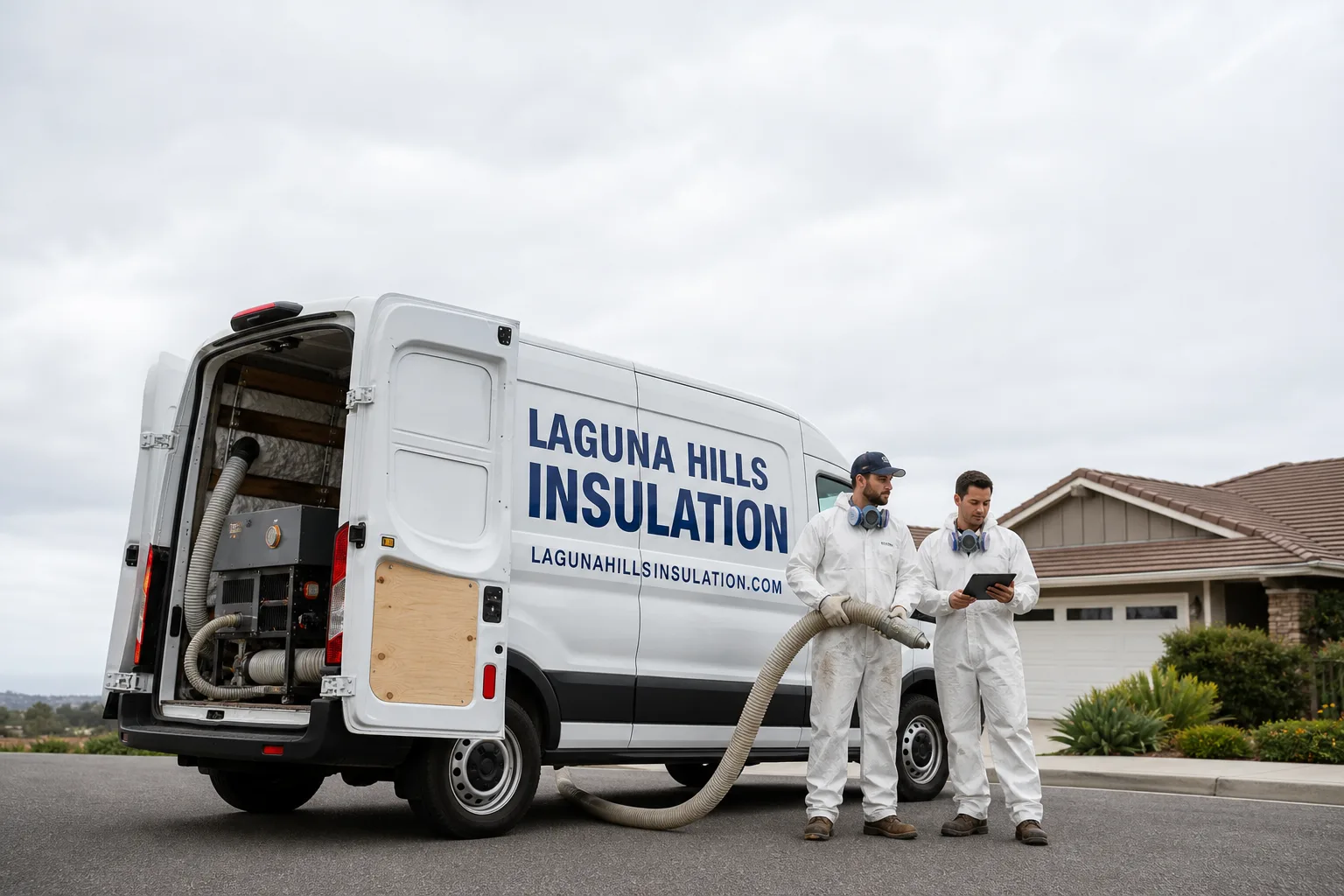
Fast, Reliable Attic Insulation Across Huntington Beach
Attic insulation in Huntington Beach is a corrosion-and-moisture problem split between two climates inside one city. Near the coast in 92648 and 92649, salt-laden fog rusts duct straps, staples, and foil facings years before the insulation’s thermal life actually ends. A few miles inland in 92646 and 92647, the same city bakes under dry summer heat that radiates down through under-vented attics. We design for both, because we’ve worked both sides of Beach Boulevard long enough to know they demand different strategies. Call us at (866) 393-6041 and we’ll tell you which side of Huntington Beach your attic actually lives in.
Why Laguna Hills Insulation Is Huntington Beach’s Preferred Attic Insulation Company
Our Attic Insulation crews work in Huntington Beach every week, and that repetition has taught us what generic insulation contractors miss: a bungalow near Main Street fights salt air while a tract home off Talbert Avenue fights heat, and the fix is not the same roll of fiberglass. We stock corrosion-resistant fasteners and stainless staples for fog-belt attics, and we carry radiant barrier products for the inland side. That range of material choices means we’re not locked into a single answer when we quote the job.
Garrett Lund, who leads our company, has built the business around being material-honest. If your 1960s stucco home near downtown Huntington Beach needs vapor management more than extra batts, that’s what we’ll recommend. If a radiant barrier in your 92646 attic is money better spent than blown-in top-up, we’ll tell you that too. Homeowners comparing multiple bids tend to remember the contractor who explained the what and the why, not the one who pushed the thickest estimate.
When you call (866) 393-6041, you’re talking to someone who knows that attic venting near the marine layer is a different animal than venting near the 405. That local fluency shows up in the quote, the material spec, and the finished attic.
Attic Ventilation in Huntington Beach
Attic Ventilation in Huntington Beach is the first thing we evaluate on any coastal attic job, because a vented attic in the 92648 fog belt behaves differently than one in the dry inland 92646 tracts, and both fail without enough airflow. The job involves assessing the existing soffit and roof vents, verifying that baffles are in place where insulation meets the eaves, and often adding ventilation before or alongside new insulation so the attic air actually moves. A typical attic ventilation upgrade in Huntington Beach runs $450 to $1,200 depending on vent type and roof configuration, though a full re-vent with new soffit work on an older bungalow can push toward $1,800.
Marine-Layer Moisture Control
Homes within a mile or so of the water in 92648 and 92649 live with a fog bank that rolls in most summer nights. That marine air condenses on a cool attic’s underside, and without proper airflow it soaks into fiberglass batts and matts them against the roof deck. Our ventilation-first approach means we pull the saturated insulation, fix the airflow path, and only then reinstall dry material.
Inland Heat Venting
Over in 92646 and 92647, the dominant problem is heat buildup in mid-century attics that were originally vented with a couple of small gable vents and nothing else. On July afternoons those attic spaces can hit 140 degrees, and the radiant load pushes straight through the ceiling into the living space. Upgrading to a balanced soffit-to-ridge system or adding powered attic ventilation drops that temperature and extends the life of whatever insulation sits below.
Radiant Barrier in Huntington Beach
Radiant Barrier in Huntington Beach is one of the few upgrades that pays off differently depending on exactly where you live, and we install it with that split in mind. On the inland side, a radiant barrier stapled to the underside of the roof rafters can drop attic temperatures by 20 to 30 degrees in summer, which is real money off your air conditioning load. On the fog-belt side, its value drops because you get fewer high-heat days, but it still helps in August when the marine layer burns off by noon. A typical radiant barrier installation in Huntington Beach runs $1,000 to $2,200 for an average 1,200 to 1,600 square foot attic, depending on access and rafter spacing.
Inland 92646/92647 Retrofit
Mid-century tract homes in the inland zones share a common attic profile: low ventilation, dark composition shingles, and afternoon sun with no fog to blunt it. A radiant barrier here addresses the heat source directly rather than trying to move all that hot air out. We usually pair it with attic ventilation upgrades for the strongest result.
Coastal 92648/92649 Flash-Heat Days
Near the beach, a radiant barrier is a lighter-touch addition. The marine layer keeps most summer days mild, but when Santa Ana conditions push temperatures into the 90s, an unvented or poorly vented attic still cooks. The barrier gives that attic some thermal defense without needing the full vent rework some older coastal homes would otherwise require.
Trusted Brands We Service in Huntington Beach
We install and service Owens Corning, Johns Manville, and Knauf products, and we keep a healthy stock of materials for Huntington Beach jobs so we’re not making you wait on a supply house in Irvine. Rockwool shows up often on coastal quotes because its moisture-resistant mineral wool stands up to the marine layer better than fiberglass in a fog-heavy 92648 attic. When you call us, we’ll tell you which brand actually fits your home’s conditions, not just whose truck is already loaded for the day.
Common Attic Insulation Problems We See in Huntington Beach Homes
- Rusted fasteners and failed foil in the fog belt. Standard staples and duct straps corrode in the salt air of 92648 and 92649, which causes batts to sag and delaminate off the roof deck years before their thermal value is spent. We replace them with stainless or corrosion-resistant hardware and spec moisture-tolerant facings.
- Damp, matted insulation on low-pitch roofs. Older bungalows near downtown Huntington Beach and along the coast have shallow attic cavities where the marine layer can’t be vented out fast enough. Condensation settles into the fiberglass and compresses it, killing the R-value.
- Overheated under-vented attics inland. Tract homes in 92646 and 92647 built in the 1950s and 1960s often have minimal venting and no radiant barrier. The underside of the roof bakes all afternoon, and the batts degrade faster on the hot side.
- Original 50s-era insulation that was never upgraded. Many Huntington Beach homes still carry their original 2-inch batts, which were rated around R-7 when new and have since settled to maybe R-4. That’s barely a thermal barrier by today’s standards, and it’s cheaper to replace than to keep stacking on top.
Pricing for Attic Insulation in Huntington Beach, CA
A full attic insulation replacement in Huntington Beach typically runs $1,800 to $3,600 for a 1,000 to 1,500 square foot single-story home, depending on material choice and how much old material needs to be pulled first. Blown-in fiberglass or cellulose top-ups usually land between $900 and $1,600. Batts of Rockwool mineral wool run higher, but on a fog-belt 92648 home they may be the only product that makes sense long-term. Access matters too: flat or low-pitch roofs common near downtown cost more per hour than an open attic off Adams Avenue. Call (866) 393-6041 for a free estimate, and we’ll quote the exact number for your address.
We Also Serve Cities Near Huntington Beach
Along with our Attic Insulation in Huntington Beach work, we run crews into Midway City, Fountain Valley, Westminster, and Costa Mesa on a regular basis. If you’re just outside the Huntington Beach city line, the same crew and the same material-agnostic approach apply. Call (866) 393-6041 and we’ll schedule you like any Huntington Beach job.
Serving Huntington Beach, CA — Our Local Coverage Area
We’re based in the Huntington Beach area and know this community well. Use the map below to see our service coverage — if you’re nearby, we can almost certainly help.
FAQs About Attic Insulation in Huntington Beach
Salt-laden marine fog is the culprit. The fog deposits salt on every metal surface in the attic, rusting staples, duct straps, and foil facings within five to ten years, while the same hardware inland in 92646 can go twenty years without visible corrosion. That corrosion lets batts sag and delaminate, which collapses their R-value. The fix is corrosion-resistant fasteners, stainless staples, and moisture-tolerant insulation products, which is what we install on every fog-belt job. Call (866) 393-6041 and we’ll assess what’s actually failing in your attic.
Yes, and this is the single biggest difference between a coastal attic job and an inland one. In 92648 and 92649, we run stainless staples and galvanized or coated duct straps as standard. Inland in 92646 and 92647, standard fasteners hold up fine, so we don’t burden the quote with hardware the home doesn’t need. It’s a detail most contractors never mention, but it determines whether your insulation is still hanging properly after five coastal summers.
Expect the old insulation to come out first. On these older Huntington Beach homes, the shallow attic cavity traps marine-layer condensation against the fiberglass, and by now it’s matted, musty, and doing almost nothing. We pull the saturated batts, correct the attic ventilation path, and reinstall with a moisture-tolerant product like Rockwool or fiberglass batts with corrosion-resistant fasteners. Most of these jobs run between $2,000 and $3,500 without new venting, and a bit more if we re-vent at the same time. Call (866) 393-6041 for an exact quote.
It makes more sense inland, but it still has a place on the coast. In 92646 and 92647, a radiant barrier under the roof deck can drop attic temperatures by 20 to 30 degrees in summer, which is a direct cut to your cooling load. In the fog belt of 92648 and 92649, you get fewer extreme heat days, but those August afternoons where the marine layer burns off still push attic heat into the house. We’ll tell you honestly if your specific block justifies the cost, and if it doesn’t, we’ll say so.
We install Owens Corning, Johns Manville, Knauf, and Rockwool, among others, and the coastal versus inland split often decides which one goes in. Rockwool mineral wool handles marine-layer moisture better than fiberglass, so it earns its higher price near the beach. Inland, a standard Johns Manville or Knauf batt or blown-in product does the thermal job at a lower cost. Call (866) 393-6041 and we’ll walk through the material options that fit your side of Huntington Beach.
Call Laguna Hills Insulation for Your Huntington Beach Attic
If your attic is a fog-belt corrosion story or an inland heat story, we can tell you which one before we ever climb the ladder. Call (866) 393-6041 for a free estimate, and we’ll quote the right materials for your Huntington Beach home without pushing the most expensive option just because it’s in the truck.
Written by Garrett Lund, Owner at Laguna Hills Insulation, serving Huntington Beach attic insulation, spray foam, and blown-in needs.