
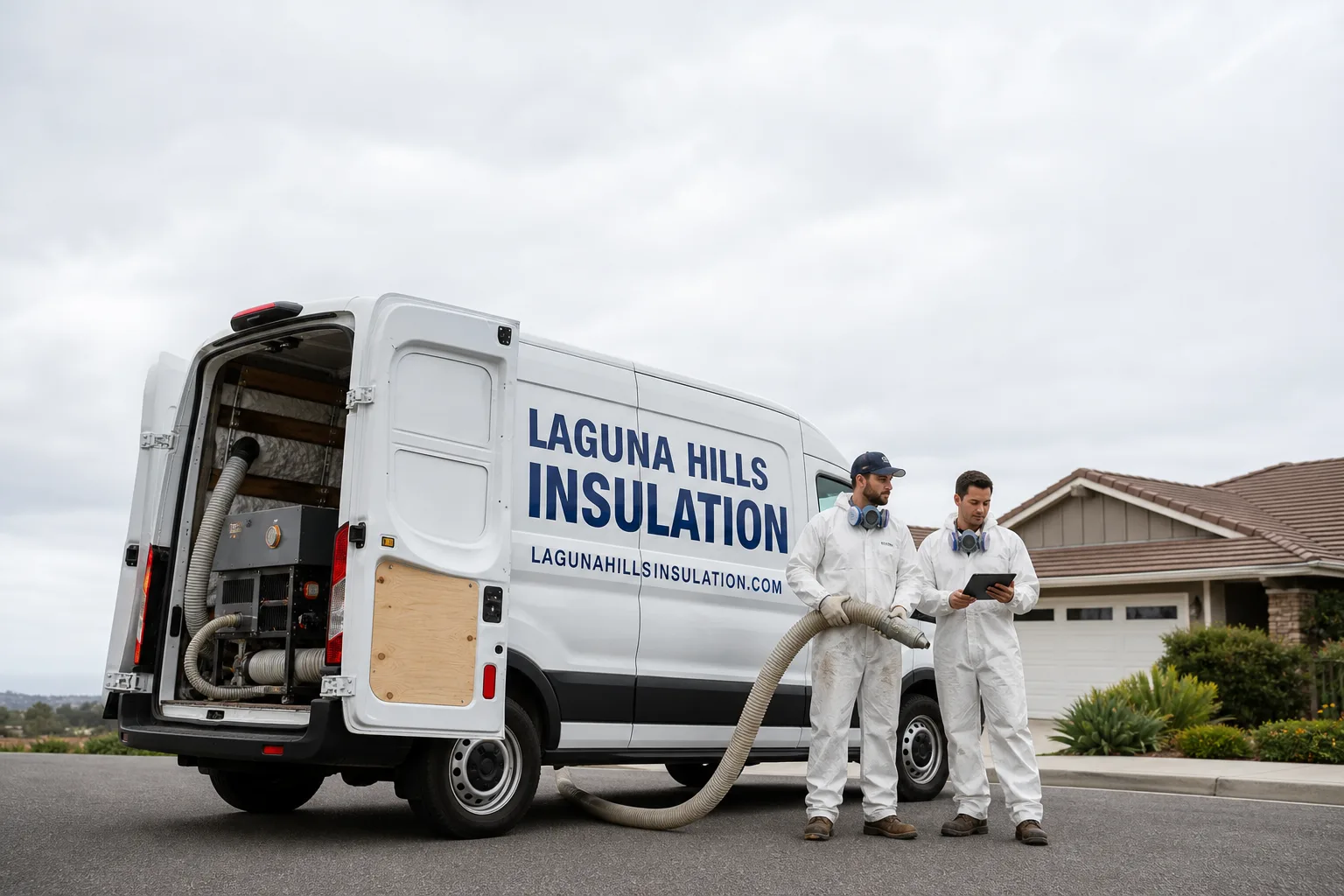
Attic Insulation in Anaheim: What It Costs and What Actually Works Here
Attic insulation in Anaheim is fundamentally a heat-gain problem, not a heat-loss one. Summer afternoons inland toward the hills push above 100°F, and attics in the older tracts routinely bake past 140°F without proper insulation and ventilation. A typical blown-in attic insulation job in Anaheim runs $1,800 – $3,200 for a 1,200 sq ft home, while attic insulation top-up work lands between $900 and $1,800. The right material choice here is driven by keeping cooling costs down, not trapping winter warmth. Call (866) 393-6041 for a free estimate from Attic Insulation specialists who know Anaheim’s housing stock block by block.
Fast, Reliable Attic Insulation Across Anaheim
We work in Anaheim every week, from the 1950s stucco tracts off West Broadway in 92805 to the larger two-story homes in the eastern hills of 92807. Our crews know what’s behind those attic hatches: thin original batts, bare joists, undersized gable vents, and duct runs leaking conditioned air into a 140°F space. We respond to Anaheim service calls typically within 24 – 48 hours, and we carry the materials your house actually needs, not just whatever’s on the truck. If you’re off Lincoln Avenue near the 5, or up toward Canyon Hills, we’ve been there. Call us at (866) 393-6041 and we’ll tell you honestly whether you need a top-up, a full replacement, or just better venting.
Why Laguna Hills Insulation Is Anaheim’s Preferred Attic Insulation Company
Most insulation contractors in Anaheim push one product line. We don’t. Garrett Lund built this company around a material-agnostic approach: eight manufacturer brands and three installation methods under one roof, so the right product wins the job, not the easiest upsell. Anaheim homeowners comparing bids respond to that honesty. We’ll tell you when blown-in fiberglass from Owens Corning makes sense for a shallow 1950s attic, or when Rockwool mineral wool is worth the premium for its fire resistance, or when closed-cell spray foam from Icynene is the only product that will actually solve a venting problem in a hillside custom home. We stock local parts and materials for fast Anaheim turnaround, and our crews know the difference between a 92804 tract house and a 92807 hillside build before they even open the attic hatch.
Attic Insulation Removal in Anaheim
Attic insulation removal in Anaheim is most common in the post-war stucco tracts of west and central Anaheim, where original 1950s batts have compacted, absorbed decades of dust, or been chewed through by rodents. The job involves vacuuming out the old material down to the deck, inspecting the joists and wiring, and prepping the space for new insulation. In Anaheim, removal typically runs $1.10 – $1.80 per square foot, so a 1,000 sq ft attic lands between $1,100 and $1,800 before new material goes in. You need removal when old insulation is wet, pest-damaged, or so thin it’s no longer doing anything. Call (866) 393-6041 and we’ll assess it honestly.
When Removal Beats a Top-Up
If your central Anaheim home still has its original 1950s batts and you add new blown-in fiberglass on top, you’re burying a problem. Compacted material doesn’t insulate, and whatever rodent activity or moisture issue exists underneath just keeps doing damage. We’ll tell you straight: sometimes removal is the only honest fix.
What Removal Involves
We bring a commercial vacuum system, seal off the attic access, and pull everything down to bare deck. Then we inspect the framing, wiring, and vents before any new material goes in. Anaheim’s dry climate means moisture issues are less common than in coastal towns, but pest damage in older tracts isn’t rare.
Insulation Contractors in Anaheim
Insulation contractors in Anaheim fall into two camps: single-line companies that install whatever they stock, and specialists who work across multiple material categories. We’re the second kind. When we walk a 92804 tract home, we’re checking R-value targets, attic depth, vent sizing, and whether the existing ductwork needs wrapping. That’s a different job than a 92807 hillside home where thermal bridging through the roof deck is the bigger issue. For Anaheim homes, a full attic insulation package including air sealing, blown-in material, and ventilation prep typically runs $2,800 – $5,500 depending on square footage and access. We’ll give you a precise number after a site visit, not a phone guess. Call (866) 393-6041 for a free estimate from contractors who actually know Anaheim’s housing stock.
What a Real Assessment Covers
We measure attic depth, check vent sizing, look for unsealed top plates and can lights, and test whether your duct runs are leaking conditioned air into the attic. In Anaheim’s shallow 1950s attics, air sealing matters as much as insulation. A perfectly insulated attic with leaking ducts still costs you cooling dollars.
Material Choice Isn’t a Guessing Game
Closed-cell spray foam from Icynene creates an air barrier and a thermal barrier in a single application. That’s sometimes the right call in a hillside Anaheim home with a complex roofline. But in a simple gable-roofed tract house, blown-in fiberglass from Owens Corning or Johns Manville at the right R-value often does the job for less money. We’ll tell you which one fits.
Trusted Brands We Service in Anaheim
We install materials from Owens Corning, Johns Manville, Knauf, and Rockwool across Anaheim. That matters because different houses need different things. Owens Corning blown-in fiberglass is a workhorse for west Anaheim tract attics. Rockwool mineral wool earns its price in fire-prone hillside zones. Knauf batts handle the straightforward jobs. We stock enough of these Anaheim-specific materials to keep turnaround fast, and we’ll name the product we’re recommending and why rather than just telling you it’s “good stuff.”
Common Attic Insulation Problems We See in Anaheim Homes
- Thin original 1950s insulation with no radiant barrier. West and central Anaheim tracts built in the 1950s through 1970s often still have their original thin batts or bare joists. On an inland-hot afternoon, those attics climb into the 140s, and the AC runs continuously without ever satisfying the thermostat.
- Undersized attic ventilation from the original build era. Those 1950s gable vents were sized for a different climate expectation. Radiant heat gets trapped under the decking, which degrades even newly installed insulation within a few summers.
- Unsealed top plates, can lights, and duct runs in shallow tract attics. Conditioned air leaks into a superheated attic space, so cooling dollars escape before insulation ever performs. Air sealing is the fix, and it’s the step most Anaheim retrofit jobs skip.
- No radiant barrier on west-facing roof planes. In Anaheim, a radiant barrier paired with proper ridge and eave venting can drop attic temperatures by 20 – 30°F on August afternoons. Most older Anaheim homes have none.
Pricing for Attic Insulation in Anaheim, CA
Blown-in attic insulation in Anaheim runs $1,800 – $3,200 for a typical 1,200 sq ft single-story tract home. Attic insulation top-up work lands between $900 and $1,800. Full replacement including removal of old material runs $2,800 – $5,500 depending on attic access and whether air sealing is included. Radiant barrier installation adds $1,200 – $2,400 on a standard Anaheim roof plane. The biggest cost variables are attic depth, access difficulty, and whether your vents need upgrading to actually exhaust heat. We give free, itemized estimates. Call (866) 393-6041 and we’ll walk you through exact numbers for your specific house, not a generic Anaheim average.
Why Anaheim’s Summer Heat Changes the Insulation Calculation
Anaheim sits in a coastal-influenced but inland Orange County climate. The coast is only about 10 miles away, but by the time you’re inland toward the hills around 92807, summer afternoons regularly hit the high 90s and August days push above 100°F. The warm, dry climate keeps moisture and freeze concerns low, so insulation decisions here center on heat gain, attic ventilation, and duct performance rather than cold-weather thermal resistance. That makes radiant barriers, proper eave and ridge venting, and duct wrapping genuinely more valuable in Anaheim than in a cooler California market. A homeowner in Orange or Fullerton might never think about attic temps; in Anaheim’s west-side tracts, it’s the difference between a west-facing bedroom that’s livable at 3 p.m. and one that isn’t.
Here’s the Anaheim-specific reality: in the 1950s-era stucco tracts of central Anaheim (92801, 92802, 92804, 92805), many attics still have only a thin original insulation layer or bare joists, and vents sized for the house’s 1950s build era. Summer attic temperatures climb into the 140s even though the beach feels close. Coastal-adjacent buyers often underestimate this. They assume “near the coast” means mild attic conditions. It doesn’t. The inland heat gain is real, and the fix is specific: air sealing, proper blown-in coverage, upgraded venting, and often a radiant barrier.
A Real Anaheim Job: West Broadway, 92805
On a post-war single-story tract off West Broadway in central Anaheim, our crew opened a shallow attic with thin original batts, bare joists between them, and small 1950s-era gable vents that left the deck baking past 140°F on an August afternoon. We air-sealed the top plates and can lights, added blown-in fiberglass over the joists, then paired a radiant barrier with new ridge and eave venting so the attic could actually exhaust that heat. The homeowner’s west-facing bedrooms stopped cooking by 3 p.m. and the AC stopped short-cycling through the evening. That’s the job we do over and over in Anaheim’s older tracts. If your house sounds like that one, call (866) 393-6041 and we’ll come look at it honestly.
We Also Serve Cities Near Anaheim
While this page focuses on Anaheim, our crews regularly work in Fullerton, Placentia, Orange, and Villa Park. The housing stock changes as you move around the county, but the heat-gain problem doesn’t disappear. If you’re in a nearby city and reading this, the same material-agnostic approach applies.
Serving Anaheim, CA — Our Local Coverage Area
We’re based in the Anaheim area and know this community well. Use the map below to see our service coverage — if you’re nearby, we can almost certainly help.
FAQs About Attic Insulation in Anaheim
Yes, in most cases. If your central or west Anaheim home still has its original 1950s batts or bare joists, removal runs $1.10 – $1.80 per square foot and gives us a clean deck to work from, plus a chance to inspect wiring and venting before new material goes in. Adding new insulation over compacted or pest-damaged old material buries the problem instead of fixing it. Call (866) 393-6041 for an honest assessment of your specific attic.
Anaheim’s inland position means summer afternoons push into the high 90s and above 100°F toward the hills, and 1950s-era attics with thin insulation and undersized vents trap that heat until the space hits 140°F or worse. Ten miles from the coast doesn’t matter when your attic has no radiant barrier and vents sized for a different era. The fix is better insulation coverage, upgraded venting, and often a radiant barrier.
Yes, more so. In Anaheim’s heat-gain climate, a radiant barrier paired with proper ridge and eave venting can drop attic temperatures by 20 – 30°F on August afternoons, which directly reduces AC runtime. That’s a meaningful payback in Anaheim, whereas in a cooler market the same product would be marginal. Expect to pay $1,200 – $2,400 for a standard Anaheim roof plane. Call (866) 393-6041 for a quote on your specific home.
We install materials from Owens Corning, Johns Manville, Knauf, and Rockwool, among others. The brand depends on your house: Owens Corning blown-in fiberglass is a workhorse for west Anaheim tract attics, Rockwool mineral wool earns its price in fire-prone hillside zones, and Knauf batts handle straightforward jobs. We’ll name the product and explain why it fits rather than just pushing whatever’s on the truck.
Anaheim’s dry summers mean moisture and freeze concerns are low, so the priority shifts entirely to heat gain, attic ventilation, and duct performance. You want insulation that resists heat transfer (higher R-value per inch helps in shallow tract attics), vents that actually exhaust superheated air, and a radiant barrier on west-facing roof planes. That’s a different specification than a humid or cold climate would demand.
Written by Garrett Lund, Owner at Laguna Hills Insulation, serving Anaheim’s attic insulation needs with a material-agnostic approach across eight manufacturer brands.