
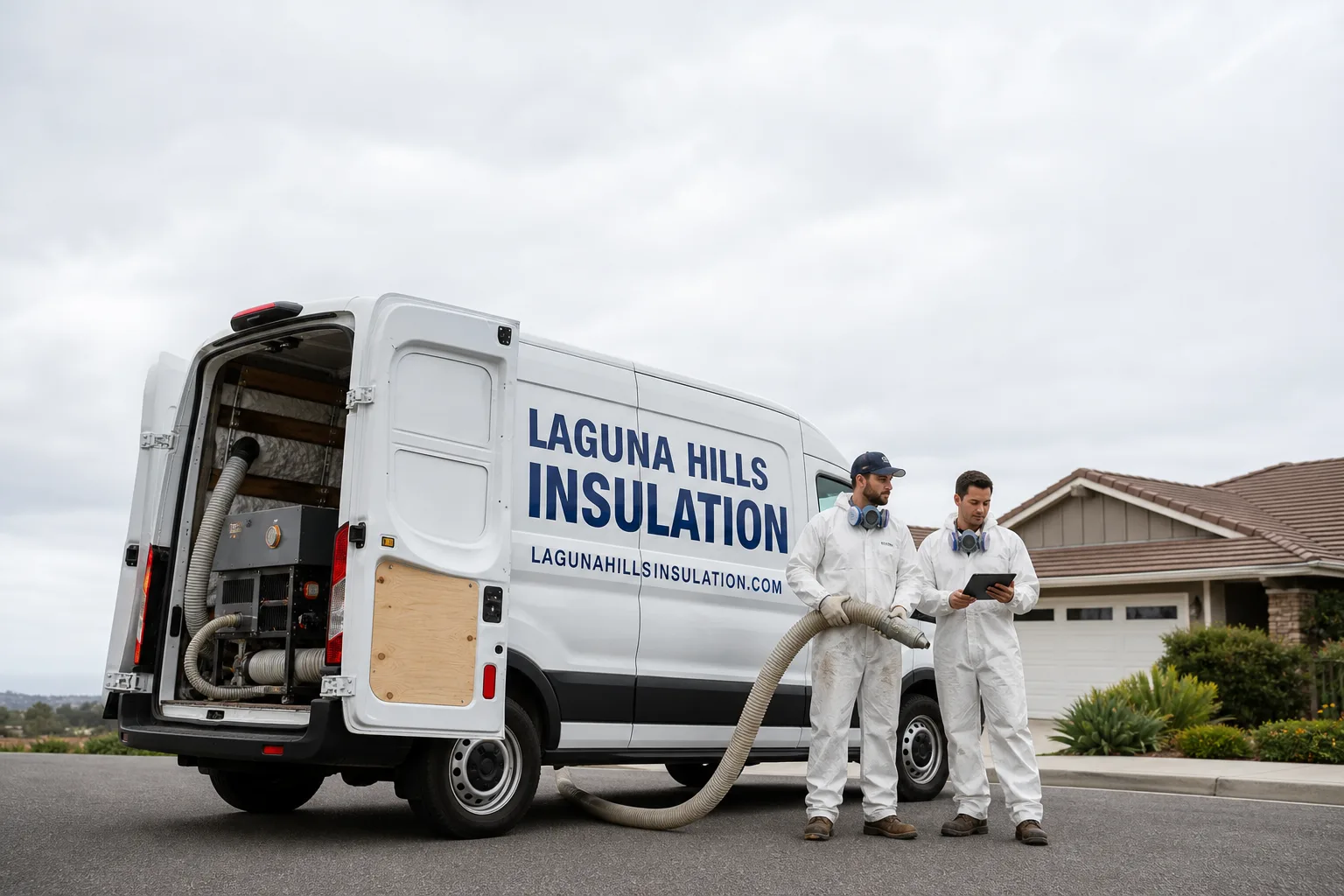
Fast, Reliable Spray Foam Insulation Across Riverside
Spray foam insulation in Riverside typically runs $2.50 to $6.50 per board foot installed, with most whole-attic or wall-cavity jobs landing between $3,800 and $12,000 depending on foam type and square footage. The real question in Riverside isn’t whether foam works. It’s whether the vents and rim joists get sequenced correctly so the foam actually holds its R-value through a 105°F August. Our crews know the difference, and we can usually reach most Riverside neighborhoods the same week you call.
We work in 92503, 92504, 92505, and 92506 weekly. Call (866) 393-6041 for a free estimate and we’ll tell you which foam type fits your home, honestly, even if it means a smaller job than you expected.
Key Takeaways:
- Spray foam in Riverside costs $2.50 – $6.50 per board foot installed; most jobs run $3,800 – $12,000.
- Santa Ana grit chokes vent screens in Riverside attics, so venting and baffle inspection belongs in every foam quote.
- We foam rim joists, wall cavities, roof decks, and garage ceilings with open-cell or closed-cell product lines from Icynene and Demilec.
- We work in Riverside’s older Magnolia Avenue and Arlington corridor homes as well as the newer builds out toward the 92508 boundary.
Why Laguna Hills Insulation Is Riverside’s Preferred Spray Foam Insulation Company
Most insulation contractors in Riverside push one product line. That’s not us. We stock and install across eight manufacturer brands, including Owens Corning, Johns Manville, and Rockwool, so the material decision follows the house, not our inventory. When a Riverside homeowner calls about a hot upstairs bedroom or a garage that hits 115°F in July, we look at the venting, the rim joists, and the existing attic before we ever open a foam kit.
Our spray foam work leans on Icynene and Demilec, two open- and closed-cell product lines built for air-sealing performance. Closed-cell from Icynene creates an air barrier and a thermal barrier in a single application, which matters in Riverside’s inland heat, where attic temperatures regularly exceed 140°F. We also carry Rockwool mineral wool for fire-resistant cavity work, something most local foam-only shops don’t stock.
Garrett Lund oversees every Riverside job. He’s the owner, and he’ll tell you straight up if spray foam is the wrong call for a 1950s rambler with legacy ductwork, or if a hybrid approach with blown-in fiberglass gets you 90% of the comfort at 60% of the cost. That’s the material-agnostic position we’ve held since day one: the right insulation for your home, not just the easiest one to install.
We reach Riverside from our Laguna Hills base in under two hours on most days. If you’re in the Wood Streets or off Van Buren Boulevard, we’ll schedule around your commute, not the other way around.
Spray Foam Insulation is one of three methods we perform in-house, alongside attic and blown-in insulation. That breadth matters when a Riverside house needs foam at the rim joist but blown-in fiberglass across the attic floor.
Spray Foam Wall Insulation in Riverside
Spray Foam Wall Insulation in Riverside focuses on the wall cavities themselves, usually from the interior during a remodel or from the exterior on stucco-clad 1990s and 2000s subdivisions. In older Riverside homes, like the post-war tract houses around 92503 and 92505, wall cavities are often empty or carry settled batts that leave gaps at framing. Foam fills those gaps and stops air movement through the wall assembly, which is a big deal when outside air sits at 100°F and your AC is fighting to hold 78°F.
We use open-cell Icynene for most wall cavity work in Riverside. It expands into odd framing, acts as an air barrier, and lets moisture move through the assembly, which matters in stucco homes that see occasional driving rain. Closed-cell Demilec goes in when a homeowner wants higher R-value per inch or added structural rigidity. You’ll pay more for closed-cell, but in walls that see direct west sun, it can be worth it.
Expect $2.50 to $4.00 per board foot for open-cell wall cavities and $4.50 to $6.50 for closed-cell, with most Riverside wall-only jobs running $4,000 to $9,000 depending on stud spacing and access.
Interior Wall Cavity Access
Most Riverside wall foam jobs happen from the inside during a kitchen or bath remodel, when drywall is already down. We coordinate with your contractor or handle the drywall opening ourselves, then air-seal around electrical boxes and plumbing penetrations before spraying. This keeps the foam tight to the framing where Riverside’s dry heat tries to sneak through.
Stucco and 1990s Subdivision Walls
Stucco-clad homes east of the 215 in 92504 and 92506 often go uninsulated in wall cavities. We inject or spray foam from the exterior by pulling a few stucco plugs, then patch and texture match. It’s a smaller disruption than a full re-side, and it transforms how those west-facing upstairs bedrooms hold temperature in late afternoon.
Rim Joist Spray Foam in Riverside
Rim Joist Spray Foam in Riverside seals the band board where your floor framing meets the foundation, a place where outside 100°F air seeps into the home through gaps around the sill plate. In Riverside’s older homes, builders rarely air-sealed this area. The rim joist sits open to the attic or crawl space, pulling hot air in every summer afternoon. We spray those cavities with closed-cell foam to stop the air movement and add R-value in the same pass.
On a 1950s single-story rambler off Magnolia Avenue in the 92505 corridor, our crew found original settled batts, a choked ridge-vent screen packed with Santa Ana grit, and rim joists open to the attic. We air-sealed and foamed the rim joist with Icynene, cleared and re-screened the venting, then sprayed the knee-wall and attic transitions so the low-pitch space could finally hold its R-value through a 100°F+ August.
Rim joist foam in Riverside runs $18 to $28 per linear foot, and a typical 1,800-square-foot home has 140 to 180 linear feet of rim area, putting most jobs between $2,500 and $5,000. It’s often the single highest-leverage air-sealing task in older Riverside construction.
Sealing the Band Board Before Attic Work
We sequence rim joist foam before attic insulation in older Riverside homes. Foaming the attic floor while the rim joist still leaks is like filling a bucket with a hole in the bottom. By sealing the band board first, the attic insulation can actually do its job.
Legacy Duct Coordination
Many mid-century Riverside homes still run galvanized ducts through the attic. When we foam a rim joist near ducts, we inspect those ducts for disconnections and leakage first. Foaming around a leaking duct just pushes more cooled air into the attic, which is the opposite of what a Riverside homeowner pays for.
Trusted Brands We Service in Riverside
We install and service spray foam from Icynene and Demilec, plus fiberglass from Owens Corning, Johns Manville, and Knauf, and mineral wool from Rockwool. For Riverside customers, that means we can match the material to the problem. Closed-cell Demilec for a rim joist in a dusty 92501 crawl space. Open-cell Icynene for a wall cavity on a stucco 92504 subdivision home. Rockwool when fire resistance is the priority. We keep common foam components and vent screens stocked for Riverside work, so we aren’t making two trips back for a baffle or a can of one-part foam. The goal is a fast, complete job, not a drawn-out one.
Common Spray Foam Insulation Problems We See in Riverside Homes
- Grit-choked vent screens and baffles. Santa Ana winds push fine dust through soffit and ridge vents in Riverside, and blocked vents quietly cancel the R-value of freshly sprayed foam. We clear and re-screen venting before every attic foam job here.
- Foam over settled original batts. Many 1950s Riverside homes still have their original attic batts, now compressed to a fraction of their rated R-value. Spraying foam over dust-caked framing or settled batts without air-sealing first means the foam bonds to a contaminated surface and underperforms.
- Open rim joists paired with leaky legacy ducts. Riverside’s mid-century homes often have galvanized ducts running through the hottest part of the attic. Foaming the rim while those ducts leak sends conditioned air into a 140°F attic and wastes the foam’s benefit.
- Santa Ana wind intrusion at gable and soffit vents. Gaps at vent edges in older Riverside homes let fine dust pack against newly sprayed foam, degrading its surface over time. We seal those edge gaps before foam goes in.
Pricing for Spray Foam Insulation in Riverside, CA
Spray foam in Riverside costs $2.50 to $6.50 per board foot installed. Open-cell runs $2.50 to $4.00, closed-cell $4.50 to $6.50. A wall-cavity-only job in a 1,500-square-foot home runs $4,000 to $7,000. A rim joist seal runs $2,500 to $5,000. A full open-cell attic retrofit on a 1,200-square-foot rambler starts around $5,500 before any venting work. Closed-cell roof deck applications, common on newer two-story builds out toward 92508, run $8,000 to $14,000. Square footage, foam depth, access, and vent condition all move the number. Call (866) 393-6041 for a free estimate and we’ll give you a straight answer, not a range.
We Also Serve Cities Near Riverside
Beyond Riverside itself, our crews regularly work in Rubidoux, Glen Avon, Pedley, and Sunnyslope. Each of those communities shares Riverside’s older housing stock and Santa Ana wind exposure, and we bring the same vent-first approach to every job. Riverside is the hub of our Inland Empire coverage, but we’re on the road to these neighbors weekly.
Serving Riverside, CA — Our Local Coverage Area
We’re based in the Riverside area and know this community well. Use the map below to see our service coverage — if you’re nearby, we can almost certainly help.
FAQs About Spray Foam Insulation in Riverside
Yes, but only if the venting gets cleared first and the rim joist gets sealed. Many 1950s Riverside homes in 92501 and 92503 have low-pitch attics where access is tight but the payback is real. Original batts are often settled to R-19 or less, and the attic is the single biggest source of summer heat gain. We air-seal the attic floor, clear the vent screens, spray the rim joist, then add blown-in or spray foam depending on the space. A one-size foam quote without venting work will underperform. Call (866) 393-6041 and we’ll look at what you actually have.
The Santa Ana wind corridor blows fine sand and debris into Riverside attic vents every fall. Screens and baffles choke, ventilation stalls, and the attic turns into a heat trap that makes foam underperform. Before we spray, we clear and re-screen those vents. It’s a Riverside-specific step that generic foam installers skip, and it’s why we start every local quote with an attic ventilation check.
Start at the rim joist. In older Riverside homes, the rim joist is the largest open air-sealing gap, and sealing it costs $2,500 to $5,000, far less than full wall-cavity foam. Wall cavities matter too, but sealing the band board and topping up the attic usually delivers more comfort per dollar in a mid-century home. We’ll look at both and give you a sequenced plan, not just a foam quote.
Older Riverside homes often run galvanized ducts through the hottest part of the attic. We inspect ducts for disconnections and leakage before foaming nearby surfaces, because sealing the rim or attic while ducts leak wastes the foam’s benefit. If ducts need repair, we’ll tell you before any foam goes in. We don’t spray over a known leak.
It depends on what the builder left you. Newer Riverside homes out toward 92508 often meet current energy codes, but roof decks and garage ceilings are still under-insulated in many cases. Closed-cell foam on the roof deck keeps the attic space cooler and protects HVAC equipment, and garage ceiling foam helps when the room above never cools down. If your builder already gave you R-38 attic and sealed rim joists, save your money. We’ll tell you if that’s the case. Call (866) 393-6041 for an honest read.
Written by Garrett Lund, Owner at Laguna Hills Insulation, serving Riverside spray foam insulation customers across the Inland Empire.