
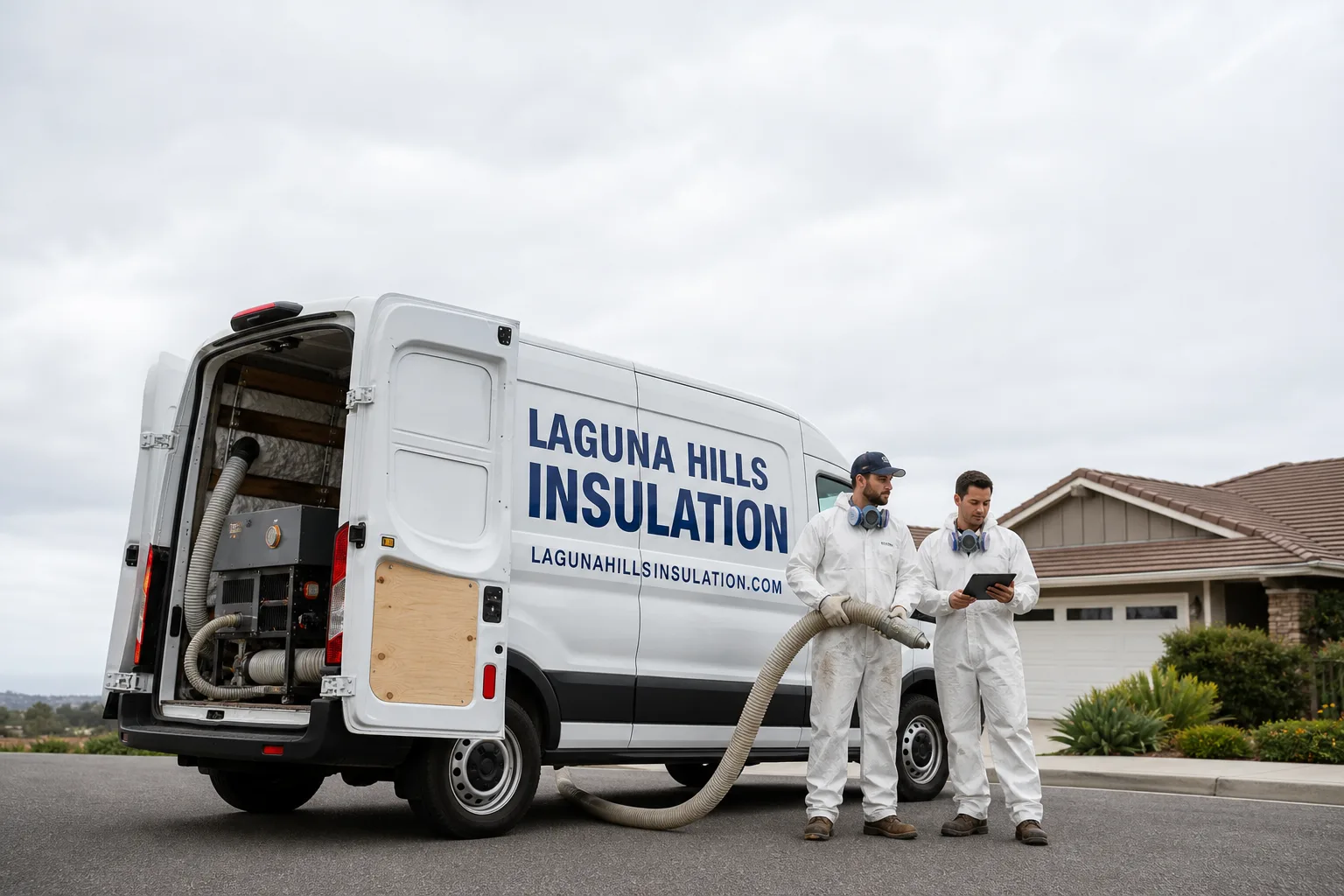
Fast, Reliable Spray Foam Insulation Across Pico Rivera
Spray foam insulation in Pico Rivera runs $2.50 to $6.50 per board foot installed depending on whether you need open-cell or closed-cell, and a typical attic retrofit on a 1,200-square-foot tract home lands between $4,800 and $9,200. Most jobs in Pico Rivera take one to two days once the attic cools enough to spray safely. We work the 90660, 90661, and 90662 zip codes regularly, and our crews know that spraying onto an oven-hot roof deck at 3 p.m. in July is how you get adhesion failures, not a sealed attic. Call (866) 393-6041 for a straight answer on what your specific walls and attic actually need.
Why Laguna Hills Insulation Is Pico Rivera’s Preferred Spray Foam Insulation Company
Most of our Pico Rivera work is retrofit, not new construction. These 1950s through 1970s stucco tracts off Whittier Boulevard were built when energy was cheap and wall insulation was optional, so we spend a lot of time drilling and filling cavities that should have been insulated sixty years ago. Homeowners here don’t need a sales pitch. They need someone who understands why the east-facing back bedrooms bake by 4 p.m. and what to do about it.
Garrett Lund built Spray Foam Insulation work around a simple rule: match the material to the house, not the other way around. We carry open-cell and closed-cell spray foam systems from Icynene and Demilec, alongside mineral wool, fiberglass, and cellulose options, because a stucco wall cavity with zero insulation needs something different than a vented attic with rafters facing afternoon sun. Pico Rivera homeowners comparing bids tend to appreciate hearing which product actually fits their walls, even when it’s not the most expensive option on the truck.
Response time to Pico Rivera from our Laguna Hills base is typically same-week for estimates and one to two days for scheduled installs, depending on attic temperatures. In summer months, we plan spray passes for early mornings or late afternoons when roof deck temps drop below about 120°F. It’s not about convenience. It’s about foam that actually adheres and cures correctly instead of off-gassing and peeling.
Spray Foam Attic Insulation in Pico Rivera
Spray Foam Attic Insulation in Pico Rivera means something specific: sealing a low-vented, underpinned attic on a mid-century tract home so the afternoon heat stops bleeding into the ceiling below. Most of these homes have minimal blown-in insulation, bare aluminum-framed vents, and roof decks that soak up sun from noon until sunset. A typical attic retrofit here runs $4,800 to $9,200 for a 1,200 to 1,800 square foot home, depending on whether you go open-cell under the roof deck or add closed-cell for a tighter air and vapor barrier.
Roof Deck Sealing for Summer Heat
On the older tracts, the real payoff is sealing the roof deck itself. Local building codes allow foam applied directly to the underside of the sheathing, and we’ve found that east-facing roof planes on homes near the San Gabriel River corridor get hit hardest by morning and midday sun. Closed-cell foam from Demilec or Icynene creates a thermal and air barrier in a single pass, which cuts the convection loop that turns your attic into an oven by mid-afternoon.
Working Around Low Aluminum-Framed Vents
Pico Rivera’s mid-century attics often have those low-profile aluminum vents that barely move air. When we install spray foam attic insulation, we address the venting strategy up front. Foaming over vents without a plan traps heat and moisture, which is exactly what you don’t want. In most cases, we convert these attics to an unvented assembly or add proper intake and exhaust paths before spraying, so the insulation performs instead of fighting the house.
Spray Foam Wall Insulation in Pico Rivera
Spray Foam Wall Insulation in Pico Rivera is a retrofit job in almost every case, because the stucco tract homes here were framed with empty wall cavities. Behind the exterior stucco, there’s usually just framing, maybe a scrap of tar paper, and then the backside of your drywall. We drill from inside and inject open-cell foam into the stud bays, or we work from the exterior face and patch the stucco after. A full wall retrofit on a 1,200 square foot home typically runs $6,500 to $11,000 depending on access, existing wiring, and how much patching the stucco needs.
Drilled Cavity Injection for Stucco Tracts
This is the work that looks like stucco repair from the street. We drill 5/8-inch holes at the top and bottom of each stud bay, inject foam under controlled pressure, and seal the holes with a matched stucco patch. Pico Rivera homeowners often tell us they were worried the walls would be torn open. They aren’t. What they get is a filled cavity, a sealed wall assembly, and a street-facing surface that looks untouched once the patch cures.
East-Facing Walls and Santa Ana Loads
East-facing walls take the brunt of morning solar gain, and in Santa Ana conditions, the wind can push hot, dry air against the stucco for days. Closed-cell spray foam at R-7 per inch does double duty here: it insulates and it acts as an air barrier, which matters when your wall sheathing is fifty years old and full of micro-gaps. For most Pico Rivera homes, closed-cell in the walls and open-cell in the attic is the combination that performs best.
Trusted Brands We Service in Pico Rivera
We install and service spray foam systems from Icynene and Demilec, the two product lines we trust most for Southern California retrofit work. Behind those, our material breadth matters for Pico Rivera customers: GreenFiber cellulose for blow-in retrofits, Owens Corning and Johns Manville fiberglass for batts where foam doesn’t make sense, and Knauf for select applications. We stock the parts and materials our Pico Rivera jobs actually need, which means fewer delays waiting on a supplier run. When you call (866) 393-6041, you get an answer about what’s in stock and what’s on order, not a vague promise.
Common Spray Foam Insulation Problems We See in Pico Rivera Homes
- Foam sprayed onto hot roof decks. Pico Rivera summer attics routinely hit 140°F by early afternoon. Spraying foam onto a deck that hot causes off-gassing, poor cell formation, and adhesion failure within months. We schedule spray passes for cooler hours and verify deck temperature before pulling the trigger.
- Uninsulated stucco wall cavities. The 1950s through 1970s tracts were framed for speed, not efficiency. Behind the stucco facade, many walls have zero insulation. Drilled cavity injection is the fix, but it has to be done with the right pressure and foam density to avoid bulging or cracking aging stucco.
- Foam applied over low aluminum-framed vents without a venting plan. Sealing the attic is good. Sealing the attic while trapping heat and moisture inside is worse than doing nothing. We see this on DIY jobs and cut-rate installs. Proper venting or an unvented assembly is part of the job, not an add-on.
- Stucco scars left unpatched after wall injection. Drilled holes need a matched patch, and on Pico Rivera homes with textured stucco, a sloppy patch is visible from the street for years. We match the existing texture and color, and we tell homeowners upfront what the patch will look like during the first month of curing.
Pricing for Spray Foam Insulation in Pico Rivera, CA
Here are the numbers we quote most often for Pico Rivera homes. Open-cell spray foam runs $2.50 to $4.00 per board foot installed. Closed-cell runs $4.50 to $6.50 per board foot. A typical 1,200 square foot attic retrofit lands between $4,800 and $9,200, and a full wall cavity injection runs $6,500 to $11,000. Garage ceilings and rim joist sealing are smaller jobs, usually $1,200 to $3,000. What moves the price in Pico Rivera specifically is attic access from tight lots, whether we’re drilling from inside or patching stucco from the outside, and how much prep the existing venting needs. Call (866) 393-6041 and we’ll give you a fixed quote, not a range to hide behind.
We Also Serve Cities Near Pico Rivera
If you’re in West Whittier-Los Nietos, Montebello, Santa Fe Springs, or Bell Gardens, we run crews through those neighborhoods every week. Many of our Spray Foam Insulation in Pico Rivera customers refer neighbors across the city line, so we keep our scheduling flexible for jobs just outside the 90660 zip code. Same team, same material breadth, same straight answers.
Serving Pico Rivera, CA — Our Local Coverage Area
We’re based in the Pico Rivera area and know this community well. Use the map below to see our service coverage — if you’re nearby, we can almost certainly help.
FAQs About Spray Foam Insulation in Pico Rivera
Yes. We drill into the stud bays from inside or from the exterior stucco face, inject open-cell foam, and patch the holes. The exterior approach leaves small patched circles that blend into the stucco texture once painted, and the interior approach hides behind drywall patches. Most Pico Rivera homeowners prefer the interior drill method because it keeps the street-facing stucco untouched. The job takes one to two days and costs $6,500 to $11,000 for a typical 1,200 square foot home. Call (866) 393-6041 and we’ll tell you which approach fits your walls.
Yes, but the vents have to be addressed before or during the install. Those low-profile aluminum vents don’t move enough air for a vented attic with spray foam on the roof deck, so we either convert the attic to an unvented assembly or add proper intake and exhaust ventilation. Foaming over them without a venting plan traps heat and moisture, which is a recipe for mold and deck rot. We’ll show you exactly what we’re doing to your venting before we spray.
Yes, because spray foam is an air seal as much as it is insulation. Pico Rivera’s cooling load means your AC runs hard from June through October, and the biggest heat gain is convection through your attic and air leakage through unsealed walls. Spray foam cuts both. Most of our Pico Rivera customers report their AC cycles noticeably less after a roof deck and wall cavity retrofit, and the east-facing bedrooms stop spiking in the late afternoon.
Santa Ana winds bring two things: hot, dry air and wind-driven pressure against your exterior walls. A properly applied closed-cell foam wall cavity holds up better than fiberglass batts in these conditions because it doesn’t sag or lose contact with the sheathing. We also schedule our spray passes with a close eye on wind speed, because overspray and mist carry badly on gusty days and can land on cars, windows, and neighboring properties. When winds exceed 20 mph, we typically reschedule the exterior injection work and hold the attic crews indoors.
We install open-cell and closed-cell spray foam from Icynene and Demilec. Those are the two product lines we trust for Southern California retrofit work, and we carry both on our trucks. For Pico Rivera specifically, closed-cell Demilec is often the right call for stucco wall cavities because of its higher R-value per inch and vapor control, while Icynene open-cell handles attic roof decks well when the assembly is properly vented or converted to unvented. Call (866) 393-6041 and we’ll tell you which one fits your home’s construction.
Written by Garrett Lund, Owner at Laguna Hills Insulation, serving Pico Rivera since the company’s founding.