
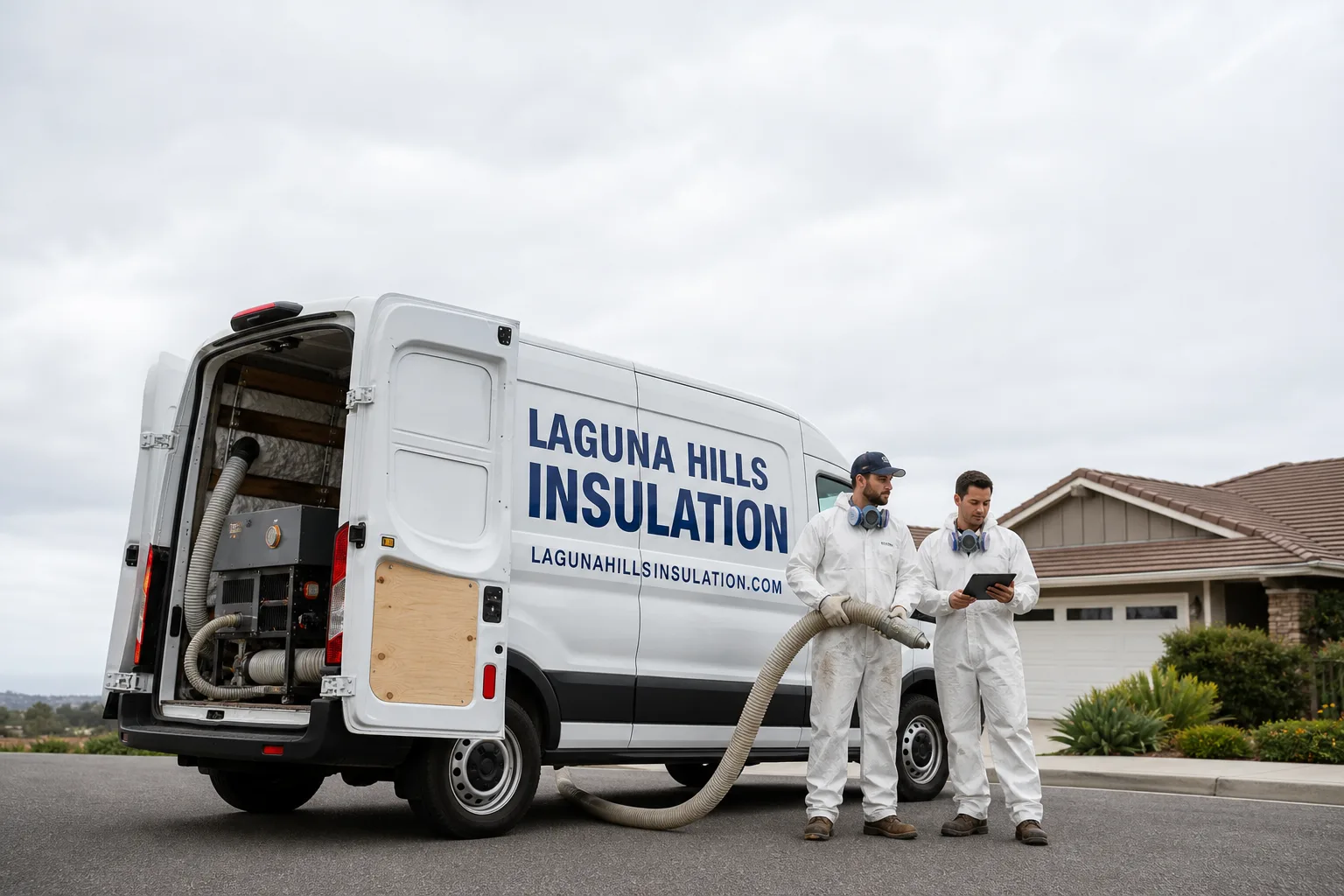
Fast, Reliable Spray Foam Insulation Across Pasadena
Spray foam insulation in Pasadena costs between $2.50 and $6.80 per board foot installed, with most whole-attic or wall-cavity projects landing in the $3,800 to $9,600 range. We get crews out to Pasadena neighborhoods like Bungalow Heaven, Madison Heights, and the hillsides above the Rose Bowl within 24 to 48 hours on standard jobs. If you’re dealing with a drafty 1920s Craftsman or a mid-century ranch that bakes in August, call (866) 393-6041 and we’ll give you a straight answer about what foam actually fits your walls.
Why Pasadena Homeowners Call Laguna Hills Insulation for Spray Foam
Pasadena is not a simple place to insulate. The housing stock swings from 1900s Arts and Crafts bungalows with balloon framing to 1950s hillside homes on slab foundations, and the right foam choice changes completely between those two building types. We have worked in enough of these houses to know when open-cell Icynene makes sense for a wall cavity and when closed-cell Demilec is the only thing that will handle a rim joist in a raised foundation.
Our Pasadena customers keep telling us the same thing: they had other contractors quote them whatever foam that crew happened to stock. That is not how we operate. We carry eight manufacturer lines, so if a 1920s wall cavity needs a lower-expansion open-cell product to protect original plaster, we use that. If a hillside garage ceiling needs the air-sealing punch of closed-cell, we use that instead.
Garrett Lund, who runs our spray foam division, has spent years getting familiar with how Pasadena’s older homes behave. He will tell you honestly whether spray foam is even the right material for your house, or whether a blown-in cellulose from GreenFiber makes more sense in your particular attic. That kind of straight talk is why homeowners in Pasadena keep our number in their phone.
Spray Foam Wall Insulation in Pasadena
Spray Foam Wall Insulation in Pasadena typically costs $2.80 to $5.50 per board foot and involves injecting or applying foam into existing wall cavities through carefully drilled access holes, or applying it to open framing during a remodel. Most of the homes we work on in Pasadena’s historic districts were built before wall insulation was standard, so we are usually retrofitting, not building fresh. The work requires patience: original plaster, narrow stud bays, and the occasional surprise behind the lathe all slow the job down, but the payoff is real. Homeowners in neighborhoods like Garfield Heights and Normandie Heights regularly see their summer cooling loads drop noticeably after we seal those walls.
Before any foam goes into a Pasadena wall, we inspect for knob-and-tube wiring. This is non-negotiable. Encasing live knob-and-tube in spray foam traps heat against the conductors and creates a genuine fire risk, and no insulation job is worth that. In many cases we coordinate with a licensed electrician to address the wiring first, then proceed with foam. It adds a step and sometimes adds cost, but it is the only responsible way to do the job in these older homes.
Working Around Original Plaster
Original plaster walls in 1900s and 1920s homes crack easily under the pressure of expanding foam. We use low-expansion open-cell products in these situations, and we drill smaller access holes than typical new-construction methods call for. After the foam cures, we patch to match the surrounding texture. A rushed crew will leave visible patches or hairline cracks radiating from every drill point, and that is not acceptable on a hundred-year-old wall.
Shrinking Siding and Air Leaks
The original redwood and cedar siding on many Pasadena Craftsman homes has shrunk over decades, leaving gaps along top plates and corner boards that let hot attic air pour into the walls. Foam alone does not fix this, because the gaps are outside the foam’s path. We air-seal those exterior seams with a vapor-permeable caulk that moves with the old wood before we apply any insulation. Skip that step and you will spend thousands on foam while the house still leaks.
Rim Joist Spray Foam in Pasadena
Rim Joist Spray Foam in Pasadena typically runs $1,200 to $2,600 for an average crawl space or basement perimeter, depending on linear footage and access. The rim joist is the band of framing where your floor meets your foundation, and in Pasadena’s raised-foundation homes it is one of the biggest air-leakage points in the entire building. Closed-cell foam from Demilec is our usual recommendation here: it air-seals, insulates, and adds structural rigidity all at once. We work in crawl spaces under homes all over northwest Pasadena and the neighborhoods around Orange Grove Boulevard, and we know these spaces are tight, dusty, and often have plumbing or old wiring running right through the work area.
Hillside homes in 91105 and 91107 bring their own challenge. Many sit on combination slab and raised foundations, where the rim joist condition changes halfway across the house. On the slab side there is no rim to spray; on the raised side there is, and it is often the single largest source of winter heat loss. We map each foundation type before spraying so you are not paying for foam in places where it does nothing.
Condensation Control During Wet Winters
Pasadena’s winter rains push moisture against foundation walls, and a poorly insulated rim joist lets that damp air condense on the underside of your subfloor. Over time you get mold, musty smells, and soft spots in the flooring above. Closed-cell foam blocks that migration path and keeps the crawl space environment drier. It is one of the highest-return insulation jobs we do anywhere in Pasadena.
Access and Prep Work
Many Pasadena crawl spaces have limited clearance, and a handful of homes in the Linda Vista and Annandale areas sit on foundations where the access hatch is barely eighteen inches tall. We bring the right equipment for tight access and we lay down protection so foam overspray does not coat your plumbing or ductwork. The prep takes as long as the actual spray in some of these older homes, and we price the job accordingly rather than surprising you on the back end.
Trusted Brands We Service in Pasadena
We stock and install Spray Foam Insulation products from Icynene and Demilec, two of the most technically demanding foam lines in the industry. We also carry Owens Corning and Johns Manville fiberglass and Rockwool mineral wool for homes where foam is not the right call. Having that much material depth matters in Pasadena because no two houses here are alike. A snug 1910 bungalow in 91104 needs a completely different product strategy than a 1965 ranch in 91107, and we will tell you which one fits your actual situation rather than selling you whatever is loaded on the truck.
Common Spray Foam Insulation Problems We See in Pasadena Homes
- Foam applied directly over knob-and-tube wiring. Encasing active knob-and-tube in spray foam traps heat and creates a fire hazard. Homes from the 1900s through the 1930s across Pasadena still have this wiring in service, and any contractor who skips the electrical inspection is putting your house at risk.
- Hasty jobs that crack original plaster. Driving large injection holes into century-old walls and pumping high-expansion foam behind them is a recipe for cracked plaster and visible patches. Arts and Crafts homes in neighborhoods like Bungalow Heaven demand low-expansion products and careful hole placement.
- Rim joist foam that blocks necessary ventilation. On hillside homes with slab-on-grade sections, spraying foam in the wrong places can trap moisture and cause condensation during winter rains. We see this regularly in 91105 and 91107, where combination foundations confuse crews that only know one foundation type.
- Ignoring the shrinking siding problem. Pasadena’s original redwood and cedar siding has gaps that let hot air bypass the insulation entirely. We have measured attic temperatures in Bungalow Heaven homes where the air-sealing deficiencies were moving more heat than the missing insulation itself.
Pricing for Spray Foam Insulation in Pasadena, CA
Here is what you should expect to pay in Pasadena’s market right now. Open-cell wall cavity injection runs $2.80 to $4.50 per board foot. Closed-cell rim joist work runs $3.50 to $5.80 per board foot or roughly $1,200 to $2,600 for a typical crawl space perimeter. Whole-attic closed-cell applications on a 1,200-square-foot Pasadena bungalow usually land between $5,200 and $7,800. What moves the number? Access, wiring remediation, whether we are working around original plaster, and the condition of your existing air-sealing. Homes in Pasadena’s historic districts tend to run toward the upper end because of the careful prep work they require. We give free estimates, and we will walk you through the line items before any work starts. Call (866) 393-6041 to schedule one.
We Also Serve Cities Near Pasadena
Our crews work throughout the San Gabriel Valley and the Arroyo Seco corridor. In addition to Pasadena, we regularly handle spray foam projects in South Pasadena, San Marino, Altadena, and East Pasadena. If you live in one of those neighboring communities, you get the same material options and the same straight answers. Spray Foam Insulation in Pasadena is our home base, but the whole area is our territory.
Serving Pasadena, CA — Our Local Coverage Area
We’re based in the Pasadena area and know this community well. Use the map below to see our service coverage — if you’re nearby, we can almost certainly help.
FAQs About Spray Foam Insulation in Pasadena
Yes, but only with low-expansion open-cell foam and careful drilling techniques. Standard high-expansion foam will crack original plaster, and a sloppy injection pattern will leave visible patches. We use smaller access holes than typical, low-pressure injection, and we patch to match the existing texture. The plaster on those walls has been there for a hundred years; the foam application has to respect that.
It does not, by itself. The gaps created by decades of siding shrinkage sit outside the wall cavity where the foam goes, so foam alone will not fix the air leaks. The correct sequence is to air-seal those exterior seams with a vapor-permeable caulk first, then apply foam to the wall cavities and rim joists. In Bungalow Heaven (91104), our crew tackled a 1920s Craftsman with original redwood siding that had shrunk, creating gaps along the top plates. After air-sealing with a vapor-permeable caulk, we applied Icynene spray foam to the rim joists and wall cavities, navigating knob-and-tube wiring and preserving the original plaster. For homeowners needing Reflectix repair in Pasadena, we often address similar air-sealing challenges on these vintage homes. The homeowner reported a 30% drop in summer cooling costs and no more drafty rooms.
Not unless the wiring is addressed first. Spray foam encasing live knob-and-tube traps heat against the conductors, which can lead to insulation breakdown and fire. In homes where knob-and-tube is still active, we pause the insulation work and recommend a licensed electrician evaluate the circuits. Once the wiring is updated or decommissioned, the foam job can proceed safely. This is one of the most common issues we encounter in Pasadena’s older housing stock, and it is the single biggest reason we will not rush a quote.
The right approach depends on where the raised foundation section sits. On the raised side, closed-cell foam at the rim joist air-seals and insulates the floor perimeter. On the slab side, there is no rim joist to spray, so the better target is usually the roof deck or attic, especially for homes that bake in the afternoon sun. We map the foundation transitions before quoting so you are not paying for foam in places it cannot help.
Yes, and in both directions. During the 100-degree summers, closed-cell foam on the roof deck or attic floor blocks radiant heat from turning your attic into an oven. During winter rains, foam at the rim joist and in wall cavities keeps damp air from condensing inside your framing and crawl space. Homes we have insulated in Pasadena consistently report lower cooling bills and fewer humidity problems in the winter months. Call (866) 393-6041 for a free assessment of where foam will actually pay for itself in your house.
Ready to get your Pasadena home insulated the right way? Call Garrett and the team at (866) 393-6041 for a free, no-pressure estimate. We will look at your walls, your foundation, and your wiring, and tell you honestly which material fits.
Written by Garrett Lund, Owner at Laguna Hills Insulation, serving Pasadena and the San Gabriel Valley.