
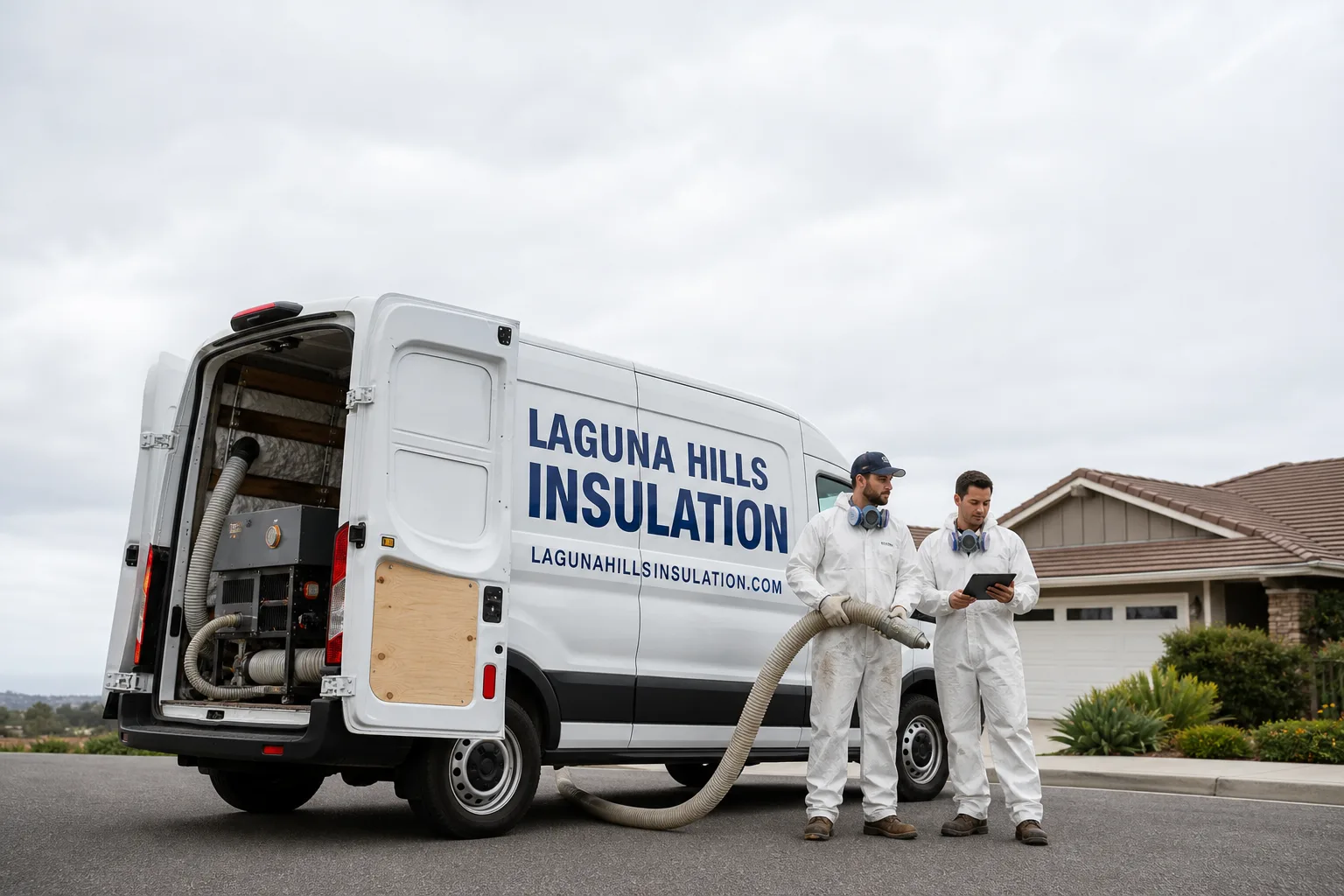
Fast, Reliable Spray Foam Insulation Across Jurupa Valley
Spray foam insulation in Jurupa Valley typically costs $2.40 – $6.10 per board foot installed, depending on whether you choose open-cell or closed-cell foam. For most Jurupa Valley ranch homes and stucco tract houses we work on, an attic application runs $3,800 – $9,400, while a full wall cavity retrofit lands between $4,200 and $11,000. We run the same crews into Glen Avon, Pedley, and Sunnyslope daily, so call (866) 393-6041 and we can usually have someone out to your place within 48 hours.
What makes Jurupa Valley different from most of western Riverside County is what we find inside your attics. Homes built between the 1950s and early 2000s dominate this city, and a lot of them are running on insulation that was marginal when it was installed and is now barely doing anything. Garrett Lund, owner of Laguna Hills Insulation, has spent years untangling the specific failure points in Jurupa Valley’s older housing stock.
Why Laguna Hills Insulation Is Jurupa Valley’s Preferred Spray Foam Insulation Company
We’re not a single-product shop that shows up with one truck and tells you it’s the answer to every problem. Our team works across eight manufacturer lines including Owens Corning, Johns Manville, and Icynene, and we run three installation methods in-house: attic insulation, blown-in, and Spray Foam Insulation. That means when a Jurupa Valley homeowner asks whether they need closed-cell against the roof deck or open-cell in the walls, the answer comes from physics and local conditions, not from what’s sitting in our warehouse.
Local reputation is built one attic at a time here. A meaningful share of our Jurupa Valley work comes from neighbors trading our number after comparing bids. Homeowners in the tract developments off Limonite Avenue and the older pockets near Mission Boulevard tell us the same story: another contractor quoted one product line, and we gave them three options with numbers attached. That’s the material-agnostic approach, and it’s the only one that makes sense in a city with this much variation in housing age.
Response time to Jurupa Valley is usually 24 to 48 hours for an estimate. We keep crews staged along the 91 and 15 corridors, so Glen Avon and Pedley jobs get the same scheduling priority as downtown Riverside. When you call, you’ll speak with someone who knows this city’s attics, not a call center in another state.
Spray Foam Attic Insulation in Jurupa Valley
Spray foam attic insulation in Jurupa Valley is the single most effective retrofit for the heat gain problem that defines this city’s summers. Most homes here were built with fiberglass batts laid on the attic floor, and after 40 to 60 years of 100°F-plus heat cycling, those batts have compressed, shifted, and lost a huge share of their labeled R-value. We regularly measure settled insulation at R-7 or less in mid-century ranches near the Santa Ana River, where the original mineral wool or early fiberglass was installed without any radiant barrier under the roof sheathing. The result is an attic that hits 140°F by midafternoon and pushes that heat straight down through your ceiling.
A spray foam attic retrofit in Jurupa Valley runs $3,800 – $9,400 for a typical 1,200 to 2,200 square foot single-family home. The spread depends on whether we’re spraying open-cell against the attic floor (the lower-cost approach, usually $1.10 – $1.90 per board foot for foam alone) or closed-cell against the roof deck to create an unvented, semi-conditioned attic (typically $2.60 – $4.10 per board foot plus prep work). Closed-cell foam from Icynene or Demilec gives you both an air barrier and a thermal barrier in one pass, which is why it’s the right call for a lot of Jurupa Valley homes with ductwork running through the attic.
Air Sealing Before Foam
Before any foam goes down, we air-seal the top plates, electrical penetrations, and recessed can lights. Skipping this step in Jurupa Valley’s hot, dry attics is a common mistake: foam applied over an unsealed attic floor traps hot air below the foam line and creates uneven curing. We pull back the old insulation, seal every penetration, then spray.
Roof Deck Application for Older Ranches
For the 1950s and 60s ranch homes along Riverview Drive and the streets feeding into the Santa Ana River, we often recommend moving the thermal boundary to the roofline. Spraying two inches of closed-cell foam directly against the roof deck converts a 140°F oven of an attic into a space that stays within 10 – 15 degrees of the living area. It’s a bigger upfront investment, but it takes the HVAC ductwork out of the blast-furnace zone and cuts cooling loads measurably.
Spray Foam Wall Insulation in Jurupa Valley
Spray foam wall insulation in Jurupa Valley addresses a different failure point than attic work, and it’s one that stucco tract homes from the 1980s and 90s share across the city. Those exterior walls are often framed with 2×4 construction and insulated with nothing or with thin fiberglass batts that leave the wall cavities under-filled. Once the stucco bakes in direct sun all afternoon, the thermal bridging through the studs turns every exterior wall into a low-grade radiant heater.
Wall cavity spray foam in Jurupa Valley runs $4,200 – $11,000 for a whole-house retrofit, depending on total wall area and access. We usually recommend open-cell foam here, which comes in around $1.30 – $2.00 per board foot and fills irregular cavity depths better than batts ever could. For homes with existing drywall, we drill and inject through small access holes; for gut-renovation or new construction projects, we spray directly into open stud bays. Closed-cell is the right call where you also need a vapor barrier or where the wall sits against a hillside retaining condition common in the upper elevations near Sunnyslope.
Stucco Tract Home Cavity Fill
If your Jurupa Valley home was built between 1980 and 2005, your wall cavities likely have R-11 or R-13 batts that have sagged over time, leaving gaps at the top of each bay. Open-cell foam injected from the interior fills those voids completely and air-seals the entire wall assembly in the same operation.
Rim Joist Sealing for Crawlspace Homes
Many older Jurupa Valley ranch homes sit on raised foundations with vented crawlspaces. The rim joist, the band of framing where your floor meets the foundation wall, leaks air constantly. We spray two to three inches of closed-cell foam along the entire rim joist perimeter, which stops the stack effect that pulls 110°F outdoor air into your living space through the floor.
Trusted Brands We Service in Jurupa Valley
We install and service spray foam systems from Icynene and Demilec, two of the most technically demanding product lines in the category, alongside traditional thermal-bulk insulation from Owens Corning, Johns Manville, and Knauf. For Jurupa Valley customers, having access to this many brands matters because it means we can match the material to the problem: GreenFiber cellulose for a lower-cost attic blow-in on a rental property, Rockwool mineral wool for a fire-resistant wall cavity, and closed-cell spray foam from Demilec for the roof deck of a mid-century ranch that’s cooking its occupants every August. We stock the application equipment and accessory components for all of these systems, so there’s no waiting on specialty parts when your project is scheduled.
Common Spray Foam Insulation Problems We See in Jurupa Valley Homes
- Settled and compressed fiberglass in mid-century ranches near the Santa Ana River. The original batts installed in these 1950s and 60s homes were often R-11 at best, and 50-plus years of heat cycling has flattened them to two inches or less. The top plates of the exterior walls are left completely unsealed, so conditioned air escapes directly into the attic.
- Attic temperatures that exceed 140°F in July and August. Jurupa Valley homes without radiant barriers or roof deck foam get hammered by direct sun on unshaded roof planes. The HVAC system has to work against a 60-degree temperature differential between attic and living space, and the ductwork leaks more as the attic gets hotter.
- Spray foam applied over deteriorated legacy insulation without proper air sealing first. We see this in homes where a previous contractor took the shortcut route. The foam skins over the old batts, moisture gets trapped between layers, and the curing is uneven in Jurupa Valley’s dry, hot attic air. The fix is pulling everything out and starting clean.
- Wall cavities in 1980s-90s stucco tract homes that were never insulated to current code. Some of these developments were built during periods when wall insulation requirements were looser, and the result is a house that bleeds heat through the studs. A foam injection retrofit addresses the problem without tearing out drywall.
Pricing for Spray Foam Insulation in Jurupa Valley, CA
Here’s the straight answer on what spray foam costs in this city. Open-cell spray foam runs $1.10 – $1.90 per board foot installed. Closed-cell runs $2.60 – $4.10 per board foot. A typical attic retrofit in a Jurupa Valley ranch home lands between $3,800 and $9,400. A whole-house wall injection project spans $4,200 to $11,000, depending on how much exterior wall area you have and whether we’re working from the inside or outside. The three variables that move your number the most are: square footage of the surface being sprayed, foam thickness required to hit your R-value target, and how much legacy insulation has to be removed first. We give free, itemized estimates, so call (866) 393-6041 and we’ll put real numbers on your specific house.
We Also Serve Cities Near Jurupa Valley
Our crews cover the full western Riverside County corridor, including Jurupa Valley and the surrounding communities of Glen Avon, Pedley, Sunnyslope, and Eastvale. If you’re in one of those areas and you’ve been told you need spray foam, we’re already running trucks through your neighborhood every week.
Serving Jurupa Valley, CA — Our Local Coverage Area
We’re based in the Jurupa Valley area and know this community well. Use the map below to see our service coverage — if you’re nearby, we can almost certainly help.
FAQs About Spray Foam Insulation in Jurupa Valley
Yes. Spray foam, particularly closed-cell applied to the roof deck, stops the radiant heat transfer that makes Jurupa Valley attics hit 140°F by midafternoon. Open-cell on the attic floor with proper air sealing also makes a significant difference, dropping attic temperatures by 20 to 30 degrees and cutting cooling loads immediately. For the 1950s ranch homes near the Santa Ana River with original insulation that has settled to almost nothing, this is the single highest-impact retrofit you can do. Call (866) 393-6041 and we’ll measure what’s in your attic right now.
No, and any contractor who says otherwise is doing you a disservice. Foam sprayed over collapsed fiberglass batts traps moisture, cures unevenly in our dry heat, and never achieves its rated R-value. The right sequence is removing the old insulation, air-sealing every penetration, then applying foam to a clean surface. We handle the removal and disposal as part of the job, so you’re not dealing with 60-year-old mineral wool dust yourself.
Attic foam addresses the dominant heat gain path in Jurupa Valley, which is downward from the roof. Wall foam addresses lateral heat gain through sun-baked stucco and thermal bridging through the studs. Most homes here need both, but if you have to phase the work, do the attic first. It’s the larger surface area, the bigger temperature differential, and the faster payback on your cooling bill.
Not if you’re going with closed-cell foam against the roof deck. The foam itself acts as a radiant barrier by stopping the heat physically rather than reflecting it. If you go with open-cell on the attic floor instead, a radiant barrier stapled under the rafters is a worthwhile addition that further reduces attic temperatures. We’ll lay out both options with numbers before you commit to anything.
It holds heat in the same way it keeps heat out. Closed-cell foam has an R-value around R-6.5 per inch, and because it air-seals as it insulates, it stops the stack effect that pulls heated air out of your living space on cold nights. For Jurupa Valley, where winters are mild but frosts do happen, that means fewer furnace cycles and a more stable indoor temperature through the coldest weeks. Call (866) 393-6041 for a free estimate and we’ll model the performance for your specific house.
If your Jurupa Valley home is fighting a losing battle against the summer heat, we’ll tell you exactly which product solves it, even if it’s not the most expensive one on the quote. Call (866) 393-6041 for a free estimate from Garrett Lund and the Laguna Hills Insulation team.
Written by Garrett Lund, Owner at Laguna Hills Insulation, serving Jurupa Valley and western Riverside County.