
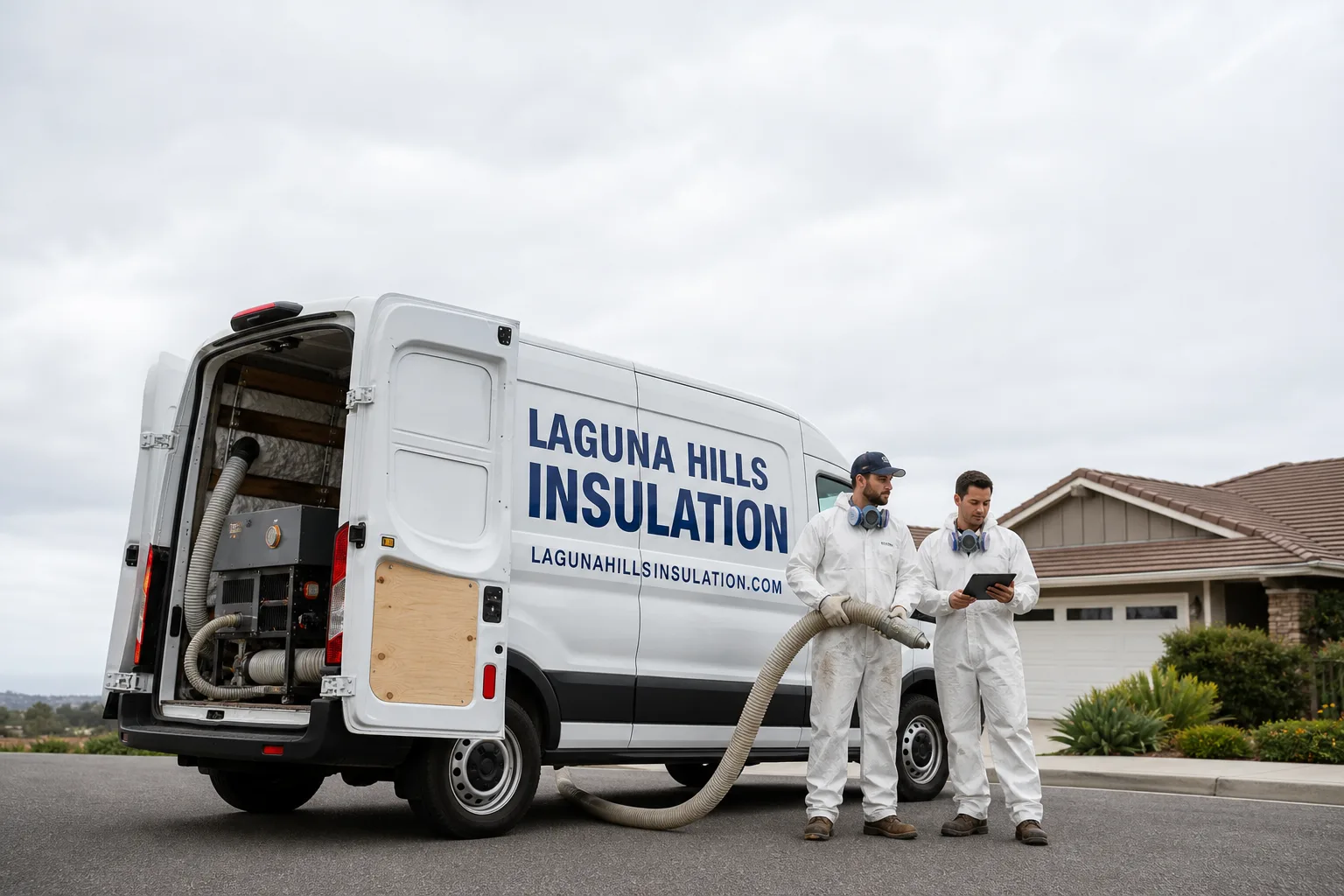
Fast, Reliable Spray Foam Insulation Across Commerce
Spray foam insulation in Commerce typically runs $2.75 to $5.50 per board foot for open-cell and $4.50 to $8.00 per board foot for closed-cell, with most whole-attic projects landing between $4,200 and $9,800 depending on square footage and foam depth. We serve Commerce from our Laguna Hills base with two-to-three-day scheduling for most residential jobs, and we know this city’s housing stock well enough to tell you when foam makes sense and when it doesn’t. Commerce sits hard against the 5 freeway, the 710 corridor, and active Union Pacific rail lines, so the insulation conversation here is rarely just about R-value. It’s about noise. Heat gain. And attics that were built in the 1950s with almost nothing between the roof deck and the living space. Call (866) 393-6041 for a free estimate and an honest read on what your home actually needs.
Why Laguna Hills Insulation Is Commerce’s Preferred Spray Foam Insulation Company
Commerce homeowners call us because we ask the question most insulation contractors skip: what problem are you actually trying to solve? If the answer is freeway rumble bleeding into the back bedrooms, open-cell in the wall cavities is a smarter spend than closed-cell on the roof deck. If the answer is a 140-degree attic cooking the ceiling drywall, two inches of closed-cell at the roofline changes the entire thermal envelope. We don’t stock one product and talk you into it. We carry eight manufacturer lines – Owens Corning, Johns Manville, Knauf, Rockwool, CertainTeed, Icynene, Demilec, and GreenFiber – and three installation methods under one roof, so the material recommendation comes from your house, not our inventory sheet.
Garrett Lund runs our crews, and he has spent years working the inland Los Angeles basin where Commerce sits. The city’s homes are mostly single-story stucco from the 1940s through the 1960s, with low attics, aging batt insulation, and a lot of heat-soaked roof decks. We’ve sprayed foam in attics off Bandini Boulevard where you could fry an egg on the rafters. We’ve fixed jobs where another contractor sprayed closed-cell over collapsed fiberglass and the foam blistered within a season. That local experience means we spec the job right the first time.
Response time to Commerce is consistently two to three business days for standard installs. We’re a straight shot up the 5. Emergency work after a foam failure or inspection red flag can often be scheduled sooner. And our Commerce customers routinely mention one thing in callbacks: they appreciate that we told them what they needed, even when it was a cheaper option than what they asked for.
Spray Foam Insulation Contractors in Commerce
Spray foam insulation contractors in Commerce work in a very different environment than contractors serving the coastal cities or the Westside. This city is dominated by rail yards, warehouses, manufacturing facilities, and the Citadel Outlets, with modest mid-century homes tucked in between. The insulation problems here come from heat, noise, and industrial adjacency, and the solution is rarely a simple attic top-off. When you need a contractor who understands that a home off Telegraph Drive has different requirements than one off Eastern Avenue, that’s where material knowledge and local experience collide.
Whole-Home Air Sealing and Thermal Envelope
Closed-cell foam from Icynene or Demilec creates an air barrier and a thermal barrier in a single application. For Commerce homes near the rail corridor, that dual performance is the entire point – sealing the attic envelope blocks both radiant heat gain and the sound transmission that travels through every gap, vent, and seam in a 1950s roof assembly. We typically install two inches of closed-cell at the roof deck for this purpose, which brings most unvented attics into conditioned space territory.
Commercial and Industrial Foam Applications
Commerce has more warehouse square footage per acre than almost any city in Los Angeles County. We spray rim joists, metal building purlins, and roof decks on commercial spaces where the priority is condensation control, thermal stability, or sound abatement between units. The material spec changes with the use case, and we’ll walk you through open-cell versus closed-cell based on whether you need moisture resistance, structural contribution, or just air sealing at the lowest cost per board foot.
Spray Foam Attic Insulation in Commerce
Spray foam attic insulation in Commerce is the highest-impact upgrade you can make to a mid-century stucco home, because these attics were built with almost no thermal barrier to begin with. Original fiberglass batts from the 1950s and 1960s have collapsed to R-9 or worse in most cases, and the roof decks absorb summer sun for twelve hours a day. Foaming the roofline turns that attic from a heat trap into a conditioned buffer zone. Typical cost for a 1,200-square-foot Commerce home runs $5,500 to $8,500 for full attic encapsulation with closed-cell.
Unvented Attic Conversion
In Commerce’s hot, dry inland basin climate, the unvented attic approach makes particular sense. Sealing the soffit vents and spraying foam directly to the roof deck stops superheated outdoor air from entering the attic at all. We recently sprayed two inches of Icynene closed-cell against the roof deck of a 1950s stucco home off Telegraph Drive near the 5 freeway. The original fiberglass batts had collapsed and rail noise was bleeding through the vents. The closed-cell layer sealed the attic envelope, cut the summer attic temperature by roughly 30°F, and noticeably muffled the freeway rumble that had plagued the back bedrooms.
Rim Joist and Band Board Sealing
Older Commerce homes leak air at the rim joist where the floor framing meets the foundation, and that gap also transmits ground-level traffic noise straight into the wall cavities. Open-cell foam at the rim joist costs a fraction of a full attic job and delivers immediate comfort improvement. Expect to pay $900 to $1,800 for a full rim joist treatment on a typical Commerce single-story.
Trusted Brands We Service in Commerce
We install and maintain spray foam from Icynene and Demilec, two of the industry’s most recognized open-cell and closed-cell product lines, and we stock the supporting materials needed to match Commerce’s housing stock – no special-order delays for mid-century attic retrofits. For customers who want a hybrid approach, we also carry Owens Corning and Johns Manville batt products, Rockwool mineral wool for fire-resistant applications, and Knauf blown-in fiberglass where a foam-and-fill strategy makes more sense. Eight brands across the full material spectrum means the right product wins the job, not the one we happen to stock that week.
Common Spray Foam Insulation Problems We See in Commerce Homes
- Foam over collapsed fiberglass. We see this constantly in Commerce’s older single-story homes. A contractor sprays closed-cell over original 1950s batts that have compressed to nothing, the trapped heat blisters the foam, and within a season the job is delaminating. Full removal of old material before spraying is not optional in these attics.
- Off-gassing from improper mixing in low attics. Two-component spray foam has to be ratio-mixed correctly, and Commerce’s low, poorly ventilated mid-century attics trap any chemical odor for weeks. This almost always traces back to a rushed install with uncalibrated equipment or cold-day application. Proper temperature control and post-spray ventilation matter more here than in newer homes with larger attic volumes.
- Foam over knob-and-tube wiring. Many Commerce homes still have active or abandoned knob-and-tube circuits in the attic. Spraying closed-cell directly over the wiring creates a fire hazard and fails inspection. We inspect every attic before quoting, and if we find live knob-and-tube, we’ll tell you the foam job should wait until the circuit is addressed.
- Heat-related foam shrinkage at vents and roof transitions. The inland basin heat puts real stress on foam at roof deck transitions where expansion and contraction happen daily. Poorly specified open-cell in these zones pulls away from the decking within a few years. We spec closed-cell at all roof transitions in Commerce attics, because the temperature swing demands it.
Pricing for Spray Foam Insulation in Commerce, CA
A typical open-cell attic spray in Commerce runs $2.75 to $3.75 per board foot, while closed-cell runs $4.50 to $6.50 per board foot depending on depth and accessibility. A 1,200-square-foot attic with closed-cell at the roofline lands between $5,500 and $8,500. Rim joist jobs run $900 to $1,800. Garage ceiling foam runs $1,800 to $3,600 depending on whether you want the door sealed as well. Factors that move the price in Commerce specifically include attic height and access, whether old insulation needs full removal, and whether knob-and-tube wiring requires an electrician’s sign-off before we spray. Every quote is written, itemized, and free. Call (866) 393-6041 and we’ll get you real numbers.
We Also Serve Cities Near Commerce
Beyond our work across Commerce, we regularly install spray foam insulation in Maywood, Bell, Cudahy, and Bell Gardens. These neighboring cities share the same inland basin heat profile and older housing stock, and the noise-and-thermal dual-purpose approach we use in Commerce applies just as directly there.
Serving Commerce, CA — Our Local Coverage Area
We’re based in the Commerce area and know this community well. Use the map below to see our service coverage — if you’re nearby, we can almost certainly help.
FAQs About Spray Foam Insulation in Commerce
Yes, closed-cell spray foam at the attic roofline reduces freeway and rail noise measurably, but noise reduction comes primarily from air sealing, not mass. The foam seals the gaps and vents where sound waves travel, and in Commerce homes near the 5 freeway or rail yards, that sealing is often the single biggest acoustic improvement available. For homes backing directly onto rail lines, we may recommend a combination of foam air sealing plus mineral wool batts for added mass. Call (866) 393-6041 and we’ll assess your specific exposure.
No, spraying foam over old compressed fiberglass batts in a Commerce attic will trap heat between the old insulation and the new foam, causing blistering and delamination in the basin heat. The old material has to come out first. That adds $1,500 to $3,000 to a typical job depending on attic size, but skipping it means paying for the job twice.
Two inches of closed-cell foam at the roofline is the standard for converting a mid-century Commerce attic into a conditioned space, delivering roughly R-13.5 plus a full air seal. If you want to reach code-required R-values without losing attic height, we can add open-cell on top of the closed-cell layer or install a hybrid assembly with blown-in over the foam. In Commerce’s heat-dominated climate, the air seal matters more than the raw R-number, and two inches of closed-cell gets you both.
Yes, and this is non-negotiable in Commerce’s older housing stock. Spraying foam directly over active knob-and-tube wiring is a fire hazard and will fail inspection. We check every attic before quoting. If we find live knob-and-tube, the electrical work has to happen first, and we’ll coordinate that schedule with your electrician so the foam goes in as soon as the circuit is cleared. Call (866) 393-6041 and we’ll walk you through what we need to see.
Yes, closed-cell spray foam applied to the underside of a metal roof deck or purlin system reduces radiant heat gain in Commerce warehouses dramatically, often dropping interior peak temperatures by 20°F or more in summer. For commercial spaces, we also address rim joists and wall-to-roof transitions where heat and condensation enter. The material spec depends on whether you need condensation control, thermal stability, or both, and every commercial foam job includes a written spec before we spray.
Written by Garrett Lund, Owner at Laguna Hills Insulation, serving Commerce since day one.