
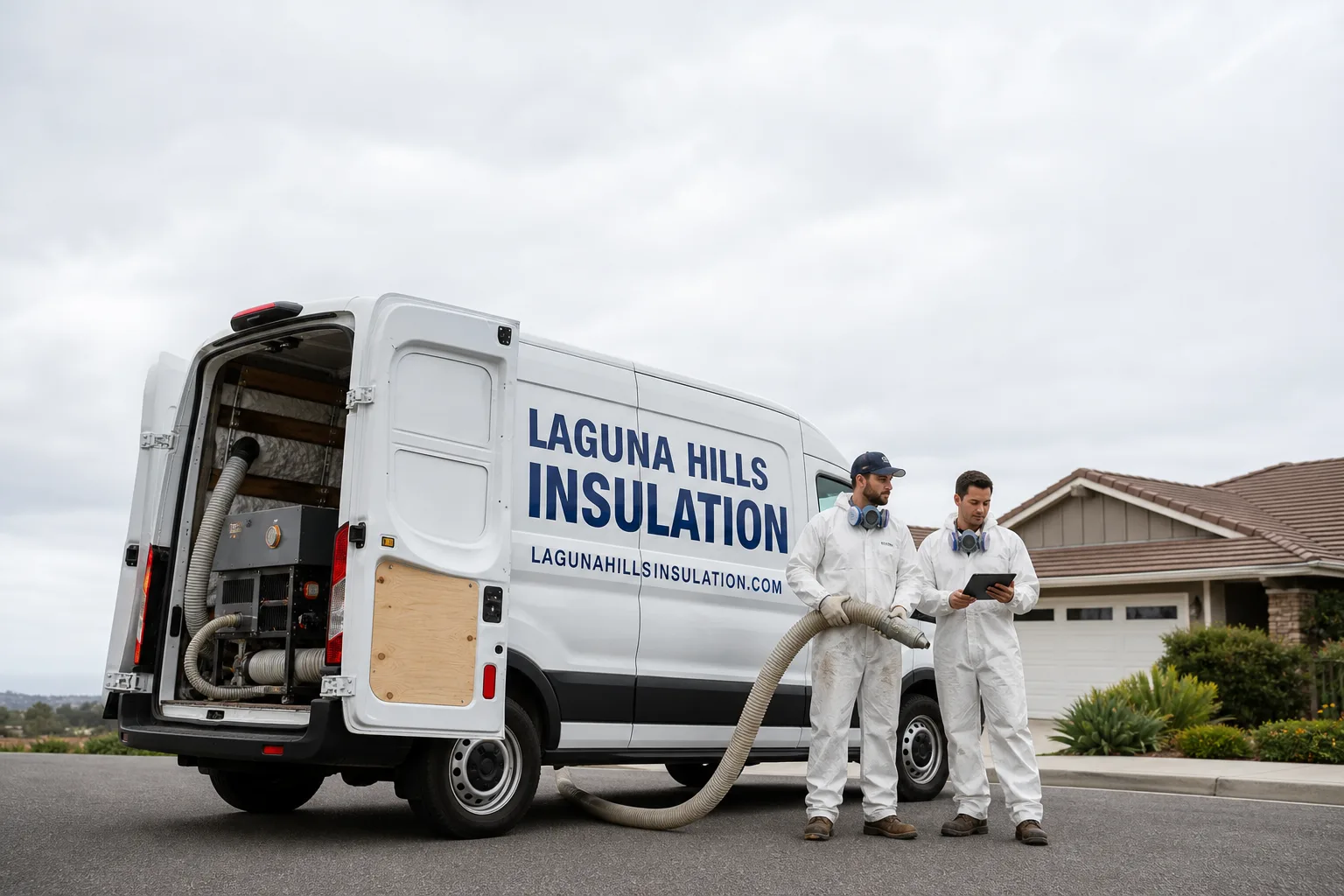
Fast, Reliable Spray Foam Insulation Across Banning
Spray foam insulation in Banning addresses two problems most other California cities don’t face with the same intensity: persistent San Gorgonio Pass winds and summer heat that sits on a home for weeks at a time. A typical closed-cell spray foam job in Banning runs $3.50 – $6.50 per board foot installed, while open-cell runs $1.80 – $2.90 per board foot. Our crews work in Banning regularly and know how wind-driven air infiltration changes what a home actually needs. Call (866) 393-6041 for a straight answer about your house.
Why Laguna Hills Insulation Is Banning’s Preferred Spray Foam Insulation Company
Banning homeowners call us because wind problems are not guesswork here. We have inspected enough attics along West Ramsey Street, Sun Lakes, and the neighborhoods near the Banning Municipal Airport to know that the pass winds move insulation in ways a sheltered Inland Empire town never sees. When we quote a job in Banning, we are quoting for wind-driven air sealing, not just thermal resistance. That distinction is why our Banning customers tell us the quote process actually made sense, and why they pass our name to neighbors on streets like Hargrave and Wilson.
Our crews respond to Banning with the same scheduling priority as our closer Orange County calls. A survey appointment is typically available within a few days, and most Banning spray foam installations are completed in one to two working days once material arrives. We carry Icynene and Demilec product lines inventory and have direct access to their technical support teams, which matters when a mid-century home off Eighth Street needs a retrofit plan, not a generic install.
Garrett Lund built this company around one idea: the material and method should fit the house, not the other way around. In Banning, that means we do not push closed-cell on every job just because it is the premium option. We recommend open-cell where air sealing is the real issue, closed-cell where wind-driven heat gain and low slope roof decks demand a vapor and thermal barrier, and we say so plainly.
Spray Foam Wall Insulation in Banning
Spray foam wall insulation in Banning usually falls into two categories: exterior wall cavity work during a remodel or retrofit, and sealing existing walls from the attic side where top plates and wire penetrations are open to the wind. Homes in the 92220 zip code that were built in the 1950s through 1970s often have nothing but a thin layer of deteriorated fiberglass in the stud bays, and many still have open top plates where the wall meets the attic. The pass winds press against the east and northeast walls and force air through every unsealed seam. Spray foam is the one material that both fills the cavity and seals the air path in a single pass.
Cavity Fill for Wind-Exposed Walls
Closed-cell foam at one to two inches brings a wall to the air-sealing level that Banning’s wind-exposed neighborhoods actually need. The R-value is secondary to the fact that air stops moving through the wall assembly. Open-cell works when the stud bays are deep enough and the homeowner’s main goal is sound deadening plus air sealing on an interior wall.
Attic-Side Top Plate Sealing
When walls are closed up and the homeowner does not want drywall torn out, we seal top plates from the attic side with a targeted spray foam application. This addresses the single biggest air infiltration path in older Banning homes without a full wall retrofit. Plan on $900 – $2,200 for a typical 1,500 – 2,000 square foot single-story, depending on attic access and how many penetrations need treatment.
Rim Joist Spray Foam in Banning
Rim joist spray foam in Banning homes is often the highest-return insulation upgrade we do here. The rim joist, the band of framing where the floor platform meets the foundation wall, is a direct air leak into the crawl space or basement. In Banning’s mid-century tract homes, the original plywood or dimensional lumber rim is frequently uninsulated and unsealed. Climb under a house on a windy spring afternoon and you can feel the pass winds moving through the rim. A typical rim joist spray foam job in Banning runs $1,200 – $3,500 depending on linear footage and access depth.
Crawl Space Air Sealing
We apply closed-cell foam to the rim in two to three inches, bridging the seam between the foundation and the framing. This stops wind-driven air from reaching the floor system and the conditioned space above it. In homes where the crawl space also has open vents to the outside, sealing the rim often drops humidity inside dramatically, which is something Banning homeowners notice immediately after the job.
When Rim Joist Is the First Step
If the budget allows only one spray foam project this year, rim joist sealing is usually where we point Banning clients first. It is a contained, measurable area, it addresses the wind problem directly, and it is done in a single day. From there, an attic upgrade can be scheduled the following season.
Trusted Brands We Service in Banning
We install spray foam from Icynene and Demilec, and we also work with Owens Corning and Johns Manville products for attic and blown-in applications. That brand depth matters when you want an honest comparison rather than a single-product pitch. For Banning clients, we keep common open-cell and closed-cell product specs on hand so we can turn around quotes without a manufacturer rep visit. If a warranty claim or a technical question comes up after install, we route it through the manufacturer’s Banning-appropriate service channels instead of leaving the homeowner to figure it out.
Common Spray Foam Insulation Problems We See in Banning Homes
- Wind-drifted attic insulation. The San Gorgonio Pass winds push original fiberglass into deep drifts against downwind eaves, leaving bare ceiling patches on the upwind side. Spray foam crews who mostly work in sheltered cities don’t recognize this pattern, but in Banning it’s the rule, not the exception.
- Unsealed top plates and penetrations. Older Banning homes have dozens of unsealed wire, pipe, and duct openings between the living space and the attic. On a windy day, air moves through these spaces faster than any insulation can slow it down.
- Thin original attic insulation. Many mid-century homes in the 92220 area had only R-11 or R-13 fiberglass installed when they were built. That was never enough for Banning’s summer heat load, and after decades of wind scouring and settling, the real coverage is often much lower.
- Open crawl space rims. The rim joists in older Banning homes draw outside air directly into the floor system on windy days. This is the most overlooked air infiltration path in the city’s housing stock.
Pricing for Spray Foam Insulation in Banning, CA
Here is what Banning homeowners can expect to pay for spray foam work in 2026:
- Open-cell attic or wall spray foam: $1.80 – $2.90 per board foot installed
- Closed-cell attic or wall spray foam: $3.50 – $6.50 per board foot installed
- Rim joist spray foam (typical single-story home): $1,200 – $3,500 total
- Top plate air sealing (attic side): $900 – $2,200 total
- Garage ceiling spray foam (exposed underside): $2.40 – $4.80 per board foot installed
Banning homes with accessible attics and open stud bays price out at the lower end. Homes with tight attics, shallow roof pitches, or pest-damaged framing push toward the upper end. Every quote we issue in Banning includes a written scope and material spec, so you know exactly what product is going in and why. Call (866) 393-6041 for a free estimate.
Spray Foam Insulation in Banning and the San Gorgonio Pass Wind Problem
Here is the thing most spray foam pages never mention about Banning: the wind is a bigger insulation problem than the heat, and it changes how the work has to be done. Banning sits at the western edge of the San Gorgonio Pass, one of the most consistently windy corridors in Southern California. That wind pushes against exterior walls, works into the attic through soffit vents, and scours loose-fill insulation away from the upwind side of the attic.
We have walked Banning attics and seen the same scene repeated: original fiberglass piled in a thick drift against the downwind eave while the upwind ceiling is nearly bare. That bare patch is not just an R-value problem. It is a concentrated air leak where conditioned indoor air gets sucked out and 100-degree summer air gets pulled in. Banning’s exposed, wind-scoured neighborhoods along the pass deal with this cycle continuously, and it is the single most predictable trigger for spray foam retrofit work here.
What this means for product choice is straightforward. In Banning, spray foam earns its cost not because it has a high R-value per inch, but because it does not drift, does not settle, and closes off the air paths that the wind exploits. Closed-cell foam from Icynene or Demilec gives you air sealing plus a thermal barrier in one application, which is why it is the right call for wind-facing walls, attic roof decks, and rim joists in this city. Open-cell does excellent air sealing at a lower material cost, and for Banning attics where the real enemy is wind infiltration, not deep cold, it is often the smarter budget fit.
The other Banning-specific factor is the heat that follows the wind. Summer temperatures regularly sit above 100°F, and on a windy afternoon the air moving through an unsealed attic can replace the entire attic air volume many times over. That is not a heating-load problem, it is a heat-gain and air-exchange problem, and it is exactly what a properly applied spray foam Spray Foam Insulation application addresses. In sheltered cities like Redlands or Riverside, the same house might get by with more fiberglass. In Banning, that fiberglass would end up in a drift against the eave within a few seasons.
Field Notes from a Banning Mid-Century Tract Home
On a mid-century tract home off West Ramsey Street near the Banning foothills, our crew found exactly this failure pattern. The original attic insulation had piled in a deep drift against the downwind eave while the upwind ceiling was essentially bare, with pass winds pulling conditioned air through unsealed top plates and old single-pane window penetrations. We removed the drifted material, sealed the open penetrations and rim areas with spray foam, and closed off those wind-driven air paths so the assembly could actually hold its rating. The homeowner told us afterward that the room at the upwind corner of the house, the one that had never held temperature in July, finally stayed comfortable. That kind of fix is not about more material. It is about putting the right material in the right place, which is our whole Spray Foam Insulation in Banning approach.
We Also Serve Cities Near Banning
Our Banning crews regularly work in Cabazon, Calimesa, Yucaipa, and Valle Vista, all of which share similar pass-wind and heat profile to varying degrees. If you live just outside the 92220 zip and need spray foam work, call (866) 393-6041 and we will schedule a site visit the same week.
Serving Banning, CA — Our Local Coverage Area
We’re based in the Banning area and know this community well. Use the map below to see our service coverage — if you’re nearby, we can almost certainly help.
FAQs About Spray Foam Insulation in Banning
Persistent San Gorgonio Pass winds press through soffit and gable vents and push loose-fill insulation across the attic floor, creating drifts on the downwind side and bare patches on the upwind side. This happens predictably in Banning homes and is a sign that your attic is wind-driven, not just under-insulated. The fix is a spray foam application that adheres in place and also seals the air paths the wind exploits. Call (866) 393-6041 and we will inspect the attic and tell you what is actually happening up there.
Both, but the Banning-specific driver is wind infiltration, which accelerates heat gain far beyond what still air would cause. Spray foam addresses both simultaneously because it seals air paths and provides thermal resistance in the same application. If you are comparing spray foam to adding more fiberglass, the air-sealing difference is the deciding factor in this city.
Yes, and in fact single-pane homes benefit more from spray foam than newer double-pane homes do, because the wall, attic, and rim air leaks are a larger share of the total heat exchange when the windows themselves offer almost no resistance. Spray foam will not fix the windows, but it will stop the wind from carrying heat through every other opening in the building envelope. Call (866) 393-6041 for a Banning-specific assessment.
Yes, rim joist sealing is one of the most direct spray foam applications on mid-century Banning homes, and it typically takes one day to complete. We remove accessible insulation, clean the rim surface, and apply closed-cell foam to bridge the foundation-to-framing seam. The result is an immediate drop in floor-level drafts and crawl space humidity.
For most Banning homes, yes, because the wind will re-scour loose fiberglass into drifts within a few years, recreating the bare spots the material was meant to cover. Spray foam stays in place and seals the air paths that fiberglass leaves open. You pay more up front, but you do not pay twice. Call (866) 393-6041 for an honest quote on what your home actually needs.
Get a Straight Answer on Spray Foam Insulation in Banning
If your Banning home is fighting the pass winds, losing cool air in the summer, or you have walked up into the attic and seen insulation piled against one eave, call us. We will inspect the house, explain what the wind is doing to your building envelope, and quote the right material for the job. No single-brand pitch, no pressure. Call (866) 393-6041 for a free Banning estimate. Our team works throughout the 92220 area and surrounding communities, and we will give you a straight answer on whether spray foam, blown-in, or a targeted air-sealing project is the right call for your home.
Written by Garrett Lund, Owner at Laguna Hills Insulation, serving Banning and the surrounding Pass area communities.