Fast, Reliable Attic Insulation Across Glen Avon
Attic insulation in Glen Avon is a different job than it is five miles south. The low-pitch ranch roofs that dominate ZIP 92509 change how we access attics, how much material we can get in, and which ventilation upgrades actually work. If you’re losing cool air through can lights or watching your AC run through the afternoon, the fix usually starts in the attic. We serve Glen Avon homeowners with full-method insulation work: blown-in, batt, spray foam, and radiant barriers. Call (866) 393-6041 for a free estimate, and we’ll tell you honestly what your roof needs and what it doesn’t.
Why Laguna Hills Insulation Is Glen Avon’s Preferred Attic Insulation Company
Most Glen Avon homes were built between 1955 and 1985, which means most have original insulation that’s settled to a fraction of its rated R-value. Garrett Lund, who leads our team, has walked hundreds of these attics across Riverside County. He knows the specific failure patterns: compressed fiberglass in ranch homes, unsealed top plates in mid-century frames, attic access doors that leak conditioned air into 100°F-plus attics. Our customers in Glen Avon tell us the same two things after every job: the house cools down faster, and the AC doesn’t cycle as hard. We carry eight manufacturer lines: Owens Corning, Johns Manville, Knauf, Rockwool, CertainTeed, Icynene, Demilec, and GreenFiber. Most Glen Avon jobs use one or two of them, matched to the roof pitch and the existing insulation.
Glen Avon sits in the Jurupa Valley area of Riverside County, where summer heat routinely climbs past 105°F and the Inland Empire sun bakes west- and south-facing walls and attics. That’s why we treat insulation here as much about heat rejection and attic ventilation as it is about winter warmth. A Glen Avon attic that hits 140°F in July needs a different strategy than a coastal attic that peaks at 110°F. We plan for the real load.
Insulation Contractors in Glen Avon
Insulation contractors working in Glen Avon have to understand one thing before anything else: these aren’t cookie-cutter attics. The low-pitch roofs, the attached patios, the detached workshops, the original 2×4 framing with 16-inch bays. When a Glen Avon homeowner calls us, the job usually involves air sealing first, then insulating, then verifying ventilation. It’s not a blow-and-go job.
Air Sealing Before Insulation
Here’s what we see constantly in Glen Avon attics: the original insulation gets topped off with new material, but nobody seals the can lights, top plates, or bath fan housings first. So hot attic air still pours into the living space through the same holes. Real airflow through an unsealed can light can be equivalent to leaving a small window open all summer. We seal these penetrations before we add any insulation. It’s the difference between a real fix and a cosmetic one.
Blown-In Fiberglass and Cellulose for Existing Homes
For most Glen Avon ranch homes, blown-in fiberglass or cellulose is the workhorse. We run it at R-38 to R-49 in attics with enough clearance, and R-30 where low-pitch framing limits depth. GreenFiber cellulose is a good fit for Glen Avon homeowners who want a recycled-material option, and it settles less than older cellulose. The cost to blow in R-38 in a typical 1,200 to 1,600-square-foot Glen Avon attic typically runs $1,800 to $3,200, depending on access and prep work.
Attic Ventilation in Glen Avon
Attic ventilation in Glen Avon is where insulation jobs go wrong when it’s skipped. A low-pitch roof already traps heat; add a radiant barrier or fresh insulation without giving the attic a way to breathe, and you’ve built an oven. We don’t install insulation in Glen Avon without checking the vent system: soffit vents, baffles, ridge or turtle vents, and the intake side of the equation.
Baffles and Intake Vents
On a working ranch attic off Galena Street, we found the incoming air path blocked by blown insulation piled over the soffit vents. The homeowner was fighting 140°F attic temperatures even after a previous insulation top-up. We installed vent baffles at every rafter bay, cleared the intakes, and the attic temp dropped almost immediately. For Glen Avon homes, we treat baffle placement as a requirement, not an add-on. A full baffle and vent correction on a 1,400-square-foot ranch typically runs $450 to $900.
Ridge and Turtle Vent Upgrades
Many 1960s and 1970s Glen Avon homes have only a few small turtle vents, which don’t move nearly enough air for an Inland Empire attic. We upgrade those to continuous ridge vents or add powered vent fans where passive airflow isn’t enough. The goal is simple: attic temp stays within 10 to 15°F of outdoor temp, even on a 105°F day. Vent upgrades for a typical Glen Avon ranch home run $600 to $1,400, including decking cuts and flashing.
Trusted Brands We Service in Glen Avon
We’re not married to one manufacturer. We stock and install Owens Corning, Johns Manville, Demilec, and GreenFiber, among others, because different Glen Avon homes need different materials. A low-pitch attic with limited clearance might get Owens Corning AttiCat blown-in fiberglass. A detached workshop with exposed rafter bays might take Demilec closed-cell spray foam for the air seal. We keep common material on hand for Glen Avon jobs, which means most estimates turn into installs within a week. If you want to know which product fits your home, call (866) 393-6041 and ask. We’ll give you the same answer we’d give a neighbor.
Common Attic Insulation Problems We See in Glen Avon Homes
- Compressed, dust-settled original insulation. Decades of heat cycles settle fiberglass batts from R-11 or R-19 to something closer to R-4 or R-6. We see this in nearly every 1970s ranch we open. Topping it off without air sealing leaves the real problem untouched.
- Unsealed can lights and top plates. Hot attic air pours through these gaps and into the living space. On one 1972 ranch off Galena Street, we found two can lights bleeding attic air directly into the living room, and the homeowner had no idea. Sealing them took less than an hour.
- Low-pitch roof heat trapping. Glen Avon ranch homes with shallow roof slopes hold heat against the ceiling, which radiates into the house all evening. Without baffles and a radiant barrier or adequate ventilation, new insulation underperforms. Many homeowners add insulation and wonder why nothing changed; the vent path was never upgraded.
- Detached workshop and addition attics with no sealing at all. The oversized attic access doors and thin walls on detached garages and workshops leak conditioned air directly into 100°F-plus Inland Empire heat. Weatherstripping and insulation upgrades on these structures make a difference measurable on the next power bill.
Pricing for Attic Insulation in Glen Avon, CA
Attic insulation pricing in Glen Avon depends on roof pitch, access, existing material, and how much air sealing the attic needs. A straightforward blown-in R-38 top-up on a 1,200-square-foot ranch typically runs $1,600 to $2,800. A full job with air sealing, baffles, vent corrections, and R-49 cellulose or fiberglass runs $2,800 to $4,800. Adding a radiant barrier across a low-pitch south or west slope adds $700 to $1,400. Detached workshop attics usually run $900 to $2,200 depending on size and whether spray foam makes sense. Every estimate includes an attic inspection, and we’ll show you what’s actually up there before you spend a dollar. Call (866) 393-6041 for a free quote; most Glen Avon jobs get scheduled within a week.
We Also Serve Cities Near Glen Avon
Our crews work throughout the Jurupa Valley and nearby Riverside County communities. If you’re in Pedley, Sunnyslope, Rubidoux, or Riverside, the same team handles Attic Insulation work in your area. For detailed service coverage, see our Glen Avon page or call us directly.
Serving Glen Avon, CA — Our Local Coverage Area
We’re based in the Glen Avon area and know this community well. Use the map below to see our service coverage — if you’re nearby, we can almost certainly help.
FAQs About Attic Insulation in Glen Avon
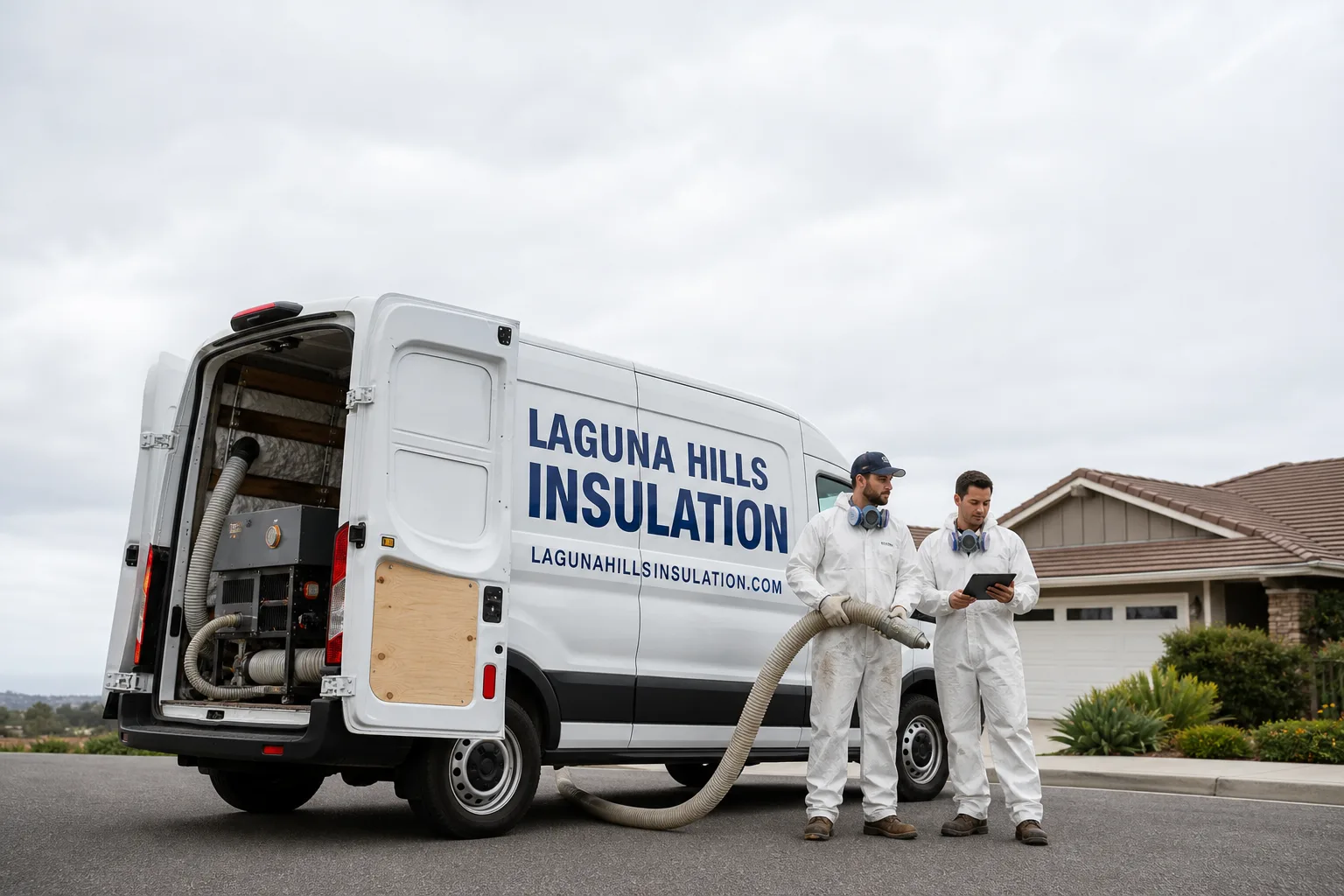
Low-pitch roofs limit attic clearance, which means we can’t always reach the eaves with standard equipment. In Glen Avon, our crews use low-profile hoses and flexible ducting to install insulation and radiant barriers without cutting new access holes. We work in attics with 18 to 24 inches of clearance at the peak and far less at the eaves, which changes where we can place baffles and how we route blown-in material. For tight attics, we often spec a thinner but higher-density blown-in fiberglass or a spray foam approach instead.
Because those can lights are essentially holes in your ceiling. In a 1970s Glen Avon ranch, the can light housings are rarely insulated or sealed, so 130°F attic air blows straight into the living room. We seal them with fire-rated covers or foam boxes before adding insulation. If you skip this step, you’re paying to insulate a sieve. It takes under an hour for most homes, and the improvement is immediate.
For most Glen Avon homes, you need both, but the radiant barrier does the heavier lifting in summer. Insulation slows heat transfer; a radiant barrier reflects it. On a low-pitch roof with full Inland Empire sun, a radiant barrier across the south and west slopes can drop attic temperature by 20 to 30°F. We recommend it for any Glen Avon attic that gets direct sun for most of the day. If your attic already has R-30 or better and the house still overheats, the radiant barrier is usually the missing piece.
For dry heat, the material matters less than the installation and the air sealing. That said, Owens Corning blown-in fiberglass handles hot attic conditions well and doesn’t settle much. GreenFiber cellulose is a solid choice for sustainability-minded homeowners and holds its R-value in dry heat. For detached workshops and tight attics, Demilec closed-cell spray foam gives you both an air barrier and a thermal barrier in one pass. We’ll spec the one that fits your roof pitch and clearance, not the one we happen to have the most of in the truck.
Yes, most detached workshop attics in Glen Avon take one day, sometimes less. We bring the material, the blower or spray rig, and the baffles and weatherstripping for the access door. The biggest variable is whether the attic has existing wiring or stored material that needs to be cleared. If the space is accessible and empty, it’s a one-trip job. Call (866) 393-6041 and tell us the size and pitch of the roof; we’ll give you a straight answer on timing and cost.
Written by Garrett Lund, Owner at Laguna Hills Insulation. Serving Glen Avon, CA and the Jurupa Valley area with full-method attic insulation, spray foam, and blown-in insulation.