
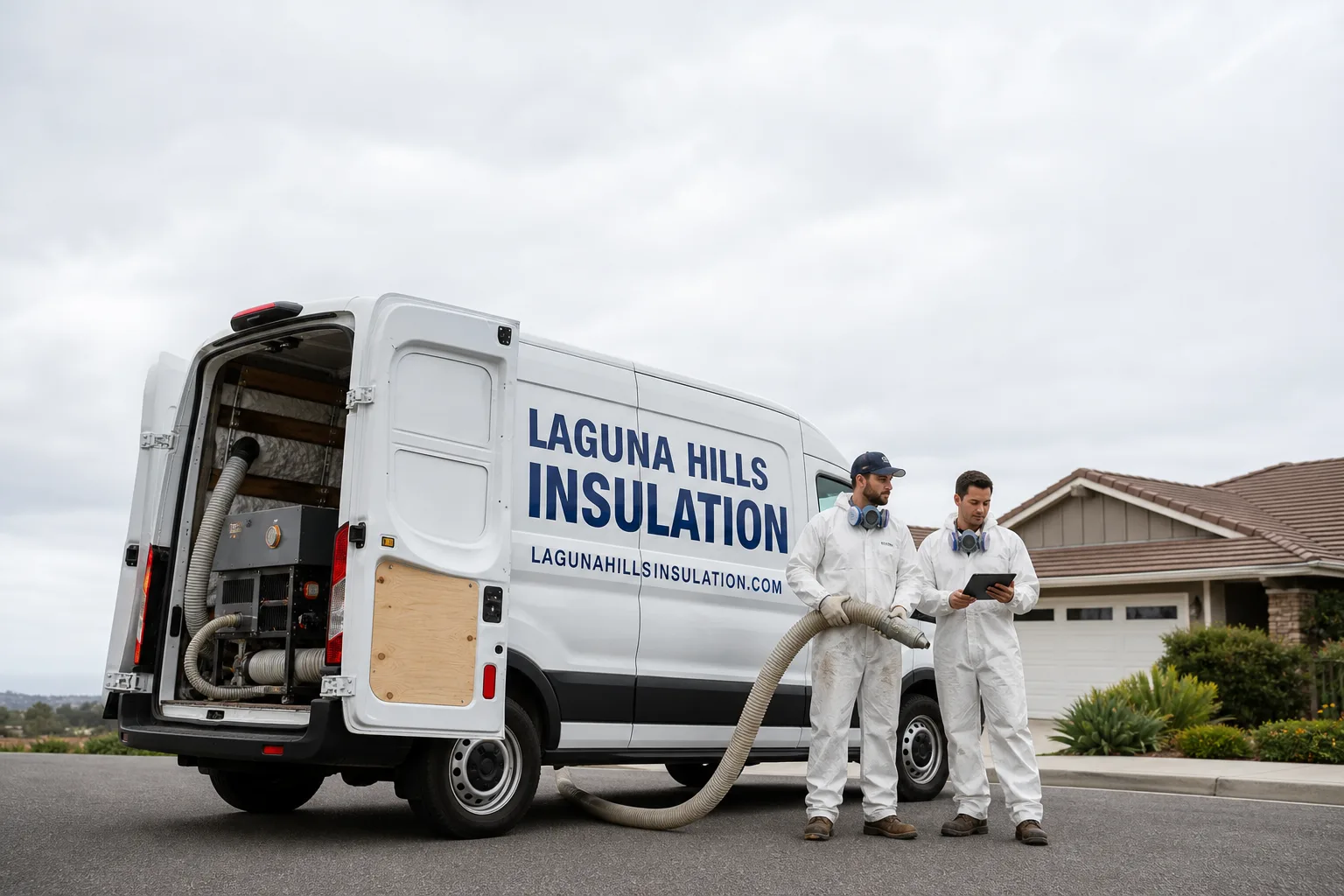
Fast, Reliable Attic Insulation Across Coto De Caza
Attic insulation in Coto De Caza typically costs $1,800 – $6,500 depending on attic size, current insulation depth, and whether we’re topping up settled fiberglass or installing a full air-sealing package with radiant barrier. Most jobs on 3,000 – 5,000 sq ft Mediterranean homes run two to three days, and we can usually schedule within a week. The catch in Coto De Caza isn’t the insulation itself. It’s the HOA. Any work that changes vent locations, roof penetrations, or exterior-visible materials needs architectural committee pre-approval before we touch the attic. We handle that process for you, start to finish.
If your upstairs rooms cook in the afternoon and your AC runs nonstop from June through October, call us at (866) 393-6041. We’ll walk you through what’s actually happening in your attic and what it’ll take to fix it.
Why Laguna Hills Insulation Is Coto De Caza’s Preferred Attic Insulation Company
Coto De Caza isn’t a typical Orange County suburb. It’s a gated, HOA-governed enclave where even a new roof vent needs paperwork. We’ve worked inside the CZ Master Association’s architectural review process enough times to know exactly what the committee looks for: vent styles that match the original build, roof-line continuity, and zero visible changes that weren’t on the approved plans. That’s not something a contractor who mostly works Rancho Santa Margarita or Lake Forest learns overnight.
Our approach is simpler than most. We carry eight manufacturer lines: Owens Corning, Johns Manville, Knauf, Rockwool, CertainTeed, Icynene, Demilec, and GreenFiber. We’ll spec whatever your attic actually needs, then coordinate the HOA paperwork around it. Garrett Lund, who leads our insulation work, has spent years navigating the specific architectural-review quirks of Coto De Caza’s older custom tracts off the main gate. That experience means fewer delays, fewer resubmissions, and a job that passes inspection the first time.
Response time to Coto De Caza runs same-week for estimates and typically 7 – 10 days to start once approvals clear. Call (866) 393-6041 and we’ll come measure your attic, check your baffles and venting, and tell you what the HOA will require before you spend a dollar.
Attic Ventilation in Coto De Caza
Attic Ventilation in Coto De Caza is the difference between an attic that stays under 120°F in August and one that bakes at 150°F and radiates heat into your ceiling all afternoon. Most original 1980s – 2000s builds in the 92690 zip code came with passive soffit-and-ridge venting that worked adequately at first. Two decades of dust, old roofing underlayment, and occasional bird or rodent activity later, a lot of those soffit vents are partially or fully blocked. The result: heat builds, AC load climbs, and upstairs bedrooms never quite cool down. Adding a radiant barrier or upgrading insulation without fixing the ventilation first just moves the problem around.
What a proper ventilation retrofit involves
We start by inspecting every soffit vent from inside the attic, then calculate total net-free vent area against your attic’s square footage. If you’re short, we spec additional vents. On tile-roof Coto De Caza homes, that usually means low-profile ridge venting or additional eave vents that match the existing roof line. HVAC load drops measurably when the attic stops superheating, and shingle or tile underlayment lasts longer too.
HOA coordination on exterior vent changes
Any vent that changes the exterior appearance of your roof or eaves falls under the CZ Master Association’s architectural review. We prepare the submittal package: proposed vent location, style, color, and roof-line impact. Then we wait for the committee’s written approval before cutting anything. It adds a week or two to the timeline, but skipping it creates an HOA violation that’s far messier to untangle after the fact.
Radiant Barrier in Coto De Caza
Radiant Barrier in Coto De Caza works because this inland Orange County climate punishes attics with intense, direct summer sun. A radiant barrier stapled to the underside of your roof rafters reflects a large portion of that radiant heat back out instead of letting it saturate the attic air. On a 4,000 sq ft tile-roof home off Oso Parkway, attic temps can drop 20 – 30°F. That directly cuts the heat bleeding down through your insulation into the living space. In wildfire-adjacent zones like the hills behind Coto’s south gate, a perforated aluminum radiant barrier also adds a modest fire-resistant layer, though it’s not a substitute for proper defensible space and fire-rated venting.
When it makes sense
Radiant barrier earns its keep when your AC runs hard from May through October and your attic has plenty of exposed roof framing. We install it above the existing insulation, leaving the soffit vents clear and maintaining a small gap at the ridge so hot air can still escape. Combined with proper ventilation and a full insulation top-up, it’s usually the difference between an upstairs that’s tolerable and one that’s actually comfortable.
Tile roof and HOA considerations
Because radiant barrier lives entirely inside the attic, it typically doesn’t require architectural committee approval on its own. But pair it with new ridge vents or a solar-powered attic fan and you’re back in review territory. We’ll tell you up front which parts of the job trigger the paperwork and which don’t. No surprises, no violation letters from the association.
Trusted Brands We Service in Coto De Caza
We install and service insulation from the brands Coto De Caza homeowners are already researching: Owens Corning and Johns Manville for fiberglass, Knauf for high-density batts, GreenFiber for recycled cellulose, plus Rockwool for fire-resistant mineral wool. Since we’re not tied to a single line, we keep local stock in our Laguna Hills warehouse and can pull what your job needs without waiting on a distributor. For Coto De Caza specifically, we keep extra baffle stock on hand because of how many original soffit vents we find blocked in those older Mediterranean tracts. The right product for your attic, not just the one we happen to sell the most of.
Common Attic Insulation Problems We See in Coto De Caza Homes
- Settled original insulation: Many homes built from the 1980s through the early 2000s still carry their original blown fiberglass. Two decades of attic heat cycles compress it to half its original depth, dropping the effective R-value well below code for the current Title 24 standard in Coto De Caza’s climate zone 8.
- Blocked or missing baffles on cathedral ceilings: Coto De Caza floor plans love volume ceilings, which means lots of sloped attic cavities and knee walls. Without proper baffles at the eave line, soffit vents get covered, air flow stops, and those rooms never cool evenly.
- Multi-zone HVAC imbalance: Large 3,000 – 6,000+ sq ft homes usually run two or three HVAC zones. If one zone’s ductwork runs through a poorly insulated attic bay, that zone runs hard while the thermostat never quite satisfies. Air sealing the attic floor and topping up insulation levels fixes this more often than replacing the HVAC unit.
- Sound transfer between floors: The same open attic bays and unsealed knee walls that leak heat also leak noise. Mineral wool batts from Rockwool, dense-packed into floor joists and partition walls, knock down footfall and voice transfer significantly. It’s a common request on Coto De Caza’s larger two-story plans.
Pricing for Attic Insulation in Coto De Caza, CA
You’ll pay more in Coto De Caza than you would in Lake Forest or Mission Viejo, and not because of the zip code’s reputation. It’s the housing stock. Bigger attics, tile roofs, cathedral ceilings, and HOA architectural-review time all add cost. A blown-in insulation top-up on a 3,000 sq ft home usually runs $1,800 – $3,200. A full removal of old insulation, air sealing, new blown-in to R-38 or R-49, plus radiant barrier on a 5,000+ sq ft home lands in the $4,500 – $6,500 range. Adding attic ventilation retrofits with HOA submittal typically adds $800 – $1,800 depending on vent count and roof configuration.
These aren’t fixed bids. We measure your attic, check your existing R-value, and show you exactly what each layer costs before you commit. Estimates are free. Call (866) 393-6041 and we’ll get you real numbers for your specific home, not a generic square-footage guess.
We Also Serve Cities Near Coto De Caza
Besides Coto De Caza, our Attic Insulation team serves Mission Viejo, Lake Forest, Laguna Hills, and Rancho Santa Margarita. The HOA landscape changes from city to city, but the insulation fundamentals don’t. We’ll handle whatever review process your community requires.
Serving Coto De Caza, CA — Our Local Coverage Area
We’re based in the Coto De Caza area and know this community well. Use the map below to see our service coverage — if you’re nearby, we can almost certainly help.
FAQs About Attic Insulation in Coto De Caza
Pure insulation work that stays entirely inside the attic does not need architectural committee approval. What triggers review is anything that changes the exterior: new roof vents, relocating vents, adding a solar attic fan, or any change to the roof line or eave appearance. We’ll tell you exactly which parts of your project need CZ Master Association submittal and prepare the paperwork for you. Call (866) 393-6041 with your address and we’ll tell you what your specific home will require.
Yes. When a Coto De Caza home needs added ventilation, we spec low-profile vents in a color and profile that matches the existing roof. The architectural committee cares about aesthetic continuity, and we’ve done enough work inside the gates to know what passes. The goal is an attic that breathes properly without a visual change your neighbors would notice from the street.
Yes, but it takes more skill than a standard flat-ceiling attic. Cathedral and vaulted cavities need baffles to keep eave vents open, then either dense-packed cellulose or spray foam depending on the cavity depth and roof assembly. Tight access points just slow us down. We’ve handled plenty of Coto De Caza homes where the scuttle hole is a two-foot square in a closet ceiling. It’s slower work, but the results are the same.
It is. Rockwool mineral wool is non-combustible and holds its shape and fire resistance far better than fiberglass under heat. For Coto De Caza homes near the ridgelines and open space behind the north and east gates, mineral wool in the attic or between floors is a real upgrade, especially when paired with ember-resistant venting. It costs roughly 30 – 50% more than fiberglass, but for wildfire-adjacent lots it’s a defensible investment. We’ll give you honest numbers for both options.
Start with an inspection. On older Coto De Caza homes, we typically find settled fiberglass at half its original depth, blocked soffit vents, and zero air sealing on the attic floor. The fix is usually a full top-up to R-38 or R-49 after air sealing, plus baffles to restore attic ventilation and, in most cases, a radiant barrier. Budget $2,800 – $6,000 depending on attic size and scope. Call (866) 393-6041 and we’ll inspect your attic, map the heat problem, and give you a fix with real numbers.
Written by Garrett Lund, Owner at Laguna Hills Insulation, serving Coto De Caza since our first HOA-coordinated attic retrofit inside the gates.