
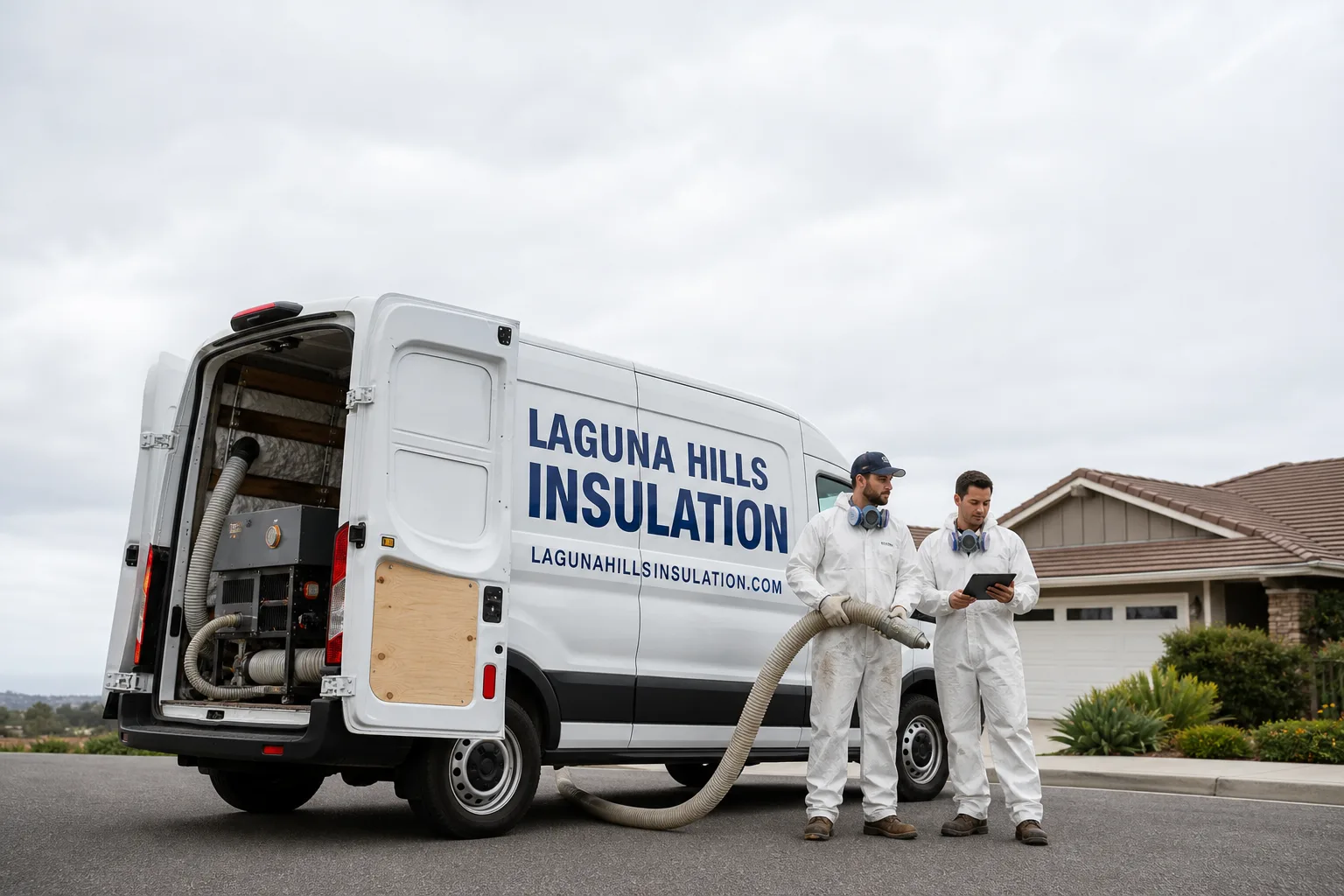
Fast, Reliable Attic Insulation Across Baldwin Park
Attic insulation in Baldwin Park usually means one of two jobs: a full clean-out and re-insulation of a 1950s or 60s tract home, or fixing the mess left behind by a garage conversion that skipped insulation entirely. We’ve done both, many times over, and we know what these houses need. If you’re in the 91706 ZIP and your upstairs rooms bake all summer while your AC runs nonstop, call us at (866) 393-6041. We’ll tell you exactly what’s in your attic, what it’s doing (or not doing), and what it costs to fix it right.
Why Laguna Hills Insulation Is Baldwin Park’s Preferred Attic Insulation Company
We’re not a one-product shop. We carry eight manufacturer brands – Owens Corning, Johns Manville, Knauf, Rockwool, CertainTeed, Icynene, Demilec, and GreenFiber – across fiberglass, mineral wool, spray foam, and cellulose. That matters in Baldwin Park because a 1958 stucco ranch with a low-pitch attic needs something different than a garage conversion with uninsulated shared walls. Most contractors stock one material and make your house fit it. We do the opposite. Garrett Lund built this company around the idea that the right insulation wins the job, not the easiest thing to install.
Our crews know Baldwin Park’s housing stock. We know the original rock wool in these attics has settled to nothing over six decades. We know the transition between the main house and the former garage is where the hot spot hides. And we know attic clearance on a 50s ranch is tight enough that a rushed crew will disturb or compress fresh insulation, which defeats the point. We don’t rush.
Attic Ventilation in Baldwin Park
Attic ventilation in Baldwin Park is the difference between an attic that runs 110°F and one that runs 150°F on the same August afternoon. In a city where summer highs sit in the 90s and 100s week after week, a properly vented attic gives your ceiling insulation a fighting chance. Without air movement through the attic, that superheated air radiates down into your living space all night. Most 1950s and 60s tract homes here were built with minimal venting – maybe a few small gable vents or a single set of eave vents that have since been painted over or blocked by re-roofing.
A standard attic ventilation job in Baldwin Park runs $400 to $1,200 depending on whether we’re installing baffles, adding eave and ridge vents, or correcting a blocked soffit. Most homes need the full treatment: baffles to keep air channels open at the eaves, plus ridge or gable exhaust up top.
Baffles and Airflow Correction
When we re-insulate a Baldwin Park attic, we insist on baffles at the eaves before any material goes in. Without them, blown-in insulation piles against the roof deck and chokes the airflow. Your attic becomes an oven with the door closed. It’s a small line item that prevents a big performance drop.
Signs Your Attic Isn’t Venting
Check your ceiling on a hot afternoon. If it feels warm to the touch even with the AC running, your attic is holding heat it shouldn’t. Peeling paint along the eaves and ice-free frost patterns on winter mornings also point to trapped moisture from poor ventilation. That moisture, not just the heat, is what rots roof decking over time.
Radiant Barrier in Baldwin Park
A radiant barrier in Baldwin Park works on a simple principle: the sun’s heat hits your roof, your roof radiates that heat into the attic, and a radiant barrier reflects most of it back instead of letting it soak into your insulation. In the San Gabriel Valley, where attic temperatures routinely hit 140°F to 150°F, a radiant barrier stapled to the underside of the roof rafters can cut attic air temperature by 15 to 20 degrees on its own. For homes with original insulation barely clinging to R-5, that’s the cheapest jump in comfort we can deliver without touching the ceiling below.
Radiant barrier installation in Baldwin Park typically runs $1,800 to $3,200 for an average 1,000 to 1,400-square-foot attic, depending on roof complexity and access. It’s not a replacement for insulation – it reduces radiant heat gain, but you still need adequate R-value to slow conductive heat transfer.
How It Works in a Low-Pitch Attic
Low-pitch attics are the standard here, which means less air volume and fewer places for heat to go. A radiant barrier gives that smaller space a break. We’ve measured the difference on Baldwin Park jobs: the same attic, same outside temperature, but the air near the roof deck drops enough that your AC compressor doesn’t have to fight as hard into the evening.
Pairing Radiant Barrier with New Insulation
The best result comes from doing both at once: clean out the dead material, air-seal the top plates, install baffles, blow in R-38 or better, then staple up the radiant barrier. Individually, each helps. Together, you’re attacking heat gain from two directions – reflecting it at the source and slowing it at the ceiling. Most Baldwin Park homeowners see the biggest summer bill change from this combination.
Trusted Brands We Service in Baldwin Park
We stock and install Owens Corning fiberglass, Johns Manville batts and blow-in, Knauf, and GreenFiber cellulose for Baldwin Park jobs. That’s not a marketing list – it’s what’s on our trucks. If your home’s existing insulation is a specific brand and you want to match it, we can usually do that. If your budget says cellulose this year and spray foam next year, we’ll tell you honestly whether that sequencing makes sense. We keep enough material staged for Baldwin Park’s typical attic sizes that we can often start within a week of the estimate, not a month. For urgent heat-loss or moisture issues, call (866) 393-6041 and we’ll see what we can do same week.
Common Attic Insulation Problems We See in Baldwin Park Homes
- Settled original rock wool or fiberglass. After 60-plus years, the insulation these houses were built with has compressed to a fraction of its original loft. We regularly measure R-5 or less where R-30 should be. You’re not getting a top-up because there’s nothing left to top up – it’s a clean-out and re-insulate job.
- Uninsulated garage conversion attics. Baldwin Park has more converted garages than almost any tract-home city we work in. The shared wall between the house and former garage often has no insulation, and the attic above the conversion is frequently an empty void. That’s a hot spot your ceiling can’t hide from.
- Compressed insulation from retrofits. Decade after decade of HVAC techs, electricians, and cable installers crawling through these low-pitch attics has trampled and compressed whatever insulation was up there. Even good fiberglass loses most of its R-value when it’s flattened to half its intended thickness.
- Blocked or absent soffit vents. Many Baldwin Park homes got re-roofed at some point, and the new roof decking or fascia closed off the original eave vents. The attic stopped breathing, and the temperature spiked. We find this on roughly a third of our Baldwin Park inspections.
Pricing for Attic Insulation in Baldwin Park, CA
A full attic insulation clean-out and re-insulation for a standard Baldwin Park ranch runs $2,400 to $4,800, depending on square footage and access. Attic batt insulation for a smaller 900-square-foot home lands around $1,800 to $3,000. Blown-in attic insulation runs $1,900 to $3,600 for typical tract-home attics here. If you’re adding a radiant barrier, budget another $1,800 to $3,200. Attic ventilation work sits in the $400 to $1,200 range. The biggest variables are attic clearance, how much old material needs to go out, and whether we’re addressing a converted garage hot spot. Estimates are free – call (866) 393-6041 and we’ll give you a number you can actually plan around.
We Also Serve Cities Near Baldwin Park
Our Baldwin Park crews regularly run jobs in Duarte, Irwindale, Bradbury, and Avocado Heights. If you’re across the 605 and wondering whether we cover your neighborhood, the answer is almost certainly yes. For a look at the full scope of what we do, visit our Attic Insulation page or the dedicated Baldwin Park service area page.
Serving Baldwin Park, CA — Our Local Coverage Area
We’re based in the Baldwin Park area and know this community well. Use the map below to see our service coverage — if you’re nearby, we can almost certainly help.
FAQs About Attic Insulation in Baldwin Park
Because the original rock wool or thin fiberglass batts in your 1950s or 60s tract home have collapsed and settled over 60-plus years, leaving R-values as low as R-5 in some areas. Blowing new insulation on top of dead, compressed material doesn’t fix the problem – the old layer is still there, holding heat and moisture, blocking airflow at the eaves, and giving you a false sense of coverage. A full clean-out removes the degraded material, lets us air-seal the top plates and any gaps around electrical and plumbing penetrations, then install fresh insulation at the correct depth and density. It costs more than a top-up, but it’s the only honest fix for Baldwin Park’s housing stock. Call (866) 393-6041 for an attic inspection and a clean-out quote tailored to your roof.
If the room that used to be your garage is always the hottest or coldest room in the house, and the wall where the garage door used to be feels warm to the touch in summer, you’ve almost certainly got an uninsulated shared wall and an attic above that conversion with little or no insulation. This is the hidden hot spot standard attic inspections miss – the tech checks the main attic, sees insulation, and never looks at the transition between the original house and the former garage. We specifically look for this on every Baldwin Park inspection because we know how many homes here have conversions. The fix usually means opening the right access points, air-sealing the shared wall top plates, and blowing insulation into the void above the conversion. Call (866) 393-6041 and we’ll trace exactly where your heat is getting in.
R-38 is the practical minimum for attic insulation in Baldwin Park, and R-49 is worth considering if you’re planning to stay long-term or you have a large attic with room for deeper coverage. The San Gabriel Valley’s sustained 90°F-to-100°F summers put enormous heat load on your ceiling, and the delta between the 140°F attic air and your 75°F living space is what drives cooling costs. Modern R-38 fiberglass or cellulose and that old settled R-5 rock wool are not in the same universe of performance. The difference shows up on your July and August bills. We can talk through R-49 versus R-38 economics for your specific roof pitch and attic height when we do the estimate.
Yes – we install Owens Corning fiberglass as a primary option for attic re-insulation in Baldwin Park, alongside Johns Manville, Knauf, and GreenFiber cellulose. The brand you get depends on the job: some attics are better served by blown-in fiberglass, some by damp-spray cellulose for better air-sealing, and some by mineral wool from Rockwool if fire resistance or moisture concerns are on the table. We stock enough material locally that we’re not stuck waiting on a supplier to deliver from out of state. Want a specific brand? Tell us and we’ll price it. We’ll also tell you honestly if a different material would do the same job for less.
Attic ventilation moves the superheated air out of your attic and replaces it with outside air, which drops attic temperature by 10 to 20 degrees in Baldwin Park’s climate and takes direct load off your ceiling insulation. Without ventilation, your attic becomes a heat oven – air trapped under the roof deck soaks through the insulation and radiates into your bedrooms all night. A properly vented attic with baffles at the eaves and ridge or gable exhaust up top gives your insulation a chance to perform at its rated R-value instead of being overwhelmed by a 150°F air mass pressing down from above. Most Baldwin Park homes built in the 1950s and 60s were under-vented from the start. Fixing that is often the missing piece after a clean-out and re-insulation.
Written by Garrett Lund, Owner at Laguna Hills Insulation, serving Baldwin Park and the surrounding San Gabriel Valley communities.