
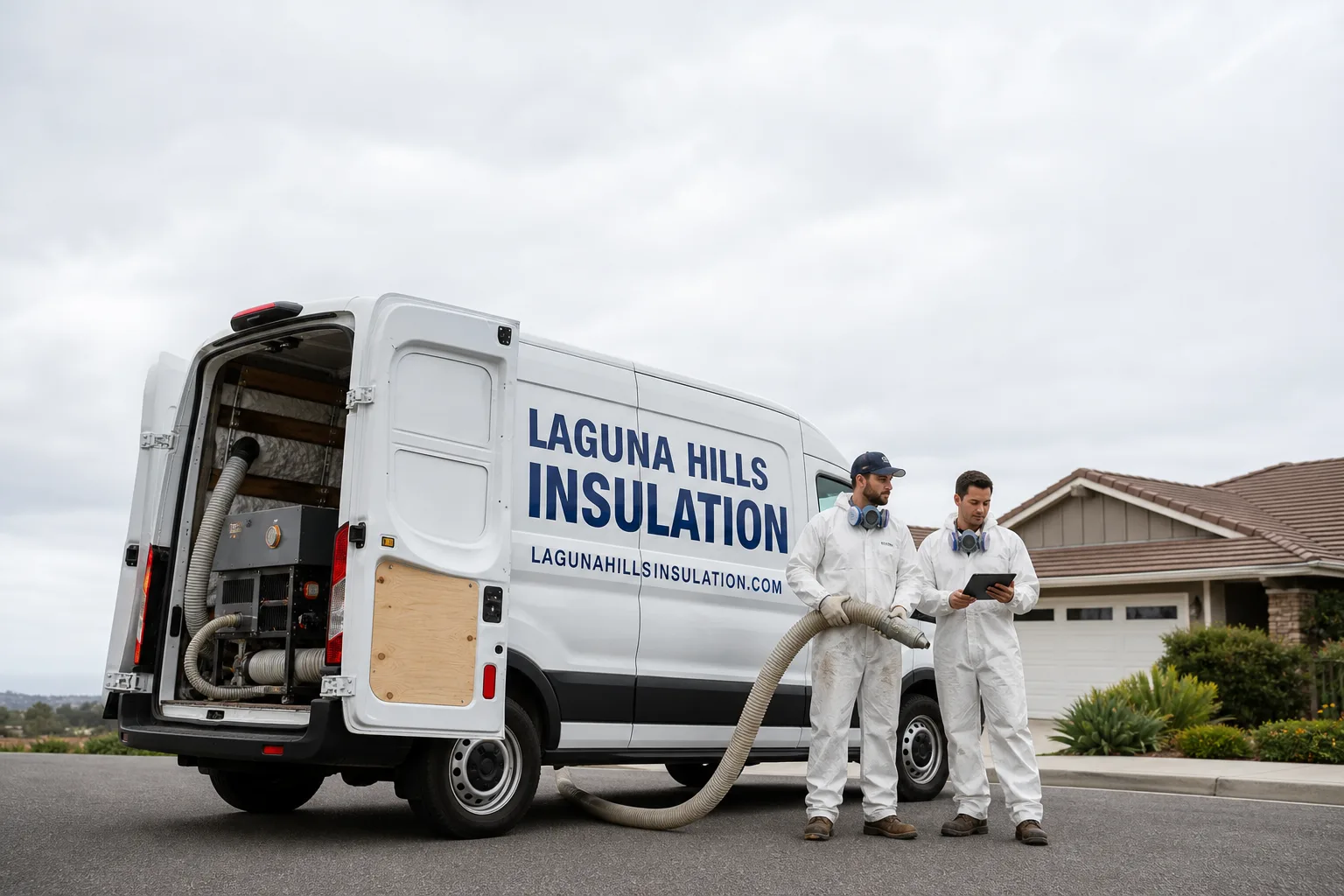
Fast, Reliable Spray Foam Insulation Across Yucca Valley
Spray foam insulation in Yucca Valley has to solve a problem most Southern California insulation contractors never think about: the same wall cavity that hits 105°F in July drops below freezing on a January night. That’s the two-way thermal swing at 3,300 to 4,000 feet, and it’s why we treat every Yucca Valley job as a high-desert retrofit, not a generic attic fill. Our Spray Foam Insulation team runs crews up Highway 62 into the 92284 and 92286 zip codes weekly, so we know these homes, their framing, and their failure points before we ever pop a lid. Call (866) 393-6041 and we’ll give you a straight answer about your house, your crawlspace, and what it actually needs.
Why Laguna Hills Insulation Is Yucca Valley’s Preferred Spray Foam Insulation Company
Most insulation outfits in the Morongo Basin are either low-desert companies driving up from Palm Springs or general contractors who sub out foam work to whoever’s available. We’re different in one specific way: our lead installer, Garrett Lund, specs insulation for the high desert’s dual load, not a Palm Springs air-conditioning-only assumption. Yucca Valley homeowners see winter-night lows that Demand Desert Hot Springs never gets, and that changes product choice, application depth, and where the air seal actually has to land. We also carry material breadth most local folks don’t expect: open cell and closed cell from Demilec and Icynene, plus mineral wool and cellulose from Rockwool and GreenFiber when foam isn’t the right fit for part of the assembly. Nobody here is pushing one product line. We’ll tell you which one actually fits, even if it’s not the most expensive option.
Our crews know the local pain points: rodent-chewed batts in mid-century cabins off Highway 247, wind-driven sand eating the facing on ranch homes east of Old Woman Springs Road, manufactured home belly boards sagging across the 92286 tracts. Response time to most Yucca Valley addresses runs one to two business days for inspection, and we stage equipment in the high desert so we’re not burning your day waiting for a crew to drive up from Orange County.
Open Cell Spray Foam in Yucca Valley
Open Cell Spray Foam in Yucca Valley is the workhorse retrofit for the town’s older ranch and cabin stock, spaces where the existing ceiling, wall, or rim framing is already shot full of air leaks but still structurally sound. We’re typically applying open cell in attics, exterior-wall cavities, and rim joists where the priority is air sealing plus a solid R-value bump without trapping moisture in the assembly. For a standard Yucca Valley single-story ranch with a vented attic, open cell on the attic floor or roofline generally runs $1,800 to $4,200 depending on square footage and access. Wall cavity injection on a mid-century cabin can run $3,500 to $7,500 when we factor in removing and disposing the collapsed legacy batts first.
What Open Cell Foam Corrects
Open cell is an air barrier first, insulation second. That matters in Yucca Valley where wind-driven infiltration through sheathing gaps, sill plates, and rim joists steals more energy than thin batts ever will. The foam expands into the cavity, locks the framing, and stops the stack effect that pulls winter heat out the top of the house while pulling cold air in low.
When Open Cell Is the Wrong Call
In Yucca Valley homes with unvented roofs, exterior walls that get direct afternoon sun on the west-facing side of town, or any area that might see sustained moisture, open cell can hold water. We spec closed cell in those spots and we’re not shy about saying so. The right insulation for your home, not just the easiest one to install.
Spray Foam Insulation Contractors in Yucca Valley
Spray Foam Insulation Contractors in Yucca Valley are not all the same, and the difference shows up in the crawlspace and the rim joist, not the brochure. A proper foam contractor here has to understand that the same job on a 1960s cabin in the western 92284 foothills and a 1990s ranch off Twentynine Palms Highway are two different specs. We handle open cell, closed cell, rim joist encapsulation, garage ceiling foaming, and roof deck applications in house, with our own crews, not a rotating pool of subs. A typical rim joist spray foam job in Yucca Valley runs $900 to $1,800 for a single-story home, while a full garage ceiling with open cell lands between $1,400 and $2,800 based on square footage and whether we’re also air-sealing the attic transition above it.
Rim Joist and Band Board Work
The rim joist is where your floor framing meets the foundation wall, and in Yucca Valley it’s usually the single leakiest spot in the entire envelope. Older cabins and ranch homes have fiberglass shoved or fallen into that bay, and cold winter air pours through. Two-component closed cell foam at one to two inches seals that bay and cuts both heating load and rodent entry paths.
Garage Ceiling and Roof Deck Applications
If your Yucca Valley home has living space above a garage or a bonus room, the garage ceiling is a high-leverage foam target. We apply open cell to the underside of that ceiling framing, air-sealing the boundary between conditioned and unconditioned space. For roof deck applications on unvented attic builds or cathedral ceilings, we use closed cell from Demilec to create both a thermal and an air barrier in one lift.
Trusted Brands We Service in Yucca Valley
We run Demilec and Icynene spray foam systems as our primary open and closed cell lines, because both hold up under the high desert’s UV exposure, temperature cycling, and wind-driven dust. For homeowners who want mineral wool in exterior walls or crawlspace lids, we stock Rockwool and Owens Corning, and we pull GreenFiber cellulose for dense-pack cavity work where foam doesn’t make sense. Having eight brands across the material spectrum means we’re not married to one manufacturer’s limitations on your house. We keep a rolling stock of the most common foam kits, sealants, and trim materials staged for Yucca Valley jobs, so parts or material shortages don’t stretch a one-day job into a three-day affair.
Common Spray Foam Insulation Problems We See in Yucca Valley Homes
- Collapsed legacy batts under an old cabin roof: 1950s – 70s retreats off the 92284 side of town often have original fiberglass batts that have settled to a fraction of their rated R-value, leaving foam to close gaps that should have been fixed decades ago. We pull the dead material, air-seal the framing, then apply foam clean over the corrected assembly.
- Wind-driven sand degrading exterior facing and opening infiltration paths: The basin’s gusty wind and blowing sand peels exterior sheathing and siding faster than in sheltered low-desert towns. That opens hairline infiltration channels that pull outside air straight through the wall, undermining any foam’s air-seal unless we address the exterior first.
- Manufactured home belly board failures across the 92286 tracts: Mobile and manufactured homes have an underbelly system that sags, tears, or gets shredded by rodents, and foaming the walls alone won’t fix the floor thermal boundary. Belly board repair, skirting, and duct re-insulation have to be part of the same job.
- Rodent-gnawed duct insulation and rim joist voids: The high desert’s rodent pressure is real, and we regularly find duct wrap chewed away and rim joist cavities turned into nesting voids. Spray foam in those cavities closes both the thermal leak and the entry point.
Pricing for Spray Foam Insulation in Yucca Valley, CA
Spray foam pricing in Yucca Valley runs a little above low-desert rates because of material staging and the extra prep on older homes. Here’s what our recent jobs have looked like: rim joist encapsulation on a single-story ranch, $900 to $1,800. Open cell attic floor or roofline on a standard 1,200 – 1,800 square foot home, $1,800 to $4,200. Wall cavity injection on a mid-century cabin with legacy batt removal, $3,500 to $7,500. Garage ceiling open cell, $1,400 to $2,800. Closed cell roof deck on a cathedral ceiling, $4,000 to $8,500 depending on depth and area. The factors that move you within those ranges: access, existing insulation removal, rodent damage repair, and whether you’re doing one area or the full envelope. Estimates are free, and we’ll give you line-item numbers, not a lump sum you can’t audit.
We Also Serve Cities Near Yucca Valley
Beyond Yucca Valley proper, our crews cover the surrounding high-desert communities including Morongo Valley, Desert Edge, Desert Hot Springs, and Garnet. If you’re in one of these areas and need Yucca Valley-level specification work done right, we’re already driving the same roads you are. Call us for scheduling and we’ll tell you which day we’re in your part of the basin.
Serving Yucca Valley, CA — Our Local Coverage Area
We’re based in the Yucca Valley area and know this community well. Use the map below to see our service coverage — if you’re nearby, we can almost certainly help.
FAQs About Spray Foam Insulation in Yucca Valley
Yes, and in most cases it’s the single highest-return insulation move you can make on one of those older cabins, because the original assemblies were never sized for the high desert’s two-way thermal swing. The key is doing it in the right sequence: remove collapsed or rodent-damaged legacy batts, air-seal framing, then apply foam. Skipping the prep step means foaming over a failed assembly. Call (866) 393-6041 and we’ll walk the cabin with you and point out what needs to happen first.
Because Yucca Valley homes sit 3,300 to 4,000 feet up and take sub-freezing winter nights plus 100°F+ summer days on the same envelope, the foam has to handle a true two-way thermal load, not the one-sided cooling-dominant demand the low desert sees. We spec deeper lifts and different product selections for winter-driven air infiltration that Palm Springs contractors never have to think about. A low-desert spec will underperform in January, plain and simple.
Partially. Foam in the walls and roofline helps, but the manufactured home’s weakest thermal boundary is almost always the underbelly and the duct system suspended beneath the floor. Belly board repair, skirting, and duct re-insulation have to happen alongside any foam work, or you’re solving only a third of the problem. We do the full assembly, not just the part that photographs well.
Closed cell foam is tough and handles UV and wind abrasion far better than open cell, but any foam exposed to direct sun and driven sand will degrade faster than foam protected by sheathing or cladding. For exterior-facing applications around eaves, rim joists, or exposed band boards, we use closed cell and recommend a protective coating or cladding repair on the exterior side. Properly installed and covered, foam in Yucca Valley holds up for decades.
For most attic and wall cavity retrofits on dry, vented Yucca Valley homes, open cell is the right value: it air-seals, it’s forgiving on irregular framing, and it costs less per board foot. But if you have a crawlspace that sees moisture, an unvented roof, or any area with standing water risk, closed cell is the correct call because it doesn’t absorb water and adds structural rigidity. We’ll tell you which one your house actually needs, even if the answer is one of each in different places. Call (866) 393-6041 for an exact spec and a free estimate.
Written by Garrett Lund, Owner at Laguna Hills Insulation, serving Yucca Valley and the Morongo Basin.