
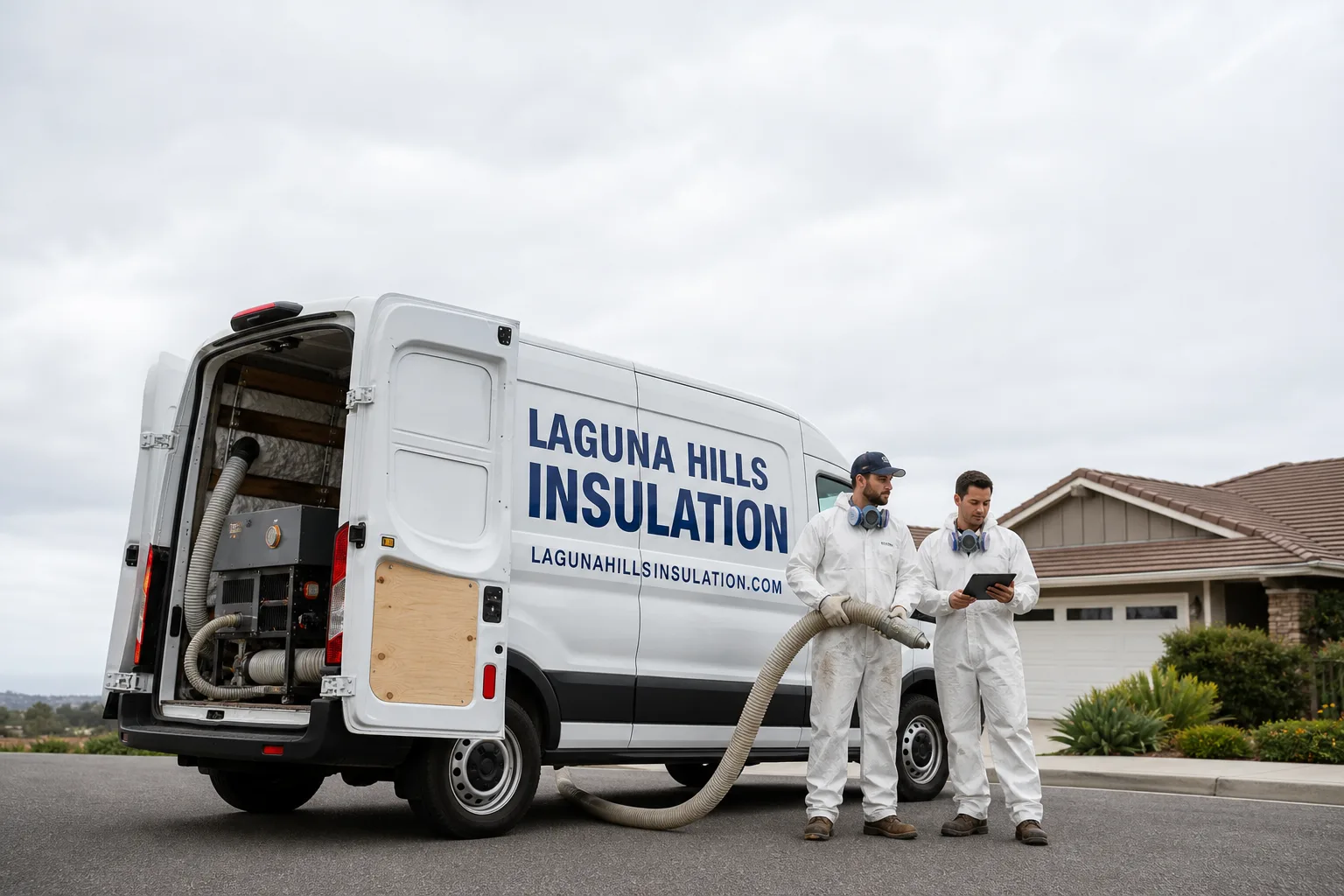
Fast, Reliable Spray Foam Insulation Across Van Nuys
Spray foam insulation in Van Nuys typically runs $2.50 to $4.50 per board foot for open-cell and $4.50 to $7.50 per board foot for closed-cell, with most full attic jobs landing between $4,800 and $11,000 depending on square footage and access. We work throughout Van Nuys weekly, from the 91406 tract homes off Victory Boulevard to the 91411 apartment buildings near Vanowen, and we schedule most estimates within two to three business days. Our team knows Van Nuys attics well enough to spot the usual problems before we even climb the ladder. Call (866) 393-6041 and we’ll tell you what your attic actually needs, not what we’re trying to unload that month.
Why Laguna Hills Insulation Is Van Nuys’s Preferred Spray Foam Insulation Company
Garrett Lund started this company with a simple rule: stock eight manufacturer lines and let the house tell us which one fits. That means when we inspect a Van Nuys attic, we’re not walking in committed to a single foam brand. We carry Icynene and Demilec open- and closed-cell systems, Johns Manville and Owens Corning products, and GreenFiber cellulose for the cases where foam isn’t the right call at all.
Van Nuys homeowners call us because we’ll tell them when spray foam is the wrong choice. If your 1950s attic has knob-and-tube wiring that needs isolation first, we’ll say so before quoting. If blown-in fiberglass would do the job for half the cost, we’ll suggest that instead. That’s the material-agnostic approach: eight brands, three methods, one specialist who’s accountable to you, not to a single product line.
Spray Foam Attic Insulation in Van Nuys
Spray foam attic insulation in Van Nuys has to solve a problem most coastal LA insulation crews never face: unvented attics that routinely hit 150°F or higher from June through September. We spray directly onto the underside of the roof deck, sealing every penetration, gap, and crack so the attic becomes a conditioned space rather than a solar oven. In Van Nuys’s semi-arid valley climate, that change alone can drop second-floor temperatures by 10 to 15 degrees on a 100°F afternoon.
Open-cell on the roof deck
Open-cell foam from Icynene is the workhorse for most Van Nuys attics. It’s lighter, expands aggressively into tight rafter bays, and air-seals the ceiling plane so well that settled dust and outdoor air stay out. Open-cell is typically the more affordable option and makes sense when the attic will remain ventilated or when the home has sufficient headroom above the insulation.
Closed-cell where space is tight
Closed-cell foam from Demilec delivers roughly double the R-value per inch of open-cell. In Van Nuys homes with low-pitch roofs and shallow rafter bays, that extra density matters because there’s simply less room to build up insulation. Closed-cell also acts as a vapor barrier, which helps in the shoulder seasons when warm daytime air and cool nights create condensation cycles in the attic.
Spray Foam Wall Insulation in Van Nuys
Spray foam wall insulation in Van Nuys addresses a specific weakness of the local housing stock: 1940s through 1960s stucco tract homes whose wall cavities were built with no insulation at all. On a 1952 ranch near Kittridge Street in 91406, the exterior walls were empty except for aging cedar shavings and decades of dust. We drilled and injected open-cell foam into each stud bay, and the difference in summer wall heat transfer was immediate.
Wall cavity injection
For existing walls, injection foam is less disruptive than tearing out drywall. Technicians drill small access holes from the exterior or interior, snake the foam applicator into each cavity, and fill from bottom to top. The foam expands to seal every gap around electrical boxes, plumbing penetrations, and framing, addressing both thermal and air leakage in one pass.
Rim joist sealing
The rim joist is where the foundation meets the floor framing, and in Van Nuys tract homes it’s often a completely unsealed band around the entire house. Closed-cell foam on rim joists blocks the stack effect that pulls hot attic air down through wall cavities in summer. This also cuts the dust and rodent entry points common in older Valley neighborhoods.
Trusted Brands We Service in Van Nuys
We install and maintain spray foam systems from Icynene and Demilec, two of the most recognized names in open- and closed-cell foam, and we pair them with supporting products from Owens Corning, Johns Manville, and Knauf where the job calls for hybrid approaches. Because we’re not married to one manufacturer, we can match the product to your Van Nuys home’s specific failure point rather than forcing your house to fit the product we happen to stock that month. Our crews carry the full spread of application equipment for all eight brands we work with, so scheduling a foam job in 91411 or 91470 doesn’t wait on a distributor who only delivers to the Valley once a week.
Common Spray Foam Insulation Problems We See in Van Nuys Homes
- Foam over degraded rock wool: Many 1940s and 1950s Van Nuys attics still have original rock wool or cellulose that has settled to R-7 or less. Spraying foam directly over that compressed layer traps heat and moisture, accelerating the breakdown of the old material and creating a messy, low-performing sandwich. The right fix is removing or raking back the old insulation first, then air-sealing before any foam goes down.
- Knob-and-tube wiring in foam: Van Nuys homes built before roughly 1955 often have knob-and-tube circuits still active in the attic. Foam sprayed directly over live knob-and-tube creates a code violation and a potential fire risk because the wiring can’t dissipate heat. We isolate the wiring, coordinate with a licensed electrician where needed, and only then proceed with foam application.
- Missing thermal or ignition barriers: In unvented Van Nuys attics that hit 150°F or more, exposed spray foam on the underside of the roof deck can discolor, sag, or fail inspection without an intumescent coating or thermal barrier. The 150°F attic is the differentiating factor: coastal LA attics rarely exceed 120°F, but a Van Nuys attic in August demands a barrier that can handle sustained heat load.
- Roof deck foam separation in low-pitch attics: Low-pitch roofs common in Van Nuys tract housing mean shallow rafter bays and less room for foam to expand evenly. Poor application leads to gaps at the top of the bay, which becomes a thermal bypass that sends hot air straight through the ceiling. We check every rafter bay with a thermal camera after application, not just the ones easy to reach from the access hatch.
Pricing for Spray Foam Insulation in Van Nuys, CA
We Also Serve Cities Near Van Nuys
Our spray foam crews work regularly in Van Nuys plus the surrounding Valley communities: Valley Glen, Sherman Oaks, Encino, and North Hills. If you’re in one of those neighborhoods and comparing insulation bids, the same material-agnostic approach applies. We’ll bring the full brand lineup and tell you honestly which product fits, even if it’s the less expensive option. See our main Spray Foam Insulation service page for details on every method we install.
Serving Van Nuys, CA — Our Local Coverage Area
We’re based in the Van Nuys area and know this community well. Use the map below to see our service coverage — if you’re nearby, we can almost certainly help.
FAQs About Spray Foam Insulation in Van Nuys
Yes, but only when paired with an intumescent ignition barrier or thermal barrier. Spray foam performs extremely well in unvented attics up to about 150°F when properly coated, but exposed foam in a Van Nuys attic that regularly exceeds that temperature can discolor, sag, and fail inspection. In the tract homes around 91405 and 91406 we always specify a barrier-rated coating for any foam installed on the underside of a roof deck. If your attic doesn’t have one, call (866) 393-6041 and we’ll tell you exactly what the inspector will require before we quote.
We don’t spray over live knob-and-tube, ever. Before any foam goes in, we identify active circuits, mark them clearly, and build isolation boxes or baffles that keep foam from contacting the wiring. In most cases that work is coordered with a licensed electrician, and the cost gets folded into your quote as a clear line item. This isn’t optional in 91406 and 91411 homes where knob-and-tube is still common, and any contractor who tells you to just spray over it is setting you up for a code violation.
No. Spraying foam directly over settled rock wool or cellulose traps heat and moisture inside that degraded layer, compressing it further and creating a medium where the old material keeps losing R-value under the weight of the new foam. The correct sequence is removal or raking back the old insulation, air-sealing the ceiling plane and top plates, then applying foam to the roof deck or attic floor. Removing old rock wool from a Van Nuys attic typically adds $1,000 to $2,000 to the job, and it’s worth every dollar compared to the performance loss of burying it.
For open-cell foam in a Van Nuys attic, we recommend R-20 to R-22 at minimum, which is the practical depth limit for most rafter bays in local tract homes. For closed-cell, R-15 to R-21 is sufficient because the foam’s density delivers far better resistance to radiant heat gain than the R-number alone suggests. The air sealing matters more than the raw R-value in this climate: a fully sealed R-22 attic outperforms a drafty R-38 attic every day in a 100°F Van Nuys summer.
The required thermal and ignition barriers are different, and it’s not a small detail. Coastal LA attics rarely exceed 120°F, so exposed foam on the roof deck passes inspection with minimal treatment. Van Nuys attics in July and August hit 150°F or more, and exposed foam at those temperatures without an intumescent coating will fail inspection and degrade over time. We recently sprayed open-cell in a 1952 stucco ranch on Kittridge Street in 91406 where the unvented attic was cooking at 155°F. After air-sealing the top plates and knee-wall over the garage, we applied Icynene to R-22 and coated it with an intumescent ignition barrier to satisfy the inspector. Attic temps dropped 25°F and the homeowner’s August bill fell by $70. That’s the Van Nuys difference, and we build it into every quote from day one.
Written by Garrett Lund, Owner at Laguna Hills Insulation, serving Van Nuys and the San Fernando Valley.