
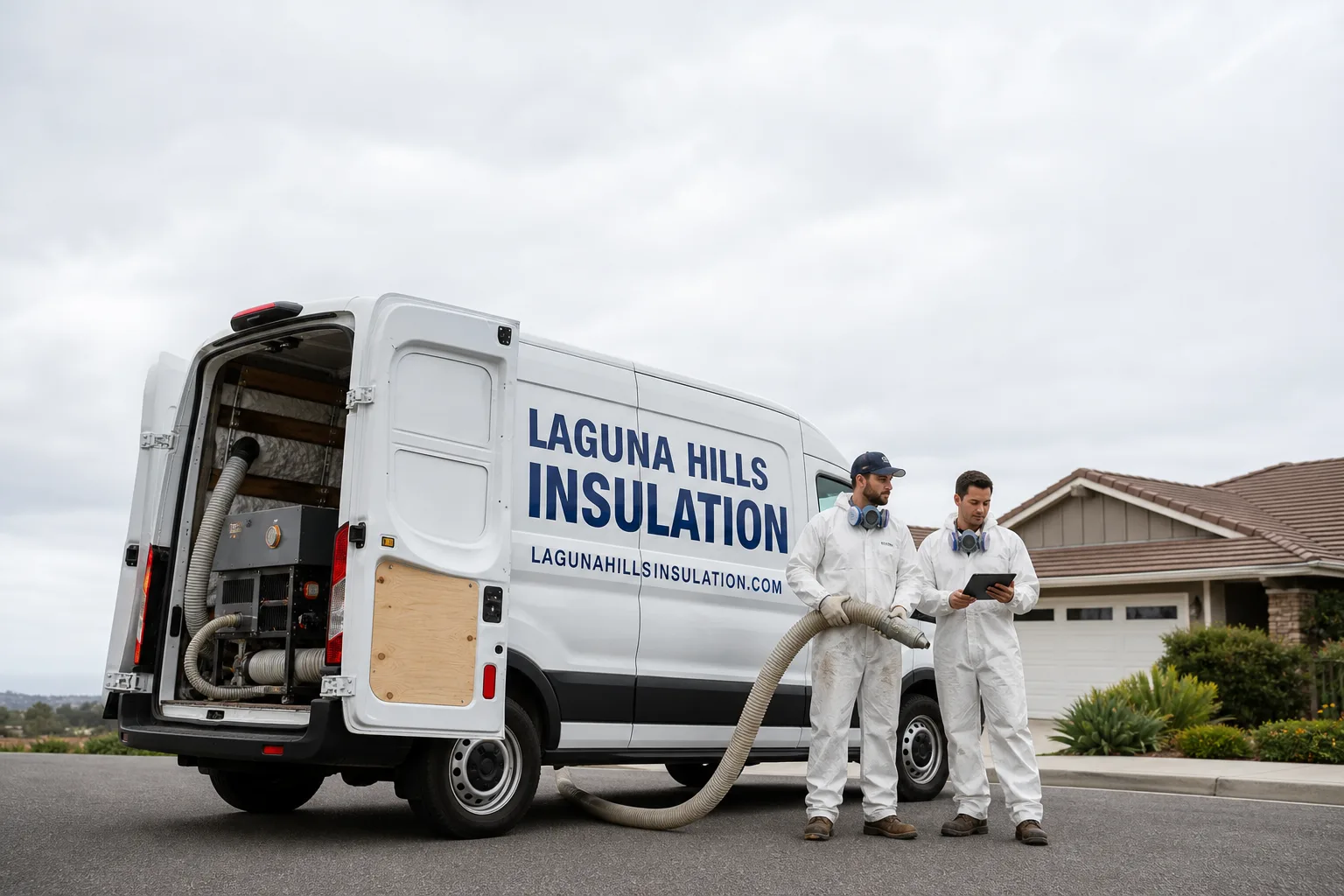
Fast, Reliable Spray Foam Insulation Across Upland
Spray foam insulation in Upland typically costs $2.50 to $6.50 per square foot installed, with most full attic or wall projects landing between $3,800 and $11,000 depending on foam type, depth, and access. We run crews into Upland weekly from our Laguna Hills shop, and we can usually be on-site within two to three business days for standard jobs. If you’re dealing with a second-floor bedroom that won’t cool down during a Santa Ana week, call (866) 393-6041 and we’ll tell you straight whether spray foam is the right fix, or whether you’d be better served by air sealing and a radiant barrier first. That’s the conversation most Upland homeowners actually need, and it’s one we’re glad to have.
Why Laguna Hills Insulation Is Upland’s Preferred Spray Foam Insulation Company
We didn’t start by pushing one foam brand and calling every home in Upland a “perfect fit.” That’s not how we work. Garrett Lund built this company around the idea that the right material should win the job, not whatever’s sitting on the truck. For Upland, that matters more than most places, because the city’s split housing stock demands different answers depending on which ZIP you live in. A 1958 ranch in 91786 has completely different insulation needs than a 2004 custom home climbing the foothills in 91784. Homeowners catch on quickly when a contractor gives them the same pitch for both.
Our Spray Foam Insulation team handles open-cell and closed-cell work from Icynene and Demilec. We also install Rockwool mineral wool and Johns Manville fiberglass when foam isn’t the right call. Having those alternatives in our back pocket means we’re not going to sell you foam just to keep the crew busy. Upland customers regularly tell us the same thing: we were the only bid that explained why foam made sense in one part of the attic and not another.
Response time to Upland runs two to three business days for most estimates and installations. Emergency callouts, like a rim joist that’s letting hot air pour into a finished basement during a heat wave, we handle as fast as scheduling allows, often next day. We cover all three Upland ZIP codes: 91784, 91785, and 91786. No “service area fee” games. You’re close enough that we treat Upland as local, not a road trip.
Spray Foam Attic Insulation in Upland
Spray foam attic insulation in Upland is the highest-impact upgrade we perform, and it’s where we spend most of our time in the 91784 foothills. The job involves applying expanding foam directly to the underside of the roof deck, sealing every gap, crack, and top plate transition so the attic becomes part of the conditioned space. In Upland, this is rarely a cold-weather play. It’s a radiant-heat play. Your attic is the buffer between your living space and a roof surface that can exceed 140°F on a summer afternoon here, especially on west- and south-facing exposures. Foam stops that heat from ever getting into the house, provided it’s paired with the right strategy and installed correctly.
A typical attic spray foam job in Upland runs $4,200 to $9,500 for a standard single-family home, with vaulted or cathedral ceilings pushing toward the upper end. The cost difference comes down to foam depth, roof geometry, and whether we’re also insulating the gable walls and knee walls, which many foothill custom homes need.
Open-Cell Foam for Attic Rafter Bays
Open-cell foam is the softer, more forgiving option. It expands aggressively and fills rafter bays completely, which is why we use it often on existing Upland homes where the roof deck has odd framing or shallow cavities. On the pest-control side, it’s also easier to spot termite activity later, which matters in foothill neighborhoods where the wood-to-ground contact is common.
Closed-Cell Foam for High-Heat Roof Decks
Closed-cell adds structural rigidity and acts as a vapor barrier, which makes it the right call for 91784 homes where roof decks bake under direct sun during Santa Ana events. It’s more expensive per board foot, typically 30 to 40 percent over open-cell, but the performance difference on a west-facing roof deck is measurable within the first summer.
Spray Foam Wall Insulation in Upland
Spray foam wall insulation in Upland addresses the second biggest source of thermal discomfort in local homes: exterior walls that let heat, noise, and wind-driven dust through the building envelope. This is common in the 1950s through 1970s ranch and tract homes across 91786, where original wall cavities are either empty or holding settled, underperforming batts. Foam fills the entire cavity, air-seals as it expands, and cuts the air movement that makes rooms feel drafty during winter Santa Ana wind events.
Wall spray foam in Upland generally costs $2.50 to $4.50 per square foot of wall area for open-cell, and $4.50 to $6.50 for closed-cell. A full exterior wall retrofit on a 1,600-square-foot ranch usually lands between $5,500 and $9,000. It’s not a cheap project, but for homes where the drywall is already open for a remodel or where rooms face the brunt of afternoon sun, it’s often the single best comfort investment you can make.
Air Sealing Top Plates and Rim Joists
Before we ever spray a wall cavity, we air-seal the top plates, bottom plates, and rim joist. On older Upland ranch homes, this is where the real leaks live. Skipping this step and spraying foam over the original framing is like putting a new roof on a house with rotted sheathing.
Moisture and Pest Control Benefits
Closed-cell foam doubles as a vapor retarder, which helps in Upland’s dry but occasionally humid inland climate. It also closes off the small gaps where rodents and pests enter wall cavities from crawlspaces. In foothill neighborhoods that back up to open chaparral, that’s a real, practical benefit homeowners appreciate.
Trusted Brands We Service in Upland
We’re not married to a single manufacturer, and that’s by design. On Upland projects, we most often work with Icynene and Demilec spray foam systems, both industry leaders in open- and closed-cell chemistry. We also install Owens Corning and Johns Manville fiberglass, plus Rockwool mineral wool, when the job calls for a traditional thermal fill instead of an air-sealing foam. Because we keep relationships with eight manufacturers, we can match the right product to the specific attic, wall, or rim joist condition we find in your home. That’s real product breadth, not a sales pitch. If a material isn’t right for your Upland house, we’ll tell you, and we’ll name the one that is.
Common Spray Foam Insulation Problems We See in Upland Homes
- Foam applied directly to hot roof sheathing in 91784. West- and south-facing roof decks in the foothills get brutalized during Santa Ana heat events. Foam sprayed directly onto that surface without a radiant barrier or proper ignition barrier can degrade early and off-gas under repeated heat cycling. We see this on homes where a previous contractor treated the attic like a Midwest vented attic and skipped the assembly details.
- Foam sprayed over settled batts in 1950s-70s 91786 ranches. This is a shortcut that traps moisture and leaves thermal bridging intact. The original attic insulation has settled to R-19 or less, and spraying foam over it without air-sealing top plates first just buries the leak points. It looks fine on a bid sheet and does almost nothing in practice.
- Wrong foam thickness on vaulted ceilings in foothill custom homes. Homeowners fixate on R-value and miss the air-sealing detail. On a vaulted ceiling in a 1980s-2000s custom home off Mountain Avenue, an inch of properly applied closed-cell foam can outperform three inches of open-cell if it’s sealing the right gaps. Contractor bids that only talk thickness are leaving performance on the table.
- Ignoring the radiant barrier entirely. In Upland’s 91784 ZIP, homes back directly into the San Gabriels. Afternoon sun and Santa Ana winds bake those attics. Spray foam alone, with no radiant-barrier strategy, is like buying a great air conditioner and leaving the windows open. The foam does its job, but the radiant gain overwhelms it.
Pricing for Spray Foam Insulation in Upland, CA
Open-cell spray foam in Upland runs $2.50 to $3.75 per board foot, which pencils out to roughly $4,200 to $6,800 for a typical attic retrofit in a 91786 ranch. Closed-cell starts around $4.25 and can hit $6.50 per board foot, putting full closed-cell attic jobs in 91784 custom homes between $7,500 and $11,000. Wall cavity work runs on square footage instead of board feet, as we noted above. What moves the price the most in Upland is roof geometry, access, and whether we need to remove and replace old insulation first. Estimates are free, and we provide a written line-item bid. Call (866) 393-6041 and we’ll schedule a walkthrough.
We Also Serve Cities Near Upland
Our crews cover the surrounding foothill and valley communities, including San Antonio Heights, Claremont, Montclair, and Rancho Cucamonga. If you’re in one of those areas and looking for Upland insulation expertise without the guesswork, we’re the same team doing the work, with the same material-agnostic approach. Call (866) 393-6041.
Serving Upland, CA — Our Local Coverage Area
We’re based in the Upland area and know this community well. Use the map below to see our service coverage — if you’re nearby, we can almost certainly help.
FAQs About Spray Foam Insulation in Upland
Spray foam is the wrong first move on many older 91786 ranches because the original attic insulation has settled, and the real problem is air leakage at top plates, can lights, and wall cavities, not missing R-value. Foam sprayed over those leak points covers the symptom. The right approach is air sealing first, then deciding if foam belongs in the rafter bays or if improved blown-in or batt insulation plus sealing does the job for far less. Call (866) 393-6041 and we’ll assess what your specific ranch actually needs.
No. Spray foam alone reduces conductive and convective heat transfer, but it does not stop radiant heat gain from sun-baked roof sheathing. In 91784 foothill homes where west- and south-facing attics exceed 140°F during Santa Ana events, foam must be paired with a radiant barrier or a properly vented roof assembly to actually reduce the heat load on the conditioned space. This is the single most important detail for foothill attics, and most bids leave it out.
Yes, in most cases. We access the rafter bays from the attic side when there’s any crawl or access space, or we use injection techniques on finished vaulted ceilings. The key detail in these foothill custom homes is sealing the transition at the top plate and gable wall, not just filling the bay. That’s where the radiant heat sneaks through. We recently foamed a 1990s custom off Mountain Avenue that had been cooking its second floor every afternoon, and the fix came down to sealing the right surfaces, not spraying more foam.
We use Icynene and Demilec spray foam systems on Upland jobs, both open-cell and closed-cell depending on the assembly. We also install Owens Corning fiberglass and Rockwool mineral wool when those materials fit better. The brand follows the application, not the other way around.
Santa Ana wind season actually makes Upland a better time for spray foam installation in many cases, because the dry air helps the foam cure faster and more predictably. The exception is closed-cell foam on extremely hot roof decks, which can complicate the chemical reaction. We typically schedule foothill attic work in the morning or on cooler days during the summer months. Call (866) 393-6041 to discuss timing for your project.
Written by Garrett Lund, Owner at Laguna Hills Insulation, serving Upland and the surrounding foothill communities.