
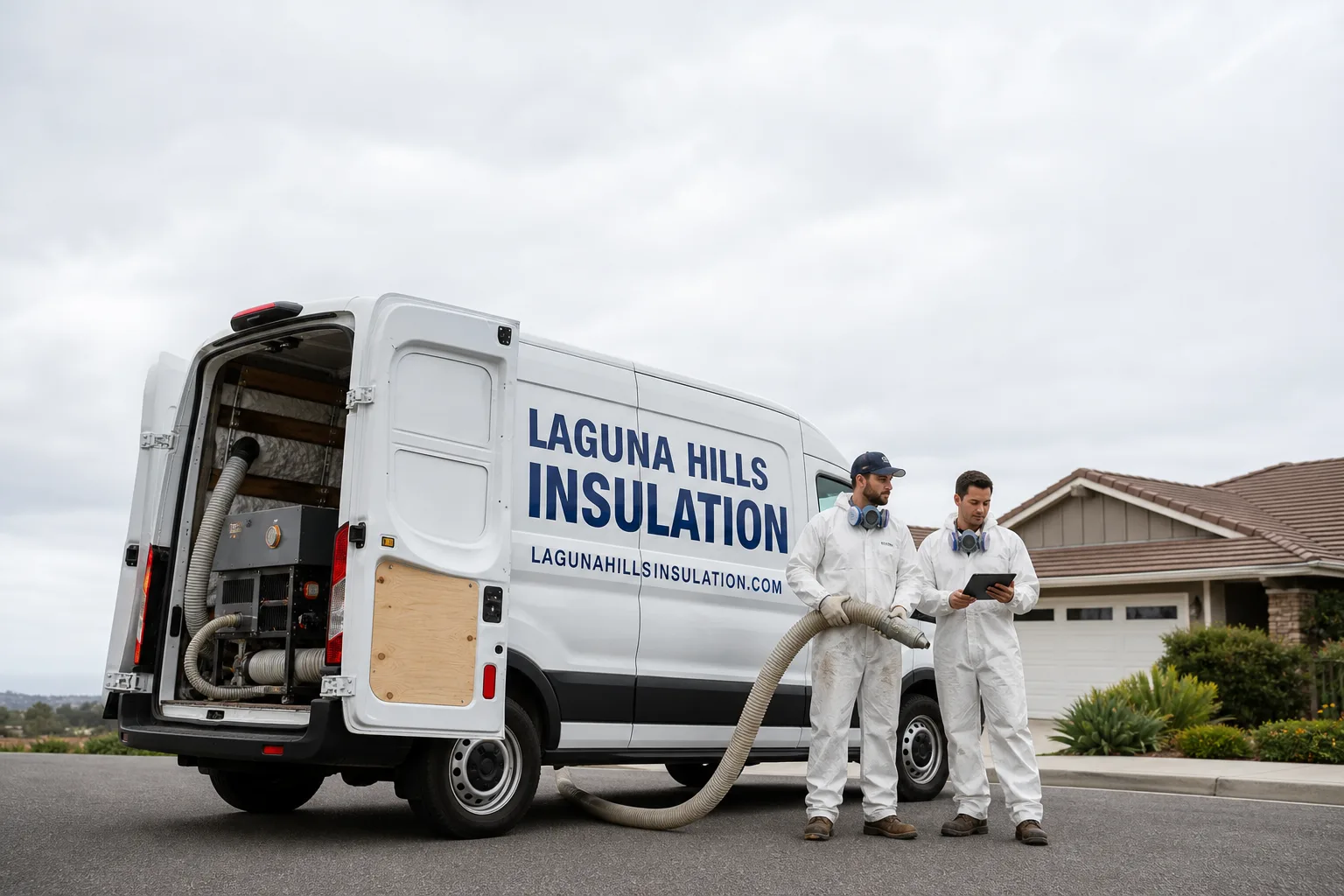
Fast, Reliable Spray Foam Insulation Across Topanga
Spray foam insulation in Topanga runs $4,200 – $9,800 for a typical attic or wall retrofit, and the material choice matters more here than almost anywhere else in Los Angeles County. Topanga’s canyon climate punishes insulation in ways coastal cities never see: 95°F afternoons, 40-degree overnight drops, and Santa Ana winds that push ash and embers into every vented attic. Call us at (866) 393-6041 for a straight answer on what your Topanga home actually needs, not what’s easiest to spray.
We know Topanga Canyon Road, Old Topanga Canyon Road, and the ridgeline drives up Saddle Peak and Fernwood Pacific. Every job here is a retrofit, not a new build, and that changes everything. Garrett Lund and our crew have worked enough owner-built cabins and mid-century ranches in 90290 to know that the framing never matches the plans, and the walls never match each other.
Why Laguna Hills Insulation Is Topanga’s Preferred Spray Foam Insulation Company
Topanga homeowners call us because we’ll tell them when spray foam is the wrong answer. That’s not a line; it’s how we work. If a home off Topanga Canyon Boulevard has original rough-sawn framing and knob-and-tube wiring, we’ll say so before we quote closed-cell foam. We’re the Spray Foam Insulation specialist that stocks multiple competing brands, so the recommendation is based on the assembly, not our inventory.
Our teams respond to Topanga same-day when we can, and typically within 24 – 48 hours for estimates. We carry Icynene and Demilec open- and closed-cell systems, plus Owens Corning and Rockwool for hybrid assemblies. That matters in a canyon where one house needs air-sealing against Santa Ana ash and the next needs thermal mass for cold-night drafts. We work both, and we’ll tell you which one applies to your home.
What builds trust in Topanga isn’t a review count; it’s showing up with the right material and knowing the house type before we walk in. We’ve seen enough 1950s cabins and 1960s ranch expansions here to know the local failure patterns. When we quote foam for a Topanga home, we’re already thinking about the vented attic, the original roof deck, and whether the wall cavities are even close to standard.
Open Cell Spray Foam in Topanga
Open Cell Spray Foam in Topanga is the right call for interior wall cavities and vaulted ceilings where the priority is sound control and air sealing, not moisture protection. It expands aggressively into irregular stud bays, which suits Topanga’s owner-built framing, but it needs a conditioned or semi-conditioned assembly to perform long-term. In a canyon house with wild temperature swings, open-cell works best on interior partitions, basement-adjacent wall cavities, and ceiling plenums where the assembly already has a ventilation path.
Where We Steer Topanga Homes Toward Open-Cell
Interior walls between a living space and a garage or workshop. Music rooms and home offices in Topanga’s hillside homes, where the acoustic benefit of open-cell’s air-permeable structure is exactly what the homeowner wants. We also use it in cathedral ceilings where the roof deck stays vented and the interior face needs an air seal. Expect $2.25 – $3.85 per board foot installed in Topanga’s retrofit conditions.
When Open-Cell Is the Wrong Tool in the Canyon
Against an exterior wall that will see moisture from fog, rain, or the marine layer pushing up Topanga Canyon. Or in a vented attic floor, where open-cell’s permeability lets humid canyon air pass through to the drywall below. We’ll tell you before you spend the money.
Spray Foam Insulation Contractors in Topanga
Spray Foam Insulation Contractors in Topanga have to understand that almost every attic here vents directly to the outside, and during Santa Ana events that outside air is full of ash, embers, and 15% humidity that dries out every gap in the framing. A contractor who sprays foam into a vented attic without addressing the vents is installing half the system. We pair closed-cell foam with ember-resistant vents and seal the soffit-to-gable path, so the assembly holds against heat gain, smoke, and ash intrusion.
Intrusion-Sealing for the Vented Attic
On canyon-floor homes, we routinely seal gable and soffit openings with ember-resistant mesh before spraying, then apply closed-cell to the roof deck if the homeowner wants a conditioned attic. That keeps ash and smoke out during a fire event and stops the hot attic air from radiating into the living space every afternoon. On ridgeline properties off Saddle Peak Road, the same approach blocks the Santa Ana wind-driven air that pushes through every crack.
Framing Compatibility Checks First
Before spraying, we check for knob-and-tube, buried junction boxes, and irregular stud bays. Spraying foam over legacy wiring traps heat and turns any future electrical repair into a demolition job. In Topanga’s older homes, that check is not optional.
Trusted Brands We Service in Topanga
We install Icynene and Demilec foam systems, and we stock Owens Corning, Johns Manville, and GreenFiber products for hybrid or non-foam assemblies. That gives Topanga homeowners options: a closed-cell air barrier from Demilec for a ridgeline home that needs fire-resistant detailing, open-cell Icynene for a music studio wall, or GreenFiber cellulose where the homeowner wants a recycled-content option. We keep common sealants, vent meshes, and trim components on the truck, so a Topanga retrofit doesn’t stall waiting on parts from the valley.
Common Spray Foam Insulation Problems We See in Topanga Homes
- Open-cell pulling away from rough-sawn framing. Topanga’s owner-built cabins often have original framing that was never planed or standardized. Open-cell foam shrinks slightly as it cures, and against those irregular surfaces it separates, leaving air channels that pull 95°F canyon heat and ash straight into the wall cavity.
- Vented attics acting as ash intakes during Santa Ana events. A standard ridge-and-soffit vent system is designed for moisture management, not ember defense. In a wind-driven fire, those vents become inlets for embers and smoke. Foam alone does not fix that. Ember-resistant vents must be part of the spec.
- Foam trapped around legacy wiring and non-standard framing. Mid-century Topanga ranches frequently have framing and electrical work that was never brought to code. Closed-cell foam locks that wiring in place, and if the foam was sprayed over knob-and-tube, the insulation itself can become a heat sink. We inspect before we spray.
- Irregular wall cavities from additions and remodels. A 1958 cabin with a 1974 addition and a 1990s bump-out has three different wall depths. Standard batts or one-size-fits-all foam jobs leave gaps. Closed-cell foam in these cavities works, but only when the installer accounts for each cavity independently.
Pricing for Spray Foam Insulation in Topanga, CA
A typical open-cell wall cavity retrofit in Topanga runs $2.25 – $3.85 per board foot installed. Closed-cell runs $3.50 – $6.50 per board foot, with the higher end reflecting the fire-resistant detailing and ember-resistant vent work that canyon homes routinely require. A full attic air-seal and roof deck application on a 1,200-square-foot Topanga home typically lands between $5,500 and $9,800. Garage ceiling jobs run $1,400 – $2,800 depending on access. Rim joist sealing in crawlspace homes runs $900 – $1,800. The factors that move the price in Topanga: attic access, the condition of the original framing, whether we need to remove failed open-cell foam first, and whether ember-resistant vents and sealing are part of the scope. Call (866) 393-6041 for a free estimate with exact numbers for your home.
We Also Serve Cities Near Topanga
Our crews regularly work Topanga and the surrounding canyons, and we serve Encino, Santa Monica, Northridge, and Sherman Oaks as well. The housing stock changes block by block, but the retrofit challenges and Santa Ana exposure carry through the whole Santa Monica Mountains corridor.
Serving Topanga, CA — Our Local Coverage Area
We’re based in the Topanga area and know this community well. Use the map below to see our service coverage — if you’re nearby, we can almost certainly help.
FAQs About Spray Foam Insulation in Topanga
The foam fails because Topanga’s original framing was never milled to a standard surface. Rough-sawn beams and hand-cut studs leave microscopic gaps between foam and wood, and the canyon’s daily 40-degree temperature swings cause the foam to expand and contract against those irregular surfaces until it separates. That’s why we air-seal the framing connection before spraying closed-cell, and why we check cavity depth before we quote. Call (866) 393-6041 and we’ll tell you whether your framing needs remediation first.
Yes, if your attic remains vented, you need ember-resistant vents even with spray foam. Foam seals the thermal envelope, but it doesn’t stop embers from entering through open soffit or gable vents. During a Santa Ana-driven fire, those embers ignite the first combustible surface they touch inside the attic. We pair closed-cell foam with ember-resistant vent mesh on every Topanga attic we spray. We’ll quote the full assembly, not just the foam.
Yes, closed-cell spray foam can be applied directly to a clay-tile or metal roof deck in Topanga, but only if the deck is structurally sound and dry. The foam acts as an air and vapor barrier and can stay exposed in an unconditioned attic. We don’t recommend open-cell against the deck, because Topanga’s inversion layers and marine fog can put condensation on the underside of the metal or tile. Ask us for a deck inspection before you commit.
If the existing open-cell foam is pulling away from the framing in more than 20% of the wall area, the right call is usually removal and re-spray with closed-cell along the exterior walls. Open-cell against an exterior wall in a canyon home with wide daily temperature swings will keep failing. If the foam is mostly intact but there are air channels at the top plates, we can cut and seal the gaps with closed-cell and save the rest. We’ll give you both numbers and let you decide. Estimates are free.
Spray foam creates an air barrier, and fiberglass only slows conductive heat loss. In Topanga, where 95°F afternoons drop into the 50s at night, air movement through the wall assembly is what drives discomfort, not just R-value. Closed-cell foam stops that air movement at the cavity, so the assembly doesn’t breathe hot canyon air in and pull conditioned air out. Fiberglass leaves those air pathways open unless it’s paired with separate air-sealing. That’s why foam is the better fit for canyon homes, especially ones with vented attics that pull in dry-season smoke.
Written by Garrett Lund, Owner at Laguna Hills Insulation, serving Topanga since 2009.