
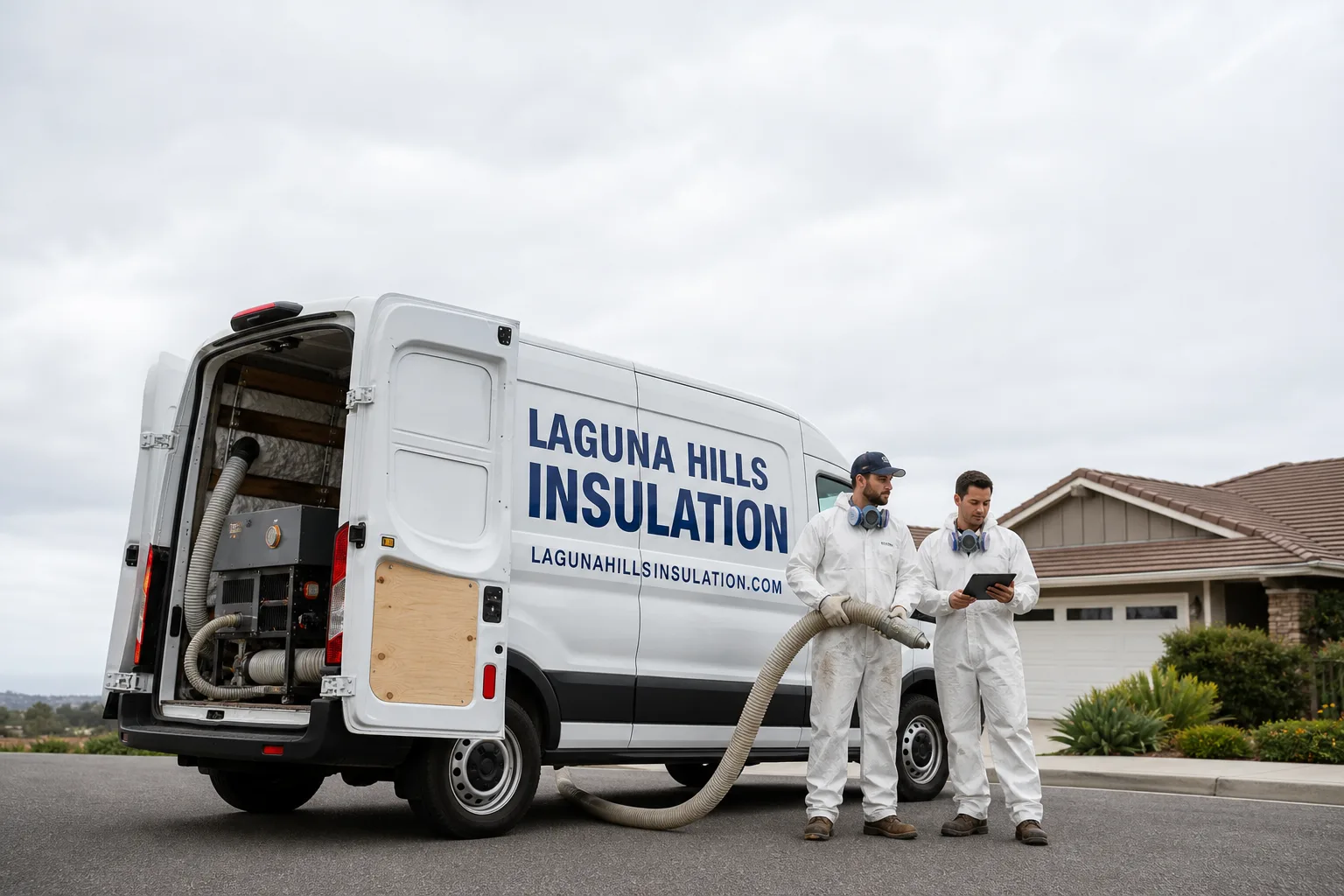
Fast, Reliable Spray Foam Insulation Across Sky Valley
Spray foam insulation in Sky Valley has to do something most low-desert insulation jobs don’t: it has to work both directions. Summer afternoons here push past 100 F, and winter nights drop below freezing on a regular basis. We work in Sky Valley every month, so our crews know what those old cabin attics look like when the wind has been working on them for forty years. If you’re dealing with a hot house in July or a cold one in January, call (866) 393-6041 and we’ll come take a look. Estimates are free, and we’ll tell you straight whether spray foam is the right call or if you’d be better served by blown-in or batts.
Why Laguna Hills Insulation Is Sky Valley’s Preferred Spray Foam Insulation Company
Sky Valley homes are a different animal from what you find down in Rancho Mirage or Cathedral City. Most were built as winter getaway cabins in the mid-century through the 1980s, which means single-pane windows, minimal wall cavities, and attics that were never meant to hold insulation against the kind of wind this valley throws at them. We’ve crawled through enough of those peaked roofs off the 92241 canyon roads to know what we’re going to find before we even open the hatch.
Garrett Lund built Laguna Hills Insulation around a simple idea: stock the materials that actually fit the job, not just the one product line that’s easiest to sell. That’s why we carry Icynene and Demilec spray foam alongside Rockwool, Owens Corning, Knauf, and GreenFiber. When we show up to a Sky Valley property, we’re not there to push a single solution. We’re there to figure out what the house actually needs, and then install it correctly.
Our response time to Sky Valley is typically same-week for estimates, and we schedule installation around the weather windows that matter up here. Nobody wants foam being sprayed in the middle of a July dust blow. We know the area, we know the wind patterns, and we know how to prep a legacy cabin attic so the foam actually bonds to something that will hold it.
Spray Foam Attic Insulation in Sky Valley
Spray Foam Attic Insulation in Sky Valley is the single highest-impact upgrade you can make to an older mountain-desert home, and the reason is simple: the attics up here fail differently than they do anywhere else. The constant wind that comes across the open valley gets into legacy attics through gable vents and soffit gaps, and over decades it physically shoves loose batts to one side. We routinely open a Sky Valley attic and find the insulation piled against one gable end while bare drywall sits exposed across the entire east slope. That means the nominal R-value on paper is effectively zero in real terms.
Spray foam fixes that failure mode at the root. Closed-cell foam like Icynene bonds directly to the roof deck and doesn’t move, doesn’t settle, and doesn’t care about wind. A typical spray foam attic job in Sky Valley runs $3,200 to $6,800 for an average 1,200 to 1,800 square-foot cabin, depending on whether you’re doing the roof deck only or also sealing the attic floor and top plates. Open-cell runs a bit less at $2,400 to $4,500, but it’s not always the right call in a wind-driven attic that needs structural air sealing.
Wind-Scoured Legacy Attics and the Prep Step Everyone Skips
The biggest mistake we see in Sky Valley is contractors spraying foam over a dirty, contaminated attic without doing the prep work first. In an old getaway cabin, the attic cavity usually has rodent soil, blown dust, and the remnants of whatever insulation was originally up there. Foam needs a clean, dry surface to bond. We vacuum out the old material, seal the penetrations, and then apply the foam. That prep step is the difference between a job that lasts twenty years and one that delaminates in five.
When we sprayed a mid-century cabin off one of the canyon roads in 92241, our crew opened the hatch and found decades-old Owens Corning batts piled against one gable end, blown there by years of wind coming off the open valley. Bare drywall sat exposed across the whole east slope above the living room. We vacuumed out rodent soil and old fiber, sealed the top plates and can-light penetrations, then applied two inches of closed-cell Icynene against the roof deck. That locked the whole assembly against the 100 F-plus summer gain and the sub-freezing winter nights in one pass.
Roof Deck vs. Attic Floor in a Mountain Cabin
In a low-desert home, spraying the attic floor can make sense because you’re just trying to stop heat gain from above. In Sky Valley, the roof deck is usually the better target. Wind-driven cold air in winter gets into the attic and chills the living space from the top down. Spraying the roof deck with closed-cell foam turns the attic into conditioned space and stops that convective loss at the only point where it actually starts.
Spray Foam Wall Insulation in Sky Valley
Spray Foam Wall Insulation in Sky Valley is a trickier proposition than the attic work, and we’ll be honest about that because most of these older cabins don’t give you much cavity to work with. Mid-century manufactured and site-built homes in this valley were framed with 2×4 walls, and many of them have little to no insulation in those cavities. But here’s the catch: if the windows are still single-pane and the envelope isn’t sealed, wind-driven infiltration just bypasses whatever you put in the walls. The foam has to be part of a whole-envelope strategy, not a standalone fix.
For walls, a typical job in Sky Valley runs $2,800 to $5,300 depending on whether we’re doing the exterior sheathing, interior cavities, or the rim joist band first. Where we can access the wall cavities during a remodel or a re-siding job, open-cell or a flash-and-batt hybrid often makes more sense than full closed-cell, simply because the R-value you need in the walls is lower than what the roof deck demands. We’ll walk you through the numbers before you spend a dollar.
Rim Joist Sealing for Wind-Driven Infiltration
The rim joist is where your floor framing meets the foundation, and in a raised-floor Sky Valley cabin it’s a leak path that never gets addressed. Air moves through the rim joist into the floor system, and that means cold feet in January no matter how much insulation you have above you. Sealing the rim joist with closed-cell spray foam is typically a $800 to $1,500 job on its own, and it’s often the fastest, cheapest comfort win in an older mountain home.
Limited Cavities and What Actually Works
Sky Valley’s mid-century cabins and manufactured homes have the same problem: the wall cavities are too thin for a thick insulation layer, and the exterior envelope leaks. If you spray the cavities without addressing the wind and the windows, you’ve spent money on a material that isn’t doing what you paid for. Where the cavities are simply too limited, adding exterior rigid foam during a re-siding project is often the better play. We’ll tell you which path makes sense for your specific structure, even when that means we do less spray foam work on the job.
Trusted Brands We Service in Sky Valley
We install and service spray foam from Icynene and Demilec, two of the most technically demanding product lines in the industry. But our truck also carries materials and components from Owens Corning, Knauf, and GreenFiber for hybrid jobs and prep work in Sky Valley attics. That matters here because the older cabins often need a mixed approach: foam for the roof deck, blown-in cellulose for the flat ceiling sections, and batts for sound control on interior walls. Having eight brands and three installation methods in-house means we don’t have to force a square peg into a round hole on a 1970s cabin that was never built for modern insulation.
Common Spray Foam Insulation Problems We See in Sky Valley Homes
- Wind-shifted legacy batts. The constant Little San Bernardino Mountain wind works through gable vents and soffit gaps for years, physically pushing old fiberglass to one side. The result is bare drywall under the summer sun and an attic with almost no effective R-value, even though the insulation is sitting right there in a pile at the gable end.
- Rodent contamination in original attics. Mid-century cabins in Sky Valley were built as seasonal getaways, and the attics were never sealed for year-round living. Rodents move in, soil the existing insulation, and create a layer of contamination that has to be removed before any new material goes down.
- Wind-driven infiltration bypassing wall insulation. If a home still has single-pane windows and an unsealed envelope, the foam in the wall cavities can’t do its job. The wind blows straight through the gaps around windows, doors, and rim joists, and the conditioned air just leaves the building through the leaks.
- Improper foam prep over dirty substrates. We see jobs where foam was sprayed directly over old dust, rodent soil, or deteriorating insulation. The foam can’t bond to that, and within a few years it delaminates and falls away. The cleanup has to happen first, and in a wind-scoured Sky Valley attic that means real debris removal, not just sweeping.
Pricing for Spray Foam Insulation in Sky Valley, CA
Here are straight numbers for the Sky Valley market. A full attic roof deck job with closed-cell spray foam on a 1,200 to 1,800 square-foot cabin typically runs $3,200 to $6,800, including the prep work and cleanup. Open-cell attic insulation runs $2,400 to $4,500. Rim joist sealing is $800 to $1,500 on a standard raised-floor home. Wall cavity spray foam ranges from $2,800 to $5,300 depending on access and total square footage. What moves the number is prep condition, roof pitch, and whether we’re dealing with rodent contamination that requires full removal first. Call (866) 393-6041 for a free estimate, and we’ll give you a number you can actually budget around, not a vague range that changes later.
We Also Serve Cities Near Sky Valley
Our crews run a regular route from Spray Foam Insulation jobs in Sky Valley down into Thousand Palms, Desert Hot Springs, Cathedral City, and Rancho Mirage as needed. If you own property in Sky Valley or anywhere else on this side of the Coachella Valley, we can schedule your estimate around our existing runs and get you on the calendar without a wait.
Serving Sky Valley, CA — Our Local Coverage Area
We’re based in the Sky Valley area and know this community well. Use the map below to see our service coverage — if you’re nearby, we can almost certainly help.
FAQs About Spray Foam Insulation in Sky Valley
Sky Valley sits at roughly 3,000+ feet in the Little San Bernardino Mountains above the Coachella Valley, and that means the insulation has to solve a two-directional problem: brutal summer heat gain from the east-side desert and hard winter cold from mountain air. Palm Desert insulation is mostly about keeping heat out. Sky Valley insulation has to keep heat out in July and keep heat in during January nights that dip below freezing. Spray foam’s air-sealing capability does both, which is more than a low-desert heat-gain treatment can promise. Call (866) 393-6041 and we’ll explain the difference with your specific roof in mind.
Yes, and it’s not optional in Sky Valley. The old batts in these legacy attics have been shoved around by wind for decades, and they’re usually contaminated with rodent soil and dust. Spray foam needs a clean, dry surface to bond. If you spray over the old material, the foam can’t adhere to the roof deck or top plates, and you’ll get delamination within a few years. We vacuum out the old insulation, seal the penetrations, and prep the surface before any foam goes down. Call (866) 393-6041 if you want us to inspect what’s up there before you commit.
Spray foam can help, but it’s not a magic fix for a 2×4 wall cavity in a home with single-pane windows and an unsealed envelope. If the wind can blow through gaps around windows, doors, and the rim joist, the conditioned air is still leaving the building no matter what’s in the walls. The order of operations matters: seal the big leaks first, then insulate the cavities. In some cases, a flash-and-batt hybrid works best. In others, exterior rigid foam during a re-siding job makes more sense. We carry all of those options and we’ll tell you the truth about which one fits your cabin.
We install Icynene and Demilec spray foam, both open-cell and closed-cell, depending on what the job demands. For Sky Valley’s wind-scoured attics and the two-season heat and cold problem, closed-cell Icynene is usually the right material for the roof deck because it creates an air barrier and a thermal barrier in a single application. We also carry Owens Corning, Knauf, and GreenFiber for prep, hybrid, and blown-in sections. Call us at (866) 393-6041 and we’ll walk you through which material fits your specific roof and wall assembly.
If you’re planning to use the cabin year-round, retrofitting is worth it, and spray foam on the roof deck is usually the best first spend. The original batts in these attics have been wind-shifted for decades, so the home is effectively running with almost no insulation up top. The retrofit pays back fastest in July and January, when the house is fighting the most extreme temperatures it sees all year. If the cabin is only going to be used a few winter weekends, a rim joist seal and attic air sealing might be the smarter play. We’ll give you both numbers and let you decide. Call (866) 393-6041 for a free estimate.
Written by Garrett Lund, Owner at Laguna Hills Insulation, serving Sky Valley and the Coachella Valley with spray foam, attic, and blown-in insulation.