
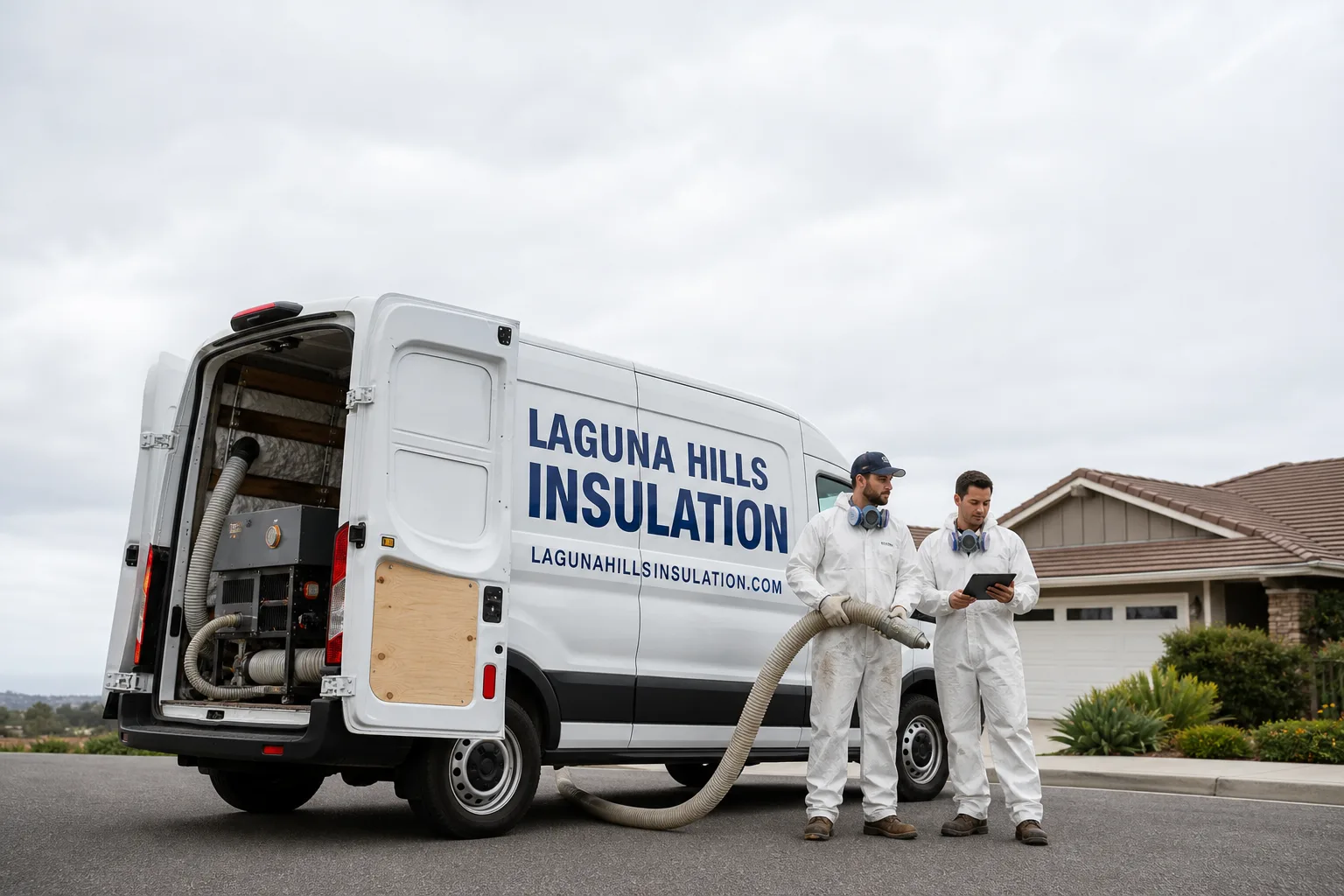
Fast, Reliable Spray Foam Insulation Across Shadow Hills
Spray foam insulation in Shadow Hills typically costs between $2,800 and $7,500 for a full attic or wall retrofit, with detached barn and casita work adding $1,200 to $3,400 per structure depending on cavity depth and square footage. Most jobs on horse-zoned parcels here involve multiple buildings, so we quote per structure after field-verifying framing. Call (866) 393-6041 for a free on-site assessment anywhere in the 91040 ZIP.
We work throughout Shadow Hills regularly. We know Sunland Boulevard, La Tuna Canyon Road, and the winding lanes off Wheatland Avenue where horse trailers share the shoulder with service trucks. Shadow Hills isn’t a tract-home suburb. Every parcel has its own story, its own framing quirks, and its own energy leaks. That’s exactly the kind of work our Spray Foam Insulation team is built for.
Why Laguna Hills Insulation Is Shadow Hills’s Preferred Spray Foam Insulation Company
Most insulation contractors quote one building and call it done. In Shadow Hills, that misses the point. A single parcel here often carries a main house, a barn, a tack room, and a casita, each built to completely different standards. Our crews walk every structure before we quote, because a foam thickness that works in the main house’s 2×6 walls will over-pack an owner-built casita’s irregular 2×4 cavities.
Garrett Lund built this company around material honesty. We stock open-cell and closed-cell foam from Demilec and Icynene, but we’ll tell you straight when Rockwool batts or a radiant barrier make more sense than spraying. Shadow Hills homeowners tend to ask sharper questions than most, and we’d rather answer them with R-values and assembly details than vague promises.
Response time to Shadow Hills is usually 24 to 48 hours for an estimate, and we schedule full crews for multi-structure jobs so we’re not dragging a project across three weeks. Your horses won’t care, but your tack room’s dust load will appreciate a crew that finishes on schedule.
Open Cell Spray Foam in Shadow Hills
Open cell spray foam in Shadow Hills is the right call when you need air sealing and sound control in a structure that already has a roof assembly doing the heavy thermal work. In the 91040 ZIP, that usually means casita lids, bonus rooms, and interior wall cavities where the over-100°F attic heat is the enemy and a radiant barrier handles the rest. It runs roughly $1.10 to $1.80 per board foot installed, with a typical Shadow Hills casita lid landing between $1,400 and $2,600.
Air Sealing Non-Standard Framing
Owner-built additions in Shadow Hills rarely have consistent cavity depth. Two adjacent stud bays can differ by half an inch. Open cell’s expansion fills those irregularities without the pressure and blowout risk you’d get from closed cell in a shallow, uneven cavity.
Dust and Livestock Gaps
Tack rooms and barn-adjacent living spaces collect dust through every unsealed seam. Open cell foam pressed into those gaps stops the fine particulate transfer that batt insulation simply can’t catch. We pre-clean exposed framing before spraying, because foam won’t bond to a surface coated in years of arena dust.
Spray Foam Insulation Contractors in Shadow Hills
Spray foam insulation contractors working in Shadow Hills need to understand something most don’t: the job is rarely a single structure. Our crews have quoted parcels where the main house was framed in the 1960s, the barn was erected without drawings in the 1980s, and the casita went up as an owner weekend project in 2003. Each one needs its own foam strategy. A full multi-structure Shadow Hills job typically runs $4,200 to $9,800 depending on square footage and cavity depth.
Field Verification Before Quoting
We measure every bay we plan to spray. Not a sample. Every bay. Non-standard framing means a quoted thickness on paper can under-fill or over-pack the wall in real life. Over-pack and you risk bowing the drywall. Under-fill and you’re paying for R-value you’re not getting.
Closed Assemblies for Fire Exposure
Shadow Hills sits in wildfire terrain. Closed-cell foam, particularly Demilec’s high-density formulations, adds structural rigidity and resists air movement better than open cell in eave and vent-adjacent assemblies. We recommend it there even when open cell makes sense elsewhere on the same parcel.
Trusted Brands We Service in Shadow Hills
We’re certified to install Icynene and Demilec spray foam systems, and we keep both product lines in rotation so a Shadow Hills job never waits on a distributor shipment from the Valley floor. For homes where spray foam isn’t the right tool, we also work with Owens Corning and Johns Manville fiberglass, plus Rockwool mineral wool for fire-resistant attic baffles near eaves. The honest answer from a contractor who carries all of it: sometimes the best Shadow Hills fix is spray foam in the walls, a radiant barrier under the roof deck, and Rockwool in the eave channels. We’ll tell you which, and we’ll tell you why.
Common Spray Foam Insulation Problems We See in Shadow Hills Homes
- Irregular cavity depth in owner-built barns and casitas. Framing members are not always nominal dimension, and spacings drift. A foam quote pulled from the main house’s wall assembly under-fills or over-packs those outbuilding walls, so we field-measure every bay before calculating board feet.
- Livestock dust contaminating bonding surfaces. Tack rooms and barns carry a fine dust load that prevents foam from adhering to exposed framing. If you spray without pre-cleaning, the foam delaminates within a year. We clean, then spray.
- Over-100°F attic heat defeating open-cell-only installs. Open cell slows air movement but doesn’t block radiant transfer. In a Shadow Hills attic with strong sun exposure, open cell without a radiant barrier leaves the space hot. We pair them on southern and western roof planes.
- Eave vents creating fire-risk air paths. Wildfire-worried homeowners in the 91040 ZIP ask about sealing eaves. The wrong foam choice there can trap heat against combustible framing. We use non-combustible or closed-cell options at vent-adjacent assemblies and leave specific vent paths per code.
Pricing for Spray Foam Insulation in Shadow Hills, CA
A typical spray foam insulation job in Shadow Hills runs $2,800 to $7,500 for a single main-house application, whether that’s an attic lid, a rim joist package, or a full wall cavity fill. Detached structures add real cost: expect $1,200 to $3,400 per barn, tack room, or casita depending on size and cavity condition. Closed cell runs higher than open cell because the material cost is higher and the application is denser, roughly $1.60 to $2.50 per board foot installed. Shadow Hills pricing runs slightly above Valley-wide averages because most jobs involve multiple structures and non-standard framing that requires more labor hours. We provide free, line-item estimates that break out each structure separately. Call (866) 393-6041 to schedule.
We Also Serve Cities Near Shadow Hills
Our crews cover the northeast San Fernando Valley and the foothill communities around Shadow Hills regularly. That includes Sunland and Tujunga just to the west, La Crescenta-Montrose over the hill, and Burbank to the south. If you’re on a horse-zoned parcel or a custom home in any of those communities, the same field-verification approach applies.
Serving Shadow Hills, CA — Our Local Coverage Area
We’re based in the Shadow Hills area and know this community well. Use the map below to see our service coverage — if you’re nearby, we can almost certainly help.
FAQs About Spray Foam Insulation in Shadow Hills
We spray foam every structure on your Shadow Hills parcel, and most of our 91040 jobs include two or more buildings. We quote each one separately after measuring cavity depths, because the barn and the main house almost never share the same framing standard. Call (866) 393-6041 and we’ll walk the entire parcel with you.
Yes, we spray foam unpermitted, owner-built structures in Shadow Hills. We can’t legalize the framing, but insulation and air sealing don’t require pulling permits for the original build. We field-verify cavity depth and assembly condition, and we’ll tell you if the framing itself needs repair before we spray.
Closed cell performs better in a Shadow Hills attic with extreme heat exposure, but it costs more. The practical answer we give most 91040 homeowners: open cell on the attic floor paired with a radiant barrier under the roof deck, or closed cell directly on the underside of the roof deck if the attic is conditioned space. We’ll price both so you can choose.
Yes, spray foam seals the gaps where livestock dust pushes through exposed framing, and it significantly reduces heat transfer through the walls and roof. We pre-clean every surface before spraying, otherwise the foam won’t bond to dust-loaded framing. It’s a standard part of our Shadow Hills tack room work.
Yes, we work alongside smart-home integrators and custom builders in Shadow Hills to sequence spray foam around conduit runs, sensor placements, and custom wall assemblies. The foam goes in first, the integrator follows with wiring and trim. Call (866) 393-6041 and we’ll coordinate with your other contractors.
Ready to get your Shadow Hills property properly insulated? Call (866) 393-6041 for a free, line-item estimate across every structure on your parcel: main house, barn, tack room, casita, workshop. We’ll measure, we’ll tell you which material fits each building, and we’ll quote you straight.
Written by Garrett Lund, Owner at Laguna Hills Insulation, serving Shadow Hills and the northeast San Fernando Valley.