
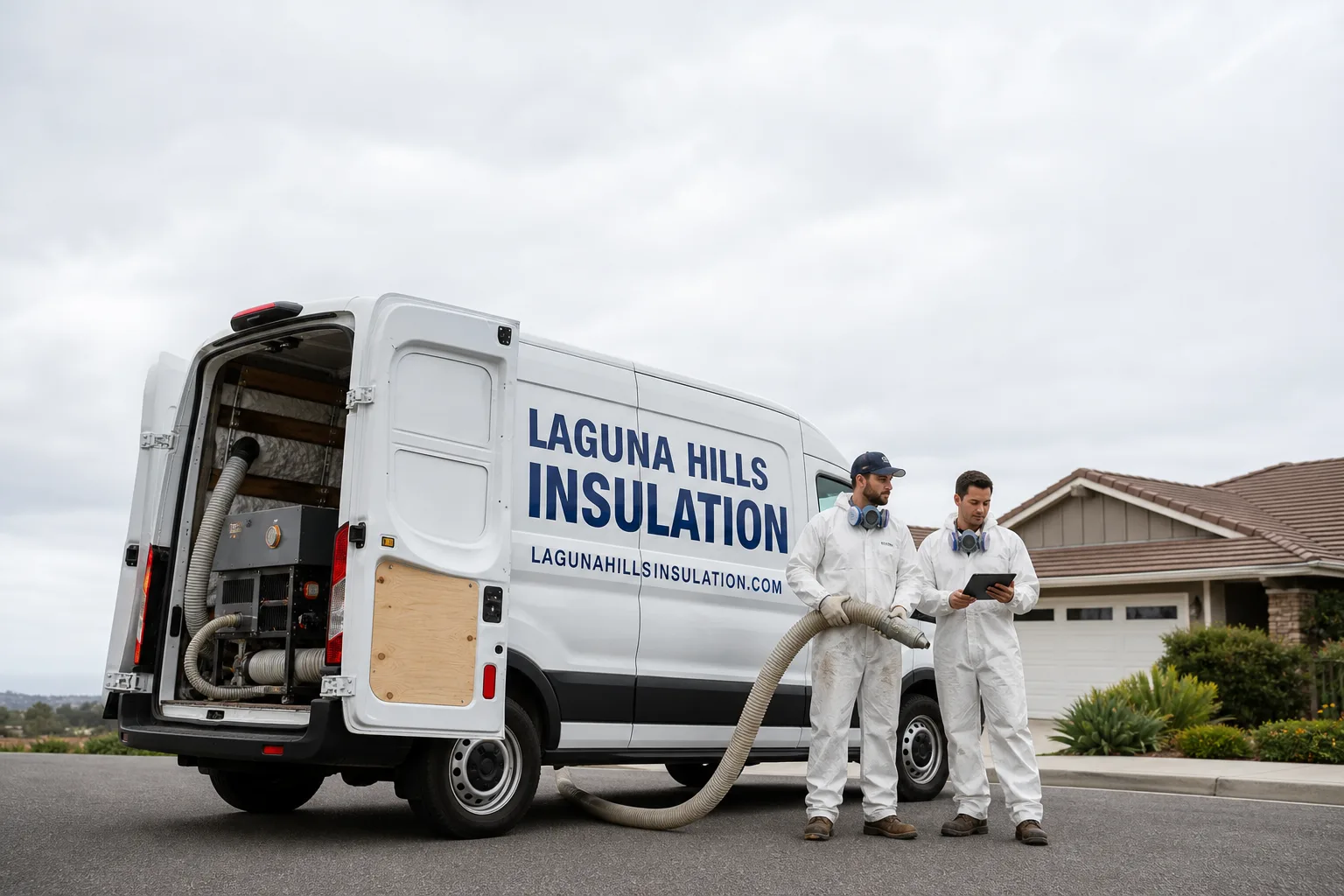
Fast, Reliable Spray Foam Insulation Across Monterey Park
Spray foam insulation in Monterey Park typically costs $2.50 to $6.50 per board foot installed, with most whole-attic projects landing between $4,800 and $11,000 depending on foam type, attic size, and how much prep work the existing space needs. We’re Laguna Hills Insulation, and we work throughout Monterey Park’s 91754, 91755, and 91756 zip codes, from the hillside tracts near the 60 Freeway to the bungalow streets south of Garvey Avenue. Call (866) 393-6041 and we’ll give you a straight answer on what your home actually needs, not what’s easiest to sell.
Monterey Park’s housing stock is its own animal. Most homes here went up between 1950 and 1975, which means attics full of original construction details nobody thinks about until summer hits. We’ve been inside enough of them to know what’s behind those lath-and-plaster ceilings and low-pitch roofs. That matters when you’re deciding whether spray foam is the right call for your house or whether blown-in insulation makes more sense. Our Spray Foam Insulation team will tell you which, honestly.
Why Laguna Hills Insulation Is Monterey Park’s Preferred Spray Foam Insulation Company
We’re not the cheapest bid, and we won’t pretend to be. What we bring to Monterey Park is technical depth and material breadth. Most insulation contractors around the San Gabriel Valley push one product line. We install eight manufacturer brands, including Icynene and Demilec for spray foam, which means the foam recommendation you get is based on your attic’s actual conditions, not what’s sitting in a warehouse. Garrett Lund built the company around that material-agnostic approach: understand the house, then pick the product.
Monterey Park homeowners call us because we know the difference between a 1954 tract home off Atlantic Boulevard and a 1972 hillside build near Monterey Pass Road. They’re not the same job. The response time to Monterey Park from our Laguna Hills base runs about an hour for scheduled estimates, and we batch jobs in the SGV corridor so lead times stay short. We’ve foamed attics where the original insulation was gone, settled, or chewed through by rodents, and we’ve walked homeowners through repair-vs-retrofit decisions without upselling them into a full treatment they didn’t need.
When you work with us, you get honest material comparisons. Closed-cell foam does something specific. Open-cell foam does something else. Fiberglass and cellulose sit in a different category entirely. We’ll give you the tradeoffs in plain terms and let you decide. That’s how we handle every home in Spray Foam Insulation in Monterey Park, and it’s why our repeat and referral business here keeps growing.
Closed Cell Spray Foam Insulation in Monterey Park
Closed Cell Spray Foam Insulation in Monterey Park is our go-to recommendation for the hillside neighborhoods north of the 60 Freeway and anywhere attic temperatures routinely climb past 140°F in July and August. This is a two-component foam that cures rigid, with an R-value around R-6.5 to R-7 per inch, and it acts as a structural stiffener, air barrier, and vapor retarder all in one application. When we spray closed-cell foam on a roof deck, we’re creating a conditioned attic space that stops radiant heat before it gets inside the living envelope.
For Monterey Park homes, closed-cell typically makes sense in three situations: attics with HVAC ductwork running through them, roof decks under low-pitch roofs where access is tight, and homes where moisture control matters as much as temperature. A full closed-cell roof deck treatment in Monterey Park runs $5,500 to $11,000 for a typical 1,200-to-1,800-square-foot single-story home. That’s a real number, not a placeholder.
Roof Deck Application for Monterey Park Heat
When we spray closed-cell directly to the underside of the roof deck, the thermal boundary moves from the attic floor to the roofline. That matters in Monterey Park because attics here are not ventilated well. Original gable vents are small, ridge vents are rare on 60s tract homes, and the result is an attic that cooks. Closed-cell on the deck changes the entire thermal profile of the house.
Duct Sealing in Older Attics
Many Monterey Park homes have forced-air ducts running through unconditioned attics. Those metal ducts leak, and in summer they’re blowing conditioned air through a 140°F space. Closed-cell foam can dramatically reduce air leakage when applied around duct runs and supply boxes. It’s not an HVAC replacement, but it makes existing systems work less hard.
Open Cell Spray Foam in Monterey Park
Open Cell Spray Foam in Monterey Park is a lower-cost, high-performance air sealing option that works best in attics we can keep ventilated, and in walls where the foam’s breathability is an asset. Open-cell cures soft and spongy at about R-3.7 per inch, and it’s a far better air sealer than fiberglass or cellulose. The foam expands to fill cavities completely, sealing around recessed lights, junction boxes, and framing irregularities that batts can’t reach.
For homes in the flatland tracts of Monterey Park, open-cell is often the right balance of performance and budget. A full open-cell attic floor application runs $4,800 to $8,500 depending on square footage and access. It’s not as thermally powerful as closed-cell at the same thickness, but for attics with decent ventilation and no ductwork, it does the job well at roughly half the material cost.
Open-Cell in Attic Floors
When we spray open-cell at the attic floor level, we’re creating an air seal at the ceiling plane. That stops the “hot-air chimney” effect that happens in Monterey Park homes with recessed lights, attic fans, and unsealed top plates. The foam expands into every gap and stays flexible, so it handles the thermal cycling of San Gabriel Valley summers without cracking away from framing.
Wall Cavity Retrofit
Older Monterey Park homes often have zero insulation in exterior walls. Open-cell can be injected through small access holes in lath-and-plaster or drywall, filling stud cavities without tearing out finished walls. It’s a specialized application, and we’ll tell you up front whether your wall construction makes it worth the investment.
Trusted Brands We Service in Monterey Park
We install and service spray foam systems from Icynene and Demilec, the two manufacturers whose product lines dominate the open-cell and closed-cell categories in Southern California. For Monterey Park customers, that means we’re not locked into one foam chemistry or one supplier. If a home needs a vapor-closed system, we spec Demilec’s closed-cell line. If it needs a breathable air seal, Icynene’s open-cell is the call. We also work with Owens Corning and Rockwool when the right answer is a hybrid approach, pairing foam with mineral wool in fire-rated assemblies. That breadth means parts, material, and technical support arrive faster for Monterey Park jobs, and we’re not waiting on a single distributor when a project timeline gets tight.
Common Spray Foam Insulation Problems We See in Monterey Park Homes
- Foam applied over settled blown-in insulation. We see this constantly in 1950s tract homes where a previous contractor sprayed foam directly over old cellulose or fiberglass without sealing the ceiling plane first. The foam adheres to the loose fill, not the drywall, and you end up with an air gap that defeats the entire purpose. We always remove or stabilize the existing material before spraying.
- Shrinkage in low-quality open-cell foam. Monterey Park’s attic heat punishes cheap foam. In hillside neighborhoods where attics hold 150°F for hours, low-density open-cell products can shrink or pull away from rafters, leaving hairline gaps that leak air. We spec Icynene’s open-cell specifically because its cured density holds up under sustained heat.
- Spraying directly over knob-and-tube wiring. Older bungalows in the 91754 and 91755 zip codes still have active knob-and-tube circuits in attic spaces. Foam sprayed over live knob-and-tube creates a fire hazard because the conductors can’t dissipate heat. Any legitimate spray foam contractor in Monterey Park should identify and address this before spraying. If we find it, we stop and tell you before proceeding, and we coordinate with a licensed electrician to decommission or replace the circuits first.
- Unsealed recessed light boxes and attic fan openings. Even well-applied foam can’t fix the hot-air chimney created by old recessed lights. In Monterey Park homes built before 1980, these fixtures are rarely IC-rated, and attic fans are just big holes in the ceiling when they’re not running. We install fire-rated covers on recessed lights and properly flash and seal attic fan openings before foam goes in.
Pricing for Spray Foam Insulation in Monterey Park, CA
Here’s what Spray Foam Insulation costs in Monterey Park right now. Closed-cell foam runs $5.50 to $7.00 per board foot installed, which puts a typical 1,500-square-foot roof deck application between $6,000 and $10,500. Open-cell foam runs $2.50 to $4.00 per board foot, so the same attic at the floor level lands between $4,800 and $7,500. Rim joist projects in crawl spaces run $1,200 to $2,400. Garage ceiling spray foam for a standard two-car garage runs $1,400 to $2,600. The variables are substrate prep, wiring conditions, access, and whether we need to remove old insulation first. We give written estimates before any work starts, and the price we quote is the price you pay. Call (866) 393-6041 for a free estimate, and we’ll walk the attic with you and show you exactly what we’re seeing.
We Also Serve Cities Near Monterey Park
If you’re outside Monterey Park proper, we cover the surrounding area too. Our crews regularly work in South San Gabriel, Alhambra, East San Gabriel, and East Los Angeles, so if you’re a few blocks over the city line, don’t assume we won’t come out. The same material-agnostic approach and the same pricing transparency apply across the San Gabriel Valley.
Serving Monterey Park, CA — Our Local Coverage Area
We’re based in the Monterey Park area and know this community well. Use the map below to see our service coverage — if you’re nearby, we can almost certainly help.
FAQs About Spray Foam Insulation in Monterey Park
Yes, but only with the right sequencing. Spray foam cannot be applied over active knob-and-tube wiring because it traps heat against the conductors and creates a fire hazard. In homes where knob-and-tube is still powered, the wiring must be decommissioned or replaced by a licensed electrician before we spray. If the knob-and-tube is already abandoned, we can proceed normally. This is a common situation in Monterey Park bungalows, and we’ll check for it during the estimate so there are no surprises. Call (866) 393-6041 and we’ll schedule a walkthrough.
Closed-cell spray foam applied to the roof deck creates a conditioned attic that blocks radiant heat transfer from the shingles to the interior. In the hillside tracts near the 60 Freeway, attics regularly hit 150°F or more, and this is the only insulation strategy that stops heat at the roofline rather than at the attic floor. The foam’s air-sealing properties also close the gaps around rafter tails and top plates where superheated attic air pushes into the living space. Expect attic temperature reductions of 25 to 35°F in these homes after a proper closed-cell roof deck application.
No, not directly. Spray foam needs to adhere to a stable substrate, and settled fiberglass or cellulose sitting on the attic floor will not provide that bond. We remove or stabilize the old insulation first, then spray directly to the drywall or roof deck. In some cases, loose fill can be moved aside and re-installed after foam is applied, but spraying over it is a shortcut that leads to delamination and air gaps. We’ll assess your attic’s condition and tell you exactly what’s required before recommending foam.
For Monterey Park’s hot, dry summers, closed-cell foam is the higher-performance option: it has roughly double the R-value per inch of open-cell, and it acts as a vapor retarder, which helps in winter when moisture from rain and indoor humidity can reach attic cavities. Open-cell is cheaper and delivers exceptional air sealing, but it does not stop radiant heat as effectively. Homes with attic ductwork or roof deck applications are better served by closed-cell. Homes needing a solid air seal on the attic floor at a lower price point are good candidates for open-cell.
Yes, and the answer depends on foam type and placement. Closed-cell foam is a vapor retarder and generally performs well in Monterey Park’s mild, wet winters without additional moisture management. Open-cell foam is vapor-open, which means moisture can travel through it, so it needs adequate attic ventilation and sometimes a supplemental vapor control measure depending on the roof assembly. Our moisture recommendations are specific to your roof type, attic ventilation, and whether you have bathroom or kitchen exhaust fans venting into the attic. We’ll cover this during the estimate.
Contact Laguna Hills Insulation for Monterey Park Spray Foam
If you’re serious about fixing the heat, air leakage, or comfort problems in your Monterey Park home, we’re ready to give you the straight answer. We’ll walk your attic, show you what’s going on, and recommend the right material, whether that’s closed-cell from Demilec, open-cell from Icynene, or something else entirely. We work across eight brands and three methods, which means the recommendation fits the house, not the inventory. Call (866) 393-6041 or reach out through our website and we’ll schedule a free estimate at your Monterey Park home.
Written by Garrett Lund, Owner at Laguna Hills Insulation, serving Monterey Park and the greater San Gabriel Valley.