
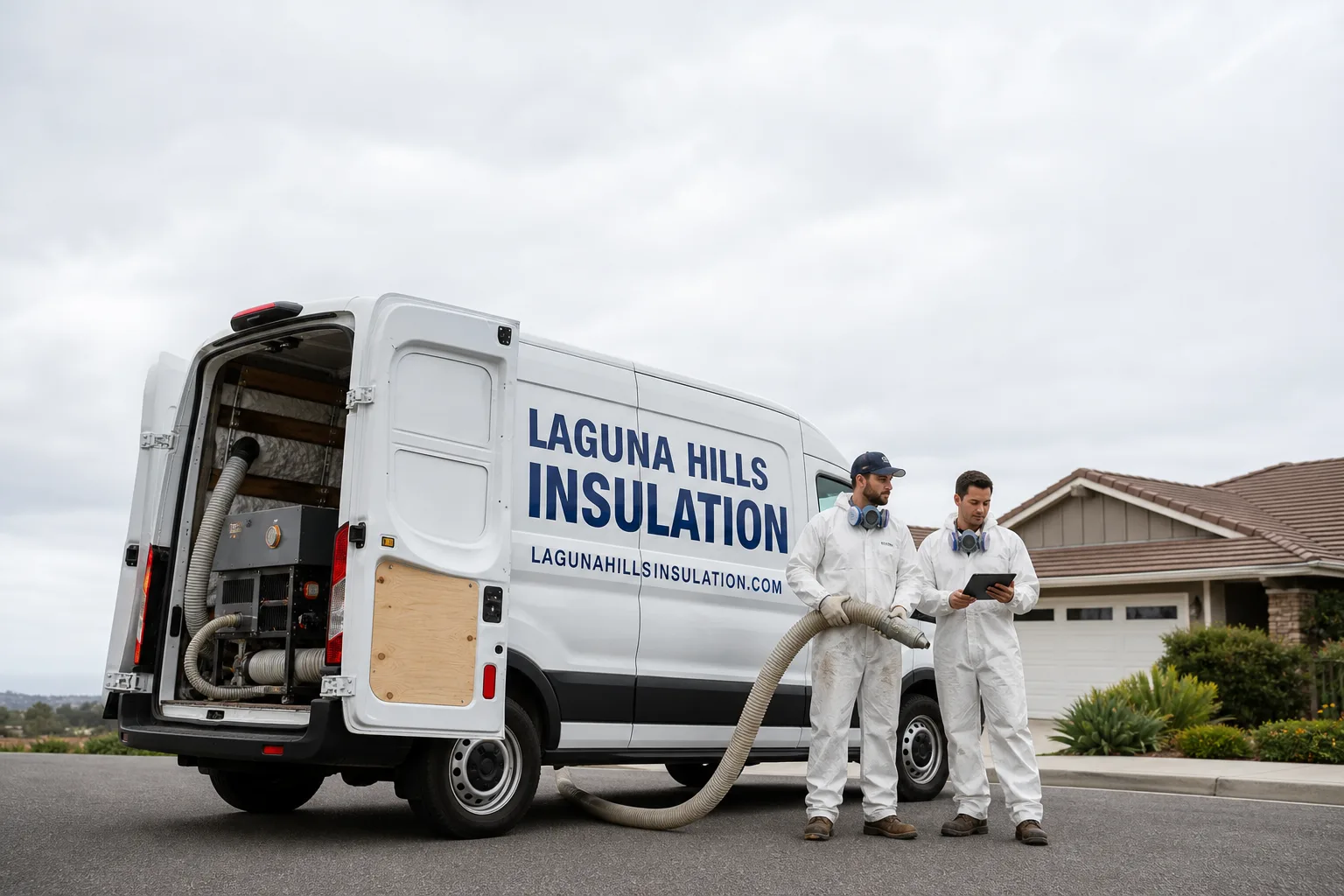
Fast, Reliable Spray Foam Insulation Across Highgrove
Spray foam insulation in Highgrove isn’t a one-size-fits-all job. Most of the homes here are citrus-era ranchers and mid-century builds, and they were never designed for the kind of heat this part of the Inland Empire throws at them every summer. We know the housing stock, we know the dust problem, and we know what it takes to retrofit these older places properly. If you’re losing cool air through your attic or feeling hot walls by 3 p.m., call us at (866) 393-6041. We’ll come out, look at what’s going on, and tell you honestly whether spray foam is the right fix or whether another material makes more sense for your house.
Why Laguna Hills Insulation Is Highgrove’s Preferred Spray Foam Insulation Company
We work differently than most insulation contractors. Where a lot of companies push whatever product line they stock, we carry eight manufacturer brands – Owens Corning, Johns Manville, Knauf, Rockwool, CertainTeed, Icynene, Demilec, and GreenFiber – and we install attic insulation, blown-in, and spray foam all in-house. That means when we look at a Highgrove home, the recommendation you get is based on what actually fits your structure and your goals, not what’s sitting in our warehouse. Garrett Lund, who leads our team, has built the company around that material-agnostic approach. Homeowners in Highgrove tell us they appreciate hearing the trade-offs directly: open-cell versus closed-cell, spray foam versus blown-in, where the R-value actually matters and where air sealing does more of the work.
We also understand what these older Highgrove houses throw at you. Pier-and-beam foundations, original redwood siding, attics full of decades of Santa Ana dust – we’ve seen it, and we plan for it. Our response time to Highgrove is typically same-week, and for attic work during summer we schedule early morning starts because we know those attics hit 140°F by early afternoon. That’s not something a contractor who doesn’t work this area would think about.
Spray Foam Insulation Contractors in Highgrove
Spray foam insulation contractors in Highgrove need to understand something that generic guides miss: this is retrofit territory, not new construction. We’re not foaming open stud bays on a fresh build. We’re working around pier-and-beam crawlspaces, original redwood siding, and attics that have been collecting dust since the Eisenhower administration. A typical spray foam job in Highgrove for a crawlspace or attic runs $2,800 – $6,500 depending on square footage and whether you need open-cell or closed-cell foam. Wall retrofits, which often involve drilling through exterior siding, typically run higher.
Pier-and-Beam Retrofit Work
Highgrove’s raised foundations mean we can access wall cavities from below in many cases, but it requires careful prep. We foam from the crawlspace upward, and on exterior walls we often drill through original redwood siding and patch it afterward. That technique is rare in neighboring slab-on-grade cities – it’s a Highgrove-specific skill.
Knob-and-Tube Wiring Checks
Before any foam goes in, we inspect for active knob-and-tube wiring. Foam applied directly over live K&T is a fire hazard, and older Highgrove homes still have it in service more often than people realize. If we find it, we stop and tell you before we spray anything.
Spray Foam Attic Insulation in Highgrove
Spray foam attic insulation in Highgrove is usually the highest-impact upgrade you can make to an older ranch home. These attics weren’t built for 100°F-plus summers – the original insulation is often compressed, vermin-disturbed, or just thin by modern standards. Sealing and foaming the attic costs $3,200 – $7,000 for most Highgrove homes, and the difference is immediate: cooler ceilings, less dust blowing through, and an AC that doesn’t run from noon to midnight. We recently foamed the attic of a 1950s ranch off Canyon Crest Drive where the original insulation had settled to about R-7. After air-sealing and applying Icynene spray foam to the roof deck, the homeowner reported their afternoon attic temperature dropped from 145°F to under 100°F, and their AC stopped cycling constantly.
Roof Deck Application Versus Floor
In the Inland Empire, we typically recommend foaming the roof deck rather than the attic floor. That turns the attic into conditioned space and keeps your ductwork from baking. Floor-level insulation alone leaves the attic at 140°F, which is where your ducts live.
Santa Ana Dust and Surface Prep
Dusty sheathing is a real adhesion problem in Highgrove. After a Santa Ana wind event, we see a layer of fine silt on attic surfaces that will cause foam to delaminate if it’s not cleaned first. Proper prep here takes longer, and skipping it is why some foam jobs fail.
Trusted Brands We Service in Highgrove
We install and service spray foam systems from Icynene and Demilec, two of the most recognized names in open- and closed-cell foam. For homeowners considering alternatives to spray foam, we also carry Owens Corning fiberglass and GreenFiber cellulose, which gives you a genuine comparison rather than a sales pitch. Because we stock materials across all of those lines, turnaround for Highgrove customers is faster than waiting on a single-brand distributor. If you’re weighing spray foam against blown-in for your attic, we’ll show you performance numbers for both and let you decide with real information.
Common Spray Foam Insulation Problems We See in Highgrove Homes
- Foam over active knob-and-tube wiring. Older Highgrove homes still have K&T circuits in walls and attics. Spray foam over live knob-and-tube is a fire hazard, and we always flag it during inspection before any foam goes in.
- Delamination from Santa Ana dust. Fine silt coats attic sheathing after wind events, and if you spray foam over it, the foam peels. Surface prep is non-negotiable here.
- Closed-cell foam in damp crawlspaces. In Highgrove’s pier-and-beam homes, closed-cell foam applied without addressing ground moisture traps damp air against framing. Moisture barriers have to be addressed first or rot follows.
- Compressed original insulation false confidence. Many homeowners assume their 1950s attic insulation is adequate. In Highgrove, we routinely find it compressed to R-7 or worse by decades of dust and rodent activity. Foaming over that without removing it first creates a false sense of performance.
Pricing for Spray Foam Insulation in Highgrove, CA
Here’s what we see across Highgrove’s market. Crawlspace and rim joist spray foam typically runs $1,800 – $3,400. Attic spray foam for a standard ranch home comes in at $3,200 – $7,000. Wall retrofit work through redwood siding is the most labor-intensive, often $6,000 – $12,000 depending on access and how much drilling and patching is required. Closed-cell foam runs about 30 – 40% more than open-cell because of material cost, but it adds structural rigidity and a vapor barrier. The big variables are square footage, whether wiring or moisture issues need addressing first, and attic accessibility. We give free estimates, and we’ll walk you through the difference between foam types before you commit. Call (866) 393-6041 and we’ll set up a time to look at your place.
We Also Serve Cities Near Highgrove
From our base in Laguna Hills, we work regularly across Grand Terrace, Colton, Loma Linda, and Rubidoux. If you’re in one of those communities, our Spray Foam Insulation team can apply the same Highgrove-specific knowledge to your project, whether it’s an older ranch with pier-and-beam framing or a newer build that’s underperforming.
Serving Highgrove, CA — Our Local Coverage Area
We’re based in the Highgrove area and know this community well. Use the map below to see our service coverage — if you’re nearby, we can almost certainly help.
FAQs About Spray Foam Insulation in Highgrove
Yes, spray foam helps substantially with Santa Ana dust because it air-seals the attic and wall cavities where wind-driven dust infiltrates. In Highgrove specifically, we see dust enter through attic vents, recessed can lights, and gaps around older windows and plumbing penetrations. Closed-cell spray foam applied to the roof deck creates an air barrier that stops much of that infiltration. Call (866) 393-6041 and we can do a blower-door test to show you where dust is coming in.
Yes, pier-and-beam foundations actually give us access that slab-on-grade homes don’t have, and we can foam wall cavities from the crawlspace in many Highgrove ranches. For exterior walls, we often drill through original redwood siding and patch it afterward, which is a technique we use regularly on citrus-era homes here. Wall retrofits take longer than attic work but are absolutely doable. We’ll inspect your specific framing before recommending anything.
Spray foam outperforms fiberglass batts significantly in Highgrove’s summer heat because it air-seals, not just insulates. Fiberglass slows conductive heat but lets air move through it, which means hot attic air still finds its way into your living space. Closed-cell foam from Icynene creates a thermal barrier and an air barrier in a single application. We’ve measured attic temperature drops of 40 to 50 degrees in Highgrove homes after roof-deck foaming. For these summers, the air sealing is as important as the R-value.
Yes, and you should have it checked. We routinely find vermin-disturbed and compressed original insulation in Highgrove attics, sometimes degraded to R-7 or worse, and laying foam over that traps the problem underneath. We remove or remediate the existing material, air-seal, and then apply foam. Our inspections always include checking for rodent damage and entry points before we recommend a scope of work. Call (866) 393-6041 for an attic assessment – estimates are free.
Early morning, without question. Highgrove attics hit 140 – 150°F by early afternoon during summer, and spray foam cures differently in extreme heat, which affects adhesion and expansion. We schedule attic work starting at first light from May through October, and we’ll tell you upfront if a job needs to be split across two mornings rather than forcing it into one hot afternoon. Winter months give us more scheduling flexibility.
Written by Garrett Lund, Owner at Laguna Hills Insulation, serving Highgrove and the Inland Empire.