
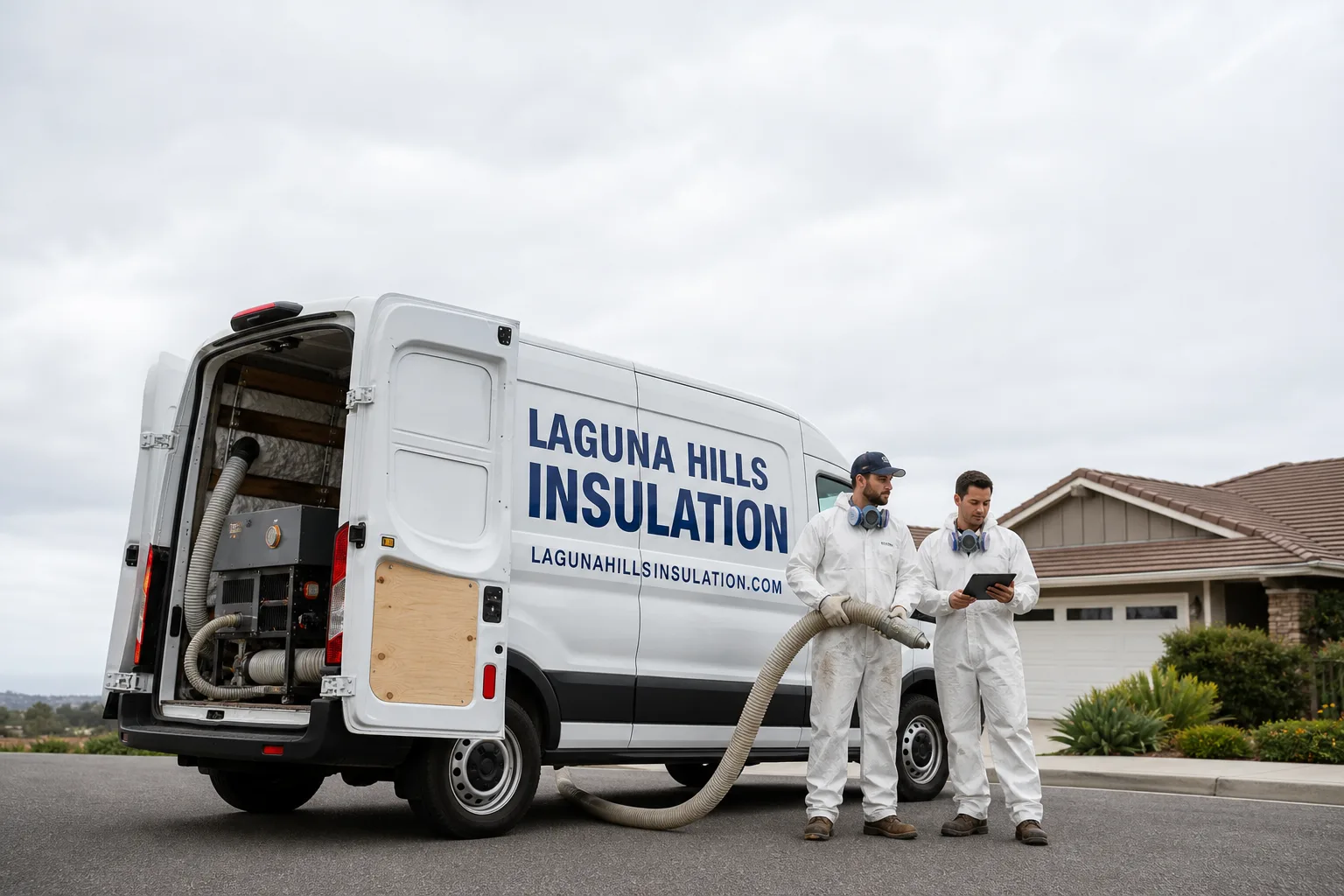
Fast, Reliable Spray Foam Insulation Across Compton
Spray foam insulation in Compton costs $2.80 – $6.50 per board foot installed, with most garage and attic projects landing between $2,400 and $7,800 depending on cavity depth and foam type. We get crews to Compton same-day for estimates and most jobs within 48 to 72 hours. If you’re dealing with an attic that bakes in July or a garage door opening that leaks dust from the Alameda Corridor, call (866) 393-6041 and we’ll tell you straight what closed-cell or open-cell foam will actually do for your house.
Laguna Hills Insulation has been running spray foam crews into Compton for years. We know the bungalows off Long Beach Boulevard, the Spanish-style tract homes near Gonzales Park, and the infill builds along Rosecrans. We know what Title 24 retrofit compliance looks like in the 90220 through 90224 zip codes, and we know which rebate programs actually pay out for Compton homeowners. More importantly, we know this market’s insulation problems are different from Carson’s or Gardena’s. The marine layer, the corridor dust, the empty wall cavities from the 1950s boom. That’s what this page is about.
Why Laguna Hills Insulation Is Compton’s Preferred Spray Foam Insulation Company
Compton homeowners call us because we carry eight manufacturer lines and three installation methods under one roof. That means we’re not trying to sell you the one product we happen to stock. Closed-cell foam from Demilec, open-cell from Icynene, mineral wool from Rockwool, blown-in cellulose from GreenFiber. We’ll spec what the house needs, not what pads our margin.
Our crews have pulled degraded batts out of attics near Compton Creek, Richland Farms, and the blocks east of the 710. We’ve foamed rim joists on post-1980s infill and sealed wall cavities on 1940s bungalows that never had insulation at all. Compton customers deal directly with Garrett Lund on material selection. No pushy sales rep. No “today only” pricing games.
Response time to Compton from our Orange County base runs under an hour for estimates. Emergency calls for garage ceiling foam after a fire, a burst pipe, or a critter intrusion get same-day scheduling when we have crews in the area. We answer the phone.
Garage Spray Foam Insulation in Compton
Garage Spray Foam Insulation in Compton usually means sealing and insulating the garage ceiling, the door frame perimeter, and any shared wall between the garage and living space. Most Compton garages built before 1970 have sheetrock on the ceiling and nothing above it except rafters and roof deck. That ceiling becomes a heat sink by 3 p.m. in August, and the door opening leaks dust from the Alameda Corridor all year.
The job involves air-sealing the door frame with closed-cell foam, insulating the ceiling cavity to R-38 or better, and flashing the rim joist where the garage meets the house. In Compton’s 90220 – 90224 tract homes, a standard two-car garage runs $1,900 – $3,400 for closed-cell ceiling foam plus door frame sealing. If the garage shares a wall with a bedroom, that wall cavity gets foamed too, which adds $800 – $1,500 depending on cavity depth.
Door Frame Sealing Against Corridor Dust
Wind-driven soot off the Alameda Corridor gets through every gap around a garage door frame. We flash the header, jambs, and sill with closed-cell foam before it expands, then trim it flush. That stops the dust at the entry point, not after it’s already inside your garage.
Salt-Air Hardware Check
Compton’s marine layer leaves salt residue on metal surfaces, and garage door hardware rusts faster here than five miles inland. Before we foam around a door opening, we inspect springs, hinges, and tracks for corrosion. Foaming over rusted hardware just hides it. We recommend replacement first, then sealing.
Closed Cell Spray Foam Insulation in Compton
Closed Cell Spray Foam Insulation in Compton is the only retrofit option that creates both an air barrier and a vapor barrier in one pass. In 90220 – 90224 homes with empty wall cavities, that matters. The marine layer pushes moisture through stucco and into stud bays every morning for most of June. Closed-cell foam stops that moisture migration cold.
A full exterior wall cavity retrofit on a 1,200-square-foot Compton bungalow runs $6,500 – $11,000 for closed-cell, depending on cavity depth and substrate prep. Attic roof decks in Compton run $4.50 – $6.00 per board foot at 2×6 depth. Yes, that’s more than open-cell. It’s also the material that correctly handles the moisture and dust conditions we see on Compton jobsites.
Substrate Prep Before Foam Application
Closed-cell foam bonds poorly to dust-coated studs or contaminated sheathing. On Compton homes near the corridor and along Compton Creek, we clean and prime substrates before spraying. Skipping this step means the foam delaminates within a season, and you’ve paid for a thermal envelope that’s peeling off your framing.
Wall Cavity Retrofits for 1945 – 1970 Homes
Those empty wall cavities are the single biggest energy leak in older Compton stock. We drill and fill from the interior or exterior, inspect with a borescope before foaming, and document the cavity depth for the rebate paperwork. Title 24 compliance and Energy Upgrade California incentives apply to this work in Compton, and we’ll walk you through the paperwork.
Trusted Brands We Service in Compton
We install Icynene and Demilec spray foam systems across Compton, and we keep both open-cell and closed-cell product on our trucks for same-week installs. For attics where foam isn’t the right call, we offer Owens Corning blown-in fiberglass, Johns Manville batts, and Knauf products. GreenFiber cellulose is available for Compton homeowners who want a recycled-material option. The brand decision follows the house’s needs, not the other way around. We’ll tell you if closed-cell Icynene is overkill for your garage ceiling and a Knauf blown-in retrofit gets you the same comfort for less money.
Common Spray Foam Insulation Problems We See in Compton Homes
- Soot-loaded attics near the corridor. Homes within a quarter mile of the Alameda Corridor accumulate wind-driven dust that mats down existing batts and clogs old vents. Foam sprayed over that contamination loses adhesion and traps the soot in your thermal envelope. We remove and dispose of degraded material first, then foam.
- Empty wall cavities with marine-layer moisture. Builders in the 1950s counted on Compton’s mild climate to cover for missing wall insulation. Now those cavities collect condensation from the morning marine layer. Closed-cell foam fixes the moisture problem and the heat gain problem in one application, but only if the substrate is cleaned and primed before spraying.
- Corroded garage door hardware hidden behind old foam. If a previous owner foamed around the garage door opening, that foam may be trapping salt against springs and hinges. We find heavily corroded fasteners on Compton garage frames more often than on inland jobs. Hardware gets replaced before new foam goes in.
- Thin attic batts in Spanish-style and bungalow tract homes. Original R-11 batts have settled to R-6 or worse in most 1940s – 1970s Compton attics. Topping off old, dusty batts just buries the contamination. Proper removal followed by spray foam gives these attics a clean R-38 thermal envelope that survives Compton’s dust loading far better than fiberglass.
Pricing for Spray Foam Insulation in Compton, CA
Garage ceiling closed-cell foam in Compton runs $1,900 – $3,400. Full attic roof deck foam on a 1,200-square-foot home: $5,200 – $7,800. Wall cavity retrofits run $8 – $11 per square foot of wall area when the cavities are empty and accessible. Open-cell runs 40 – 50% cheaper than closed-cell, but it doesn’t act as a vapor barrier, which matters on Compton homes with marine-layer moisture. Rim joist foam jobs run $900 – $1,800. These are honest Compton market numbers from 2025 – 2026 installs, not national averages. Call (866) 393-6041 for a free estimate and we’ll price your specific square footage and cavity depth.
We Also Serve Cities Near Compton
Beyond Compton, we run Spray Foam Insulation crews into East Rancho Dominguez, West Rancho Dominguez, Carson, and Gardena. Same material options, same crew quality, same straight answers on what your house actually needs. If you’re comparing bids across the South Bay, give us a call.
Serving Compton, CA — Our Local Coverage Area
We’re based in the Compton area and know this community well. Use the map below to see our service coverage — if you’re nearby, we can almost certainly help.
FAQs About Spray Foam Insulation in Compton
Compton’s marine layer carries salt aerosol that settles on metal surfaces every morning, and homes near the Alameda Corridor get an extra dose of soot and particulate. That combination accelerates corrosion on springs, hinges, tracks, and opener chains years faster than inland cities like Norwalk or Downey. We recommend galvanized or coated springs and stainless hardware if you’re replacing, and we inspect all hardware before foaming any garage door opening. Call (866) 393-6041 and we’ll check it on the estimate visit.
No. We won’t foam over dust-degraded batts. The foam needs a clean substrate to bond properly, and burying corridor soot under foam just seals contamination into your attic and cuts foam adhesion. We remove the old material, inspect the sheathing, and then apply closed-cell or open-cell foam to the roof deck. In most 1945 – 1970 Compton homes, full removal and re-foam is the correct job, not a top-off. We’ll quote the removal separately so you see exactly what you’re paying for.
Yes. Empty wall cavities in Compton’s 1940s – 1970s tract homes are the norm, not the exception. Builders skipped wall insulation entirely, counting on the mild climate. Today those cavities leak conditioned air and let marine-layer moisture migrate through the framing. Closed-cell spray foam retrofits the cavity to R-21 or better and acts as a vapor barrier at the same time. On a 1950s bungalow near Compton Creek in 90221, we found the original attic batts matted with corridor soot and the wall cavities completely empty. We pulled the batts, sealed and foamed the walls, and applied closed-cell foam around the garage door frame to lock out the dust. The homeowner paired it with Energy Upgrade California incentives, and the thermal envelope finally performs. Call (866) 393-6041 to see if your bungalow qualifies for the same retrofit.
Yes. Compton’s climate is cooling-dominant. The marine layer burns off by mid-morning, and from May through October your attic becomes a radiant heat box that pushes heat into living spaces all afternoon. Spray foam on the roof deck cuts that radiant gain far more effectively than floor-level batts, because it air-seals the attic and blocks heat transfer at the hottest surface. Heating-season savings matter less here. If your summer electric bill runs $400+ and your AC runs nonstop from 2 p.m. to 8 p.m., roof deck foam is the highest-ROI insulation job you can do in Compton. We’ll give you straight numbers on projected savings when we walk the attic.
We install Icynene open-cell and Demilec closed-cell spray foam systems in Compton, and we stock both on our trucks. Those are two of the most technically demanding foam product lines in the industry, and our crews are trained on their application specs. We also carry Owens Corning, Johns Manville, and Knauf products for attics where blown-in fiberglass or batts are the better call. The brand decision follows the house’s conditions. For a 1950s Compton bungalow with empty wall cavities and dust loading, closed-cell Demilec is the usual spec. For a newer infill attic with clean framing, open-cell Icynene often makes more sense at a lower cost. Call (866) 393-6041 and we’ll explain the tradeoffs in plain language.
Written by Garrett Lund, Owner at Laguna Hills Insulation, serving Compton and the surrounding South Bay communities.