
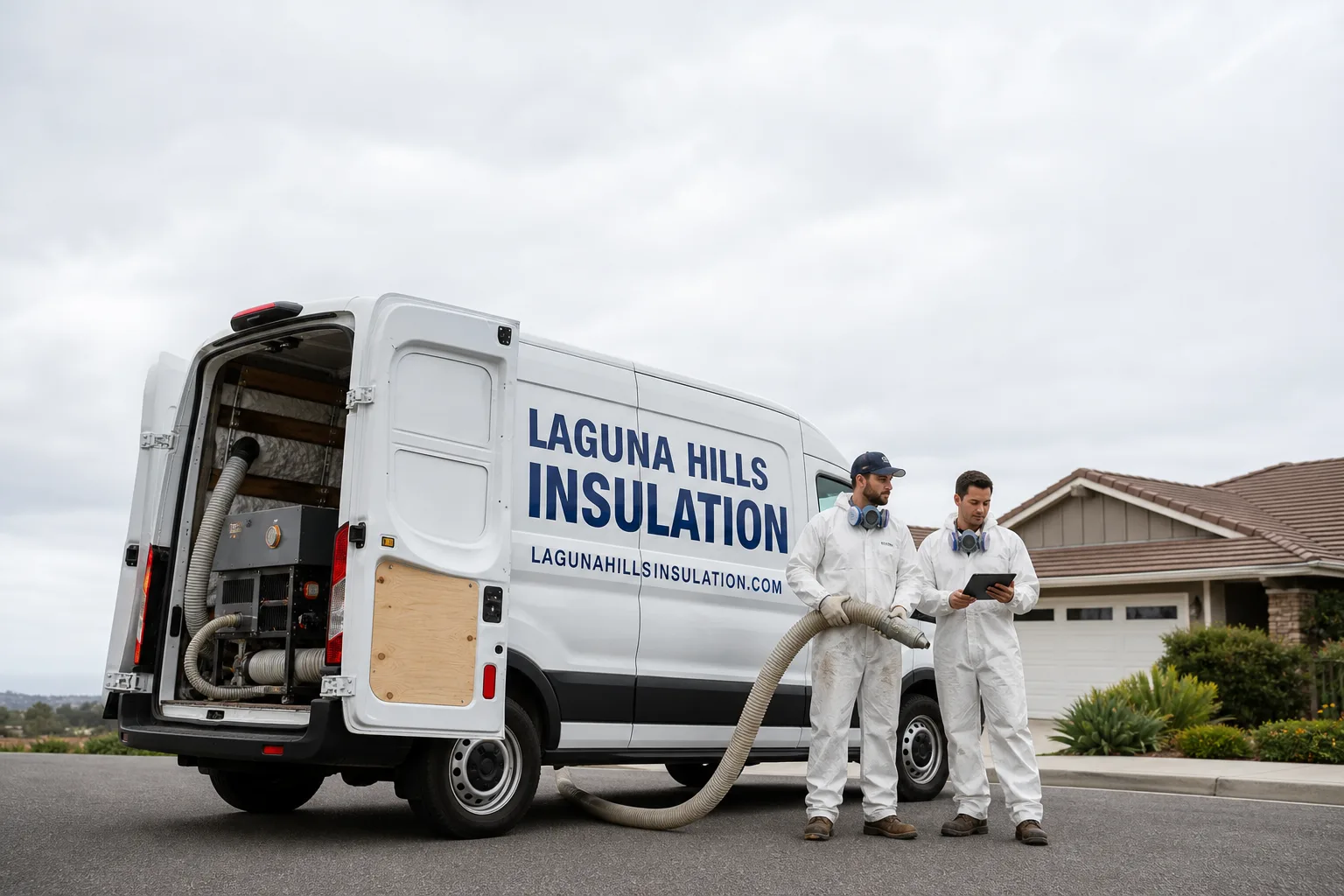
Fast, Reliable Spray Foam Insulation Across Avocado Heights
Spray foam insulation in Avocado Heights usually costs between $1.80 and $4.50 per board foot installed, with most full attic or garage projects landing in the $2,400 to $8,500 range depending on square footage and foam type. We run crews into Avocado Heights every week, so we can typically be on-site within 2 to 4 business days for standard jobs and faster for emergency calls. The semi-rural layout here, with horse properties along Workman Mill Road and Don Julian Road and older ranch homes off Avocado Heights Road, means we’ve spent years learning which insulation failures show up most in this specific pocket of the San Gabriel Valley. Call (866) 393-6041 and we’ll give you a straight answer about what your home actually needs.
Why Laguna Hills Insulation Is Avocado Heights’s Preferred Spray Foam Insulation Company
We’ve worked on enough Avocado Heights homes to know the difference between a 1960s stucco ranch and a 1980s owner-built addition before we even open the attic hatch. Garrett Lund built this company around a material-agnostic approach: we stock eight manufacturer lines and install attic, spray foam, and blown-in insulation in-house, so we’re not going to sell you closed-cell foam if your real problem is a ventilation gap. Avocado Heights customers tend to be the type who ask hard questions about R-value and vapor control. We like that. It means we get to explain the actual physics instead of handing over a canned quote.
Our crews know the 91746 ZIP code well: the narrow driveways off Valley Boulevard, the detached garages set back from the street, the converted workshops that never had a permit, let alone insulation. When you call, we answer. When we schedule, we show up. And if Garrett’s name is on the job, the material recommendation comes from what the building needs, not what’s easiest to spray.
Closed Cell Spray Foam Insulation in Avocado Heights
Closed Cell Spray Foam Insulation is the workhorse product for Avocado Heights when summer attic temperatures climb past 140°F and a space needs to actually stay cool. It’s a two-part foam that expands to roughly 30 times its liquid volume and cures into a rigid, dense layer that does two jobs at once: it air-seals and it insulates, with an R-value around R-6.5 to R-7 per inch. For a detached garage or converted outbuilding on a horse property, that dual function matters, because those structures rarely have any meaningful air barrier built into the framing. A typical closed-cell job in Avocado Heights runs $2.50 to $4.50 per board foot, applied at 2 to 3 inches in most wall and ceiling cavities.
When Closed-Cell Makes Sense Locally
If the space needs to stay cool through an Avocado Heights summer and you want to keep the framing dry from condensation, closed-cell is the stronger choice. The higher density also stiffens wall assemblies, which helps on older additions where the original carpenter may have skipped a few structural details.
Detached Garage and Shop Conversions
We foam a lot of detached garages and workshops in Avocado Heights that were never insulated when they were built. Homeowners want a usable workshop by June. Closed-cell on the ceiling and walls, combined with a ventilation check, turns a 145°F metal-roofed garage into a room that holds below 90°F on the worst afternoons. That’s a real, measured difference we’ve seen repeatedly in this ZIP code.
Open Cell Spray Foam in Avocado Heights
Open Cell Spray Foam is the right call in Avocado Heights when your primary goal is air sealing and sound dampening, not maximum R-value per inch. It’s a lighter-density foam that cures soft and spongy, expanding to fill odd-shaped cavities, rim joists, and rooflines where fiberglass batts always leave gaps. Open cell runs about $1.80 to $3.00 per board foot installed in Avocado Heights, and because it expands so much per inch of material, it’s often the more economical way to air-seal a large attic or a vaulted ceiling.
Attic Rooflines and Ventilated Spaces
For homes where the attic is part of the conditioned envelope, open cell sprayed to the underside of the roof deck stops the chimney effect that pulls conditioned air out of the house. In Avocado Heights, where smog and fine dust from nearby citrus groves and horse stalls drift into attics, an open cell air seal also keeps that particulate out of the living space.
Noise and Comfort in Owner-Built Additions
Owner-built additions in Avocado Heights often have air gaps between the roof deck and the top plate, and open cell foam fills those paths better than any batt. It also deadens road noise from Valley Boulevard and the 60 freeway corridor more effectively than fiberglass alone.
Trusted Brands We Service in Avocado Heights
We install and service spray foam from Icynene, Demilec, and CertainTeed, among others, and we maintain the technical training to work with each product line correctly. For Avocado Heights customers, that matters because we’re not locked into one manufacturer’s spec sheet. If a project calls for a high-yield open cell, we have the Demilec line. If it calls for a vapor-retarding closed cell, Icynene is in our trailer. On repair and touch-up work, we bring the right material the first trip. For related attic and blown-in work, we also stock Owens Corning, Johns Manville, Knauf, and Rockwool, so we can solve insulation problems that go beyond spray foam without sending you to another contractor.
Common Spray Foam Insulation Problems We See in Avocado Heights Homes
- Foam sprayed over rodent-contaminated loose-fill. This is the most common failure we walk into in Avocado Heights. A previous contractor sprays foam over old, compacted loose-fill without removing the droppings, urine-soaked fiberglass, and shredded nesting material first. The foam seals the odor and the contamination into the attic permanently. The correct sequence is full removal, sanitizing, exclusion work, then foam.
- Closed-cell on a detached garage with no ventilation plan. Closed cell is a vapor retarder. Put it on the ceiling of a detached garage with no soffit or ridge vents and you trap the heat and humidity that radiates up from the slab and the walls. The foam then bakes from above and wets from below. We always check venting before we spec closed-cell on any outbuilding.
- Under-thickness application on unpermitted additions. We’ve measured foam jobs in converted Avocado Heights garages where the installer sprayed one inch of closed-cell and called it done. The owner thinks they’re getting code-level insulation, but one inch of closed-cell is R-6.5, nowhere near the performance the space needs for a summer workshop. We spray to the thickness that matches the performance target, and we put that target in writing.
- Foam that never cured properly because of heat and humidity swings. Inland San Gabriel Valley summer days plus cool nights can cause surface temperatures on metal-framed outbuildings to swing 40 degrees during a cure window. We track substrate temperature before and during application. Rushing a spray on a 150°F metal roof panel produces brittle foam that pulls away from the substrate within a year.
On a small horse property off one of Avocado Heights’ rural lanes, our crew foamed the ceiling and walls of a detached workshop whose owner wanted it usable in summer. We sealed the rodent tunnels in the existing attic with closed-cell spray foam from Icynene and capped the framing, then confirmed the doors and vents still lined up before we left. One trip, one cure window, and the shop stopped baking by mid-afternoon.
Pricing for Spray Foam Insulation in Avocado Heights, CA
Open cell spray foam in Avocado Heights typically runs $1.80 to $3.00 per board foot installed. Closed cell runs $2.50 to $4.50 per board foot. A standard 1,000-square-foot attic, sprayed to an average 3-inch open cell depth, falls between $3,800 and $5,600. A detached two-car garage conversion with closed-cell walls and ceiling usually lands between $5,500 and $9,000 depending on stud depth and access. Rodent cleanup and removal before foaming adds $1,200 to $4,000, depending on how much contaminated loose-fill has to come out. The biggest cost drivers in Avocado Heights are access (low-slung ranch roofs, narrow side yards, detached structures), the condition of the existing insulation, and whether the space needs pre-foam pest exclusion. Call (866) 393-6041 for a free, itemized estimate that breaks out every line so you can compare it against any other bid.
We Also Serve Cities Near Avocado Heights
Our crews cover Avocado Heights and the surrounding communities daily, including West Puente Valley, La Puente, Valinda, and El Monte. If you’re in Avocado Heights or any neighboring area, you get the same material-agnostic approach and the same crews. Read more about our work on our Spray Foam Insulation page or visit our Avocado Heights page for a full breakdown of what we do in this specific ZIP code.
Serving Avocado Heights, CA — Our Local Coverage Area
We’re based in the Avocado Heights area and know this community well. Use the map below to see our service coverage — if you’re nearby, we can almost certainly help.
FAQs About Spray Foam Insulation in Avocado Heights
Yes. A properly specified closed-cell spray foam job on the ceiling and walls of a detached Avocado Heights garage will typically cut interior peak temperatures by 20 to 35 degrees on a hot afternoon. The key is pairing the foam with a ventilation check so you’re not trapping 145°F attic air above the new insulation. Call (866) 393-6041 and we’ll measure the space and tell you what’s actually achievable.
Because the horse properties and citrus groves in Avocado Heights create a rodent population that loves attics. Loose-fill insulation gets churned, compacted, and contaminated. Spraying foam over that seals in the odor and the droppings, so any competent contractor has to remove the old material, sanitize, and seal entry points first. We do that work in-house before any foam goes down.
For a converted garage or workshop in Avocado Heights, closed cell is usually the right answer because it adds structural rigidity, has a higher R-value per inch, and acts as a moisture retarder on a slab. Open cell is the better choice for interior attic rooflines where air sealing is the main goal and budget matters. We’ll tell you which one fits your specific building, even if the cheaper option would be easier for us to spray.
We foam the space the same way we’d foam a permitted building: to the correct thickness for the performance you want, with attention to ventilation and framing condition. We don’t report unpermitted work to the city. That’s between you and LA County. What we’ll do is document the R-value we installed so you have a record if you ever choose to bring the addition into compliance.
We primarily run Icynene and Demilec spray foam systems for Avocado Heights projects, backed by our broader material portfolio of Owens Corning, Johns Manville, Knauf, and Rockwool. Icynene closed cell is our default for detached garages and outbuildings. Demilec open cell gets the call on most attic rooflines. We choose per job, not per habit.
Written by Garrett Lund, Owner at Laguna Hills Insulation, serving Avocado Heights and the San Gabriel Valley.