
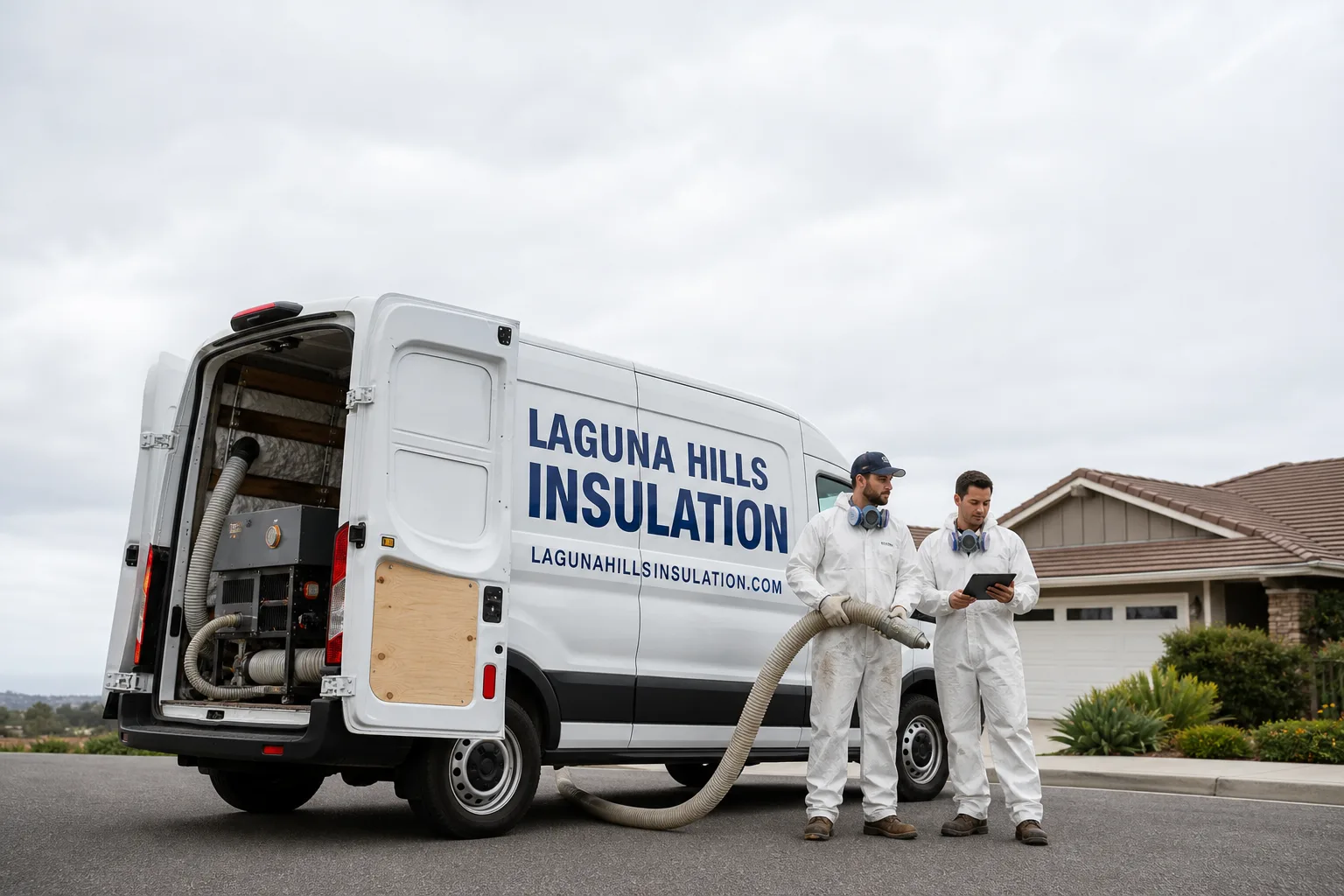
Fast, Reliable Attic Insulation Across Pomona
Attic insulation in Pomona typically runs $1,850 – $4,600 depending on the size of the attic, the material specs, and whether an old insulation removal comes first. Most projects wrap up in a single day. If your upper floor bakes in the afternoon and your AC cycles nonstop from June through October, the problem usually sits right above your ceiling.
Laguna Hills Insulation runs crews to Pomona neighborhoods like the historic Lincoln Park district, Phillips Ranch, and the older tracts off Holt Avenue and Garey Avenue. We know these attics: shallow 2×4 and 2×6 framing, decades-old Kraft-faced batts flattened into paper sheets, and in too many cases no venting at all. Call (866) 393-6041 and we’ll tell you what’s actually up there before we recommend spending a dollar.
Why Laguna Hills Insulation Is Pomona’s Preferred Attic Insulation Company
Pomona homes split into two very different animals. North and east Pomona hold stucco ranches from the 1950s through the 1970s, many with original single-pane windows and almost nonexistent attic insulation. Phillips Ranch and newer subdivisions toward the 57 freeway were framed with 2×6 walls and newer decking, but they still bake under the same inland Pomona Valley sun.
Garrett Lund, who leads our company, approaches every Pomona attic the same way: diagnose the existing thermal and air-sealing condition first, then pick the material that fixes what’s actually wrong. That’s why we stock Attic Insulation solutions across eight manufacturer lines and run our own crews for blown-in, batt, and spray foam. We don’t sub out the critical work to whoever shows up. None of it.
Pomona homeowners aren’t shy about asking hard questions, and we respect that. You want to know if the old batts can stay, whether 2×4 framing limits your insulation depth, or why your neighbor’s upper story stays ten degrees cooler. We answer those questions with a flashlight in the attic, not a sales binder in your kitchen. Response time to Pomona is usually same-day for estimates and within two to three business days for installation, depending on material availability and the season.
Attic Mold Removal in Pomona
Attic Mold Removal in Pomona is a cleanup and moisture-correction job we get called for when a homeowner notices dark staining on the roofline sheathing, a musty smell upstairs, or mold staining discovered during a re-insulation estimate. In Pomona’s dry summer heat, attic mold almost always traces back to one culprit: trapped humidity from an unvented or undersized-vents attic, often worsened by a bathroom fan that exhausts directly into the attic or a roof leak at the flashings. Mold removal on a typical Pomona attic runs $1,200 – $3,800, depending on square footage and how far the staining has spread.
Moisture Correction Before Insulation
Pomona’s older stucco tracts frequently have gable or low-profile vents that never provided enough airflow. If we treat the mold but skip the venting fix, the next insulation job fails the same way. Our sequence is to kill and scrub the fungal growth, dry the framing, add ventilation or correct the exhaust routing, then insulate.
Spot Treatment vs. Whole-Attic Work
A small stain near a bath vent costs far less than a whole-attic bloom that’s been growing for years. We’ll tell you which one you have. If the mold is localized and the roof is sound, we treat the affected area and move on. If it’s sheet-wide, the whole attic needs the full sequence.
Attic Insulation Removal in Pomona
Attic Insulation Removal in Pomona usually means vacuuming out the original Kraft-faced fiberglass or rock wool batts that were installed between the 1940s and 1970s and have since baked into near-zero performance. Decade after decade of 130°F+ attic heat flattens the fibers, breaks down the facing, and leaves the insulation performing well below today’s code minimums. Removal for a standard 1,200 to 1,800 square foot Pomona home runs $1,400 – $3,200, including disposal and basic surface prep.
Full Cleanout Sequence
We start by vacuuming the old material down to bare decking and joist bays. Then we inspect the top plates, wire penetrations, and interior wall cavities. In many Pomona homes built before 1980, the top plates were never sealed, which means attic air, dust, and heat have been falling into the wall cavities for fifty years. We seal them before anything new goes in.
When Removal Is Non-Negotiable
If your attic has rodent activity, heavy dust accumulation, mold, or the original batts have compacted to less than half their labeled depth, you’ll waste money blowing new insulation on top. In Pomona’s older tract homes, we almost always recommend full removal first. Garret and his crews don’t skip this step just to make the estimate look cheaper. That cost shows up in your summer electric bill forever.
Trusted Brands We Service in Pomona
When a Pomona homeowner asks what we’d put in our own attic, we name materials, not slogans. For most of the older stucco homes here, we recommend GreenFiber cellulose for the south-facing roof planes and standard runs, or Owens Corning fiberglass in vented attics where depth is available. For shallower 2×4 and 2×6 bays where R-value per inch actually matters more than total depth, Johns Manville high-density batts do real work. We can pull from eight manufacturers and stock local inventory for nearly every Pomona project, which keeps turnaround tight and means you don’t wait a week for material to ship from a distributor in Riverside.
Common Attic Insulation Problems We See in Pomona Homes
- Baked-flat Kraft-faced batts: Original 1940s – 70s insulation in Pomona’s older tracts compresses under decades of valley heat. What looked like R-19 at install now performs closer to R-6 or R-8. Removal and replacement is the only real fix.
- Unvented attics that cook new insulation: The older stucco homes were built with minimal or no ridge and soffit venting. Attic air hits 140°F regularly in August, which degrades insulation and shoves heat back down into living space after sunset. Venting work often has to precede or accompany the insulation.
- Unsealed top plates and wire penetrations: Shallow 2×4 framing plus fifty years of unsealed gaps means attic air pours into wall cavities and the upstairs ceiling feels like a heat lamp. Sealing before blowing cuts the air movement that insulation alone will not stop.
- Settled or missing batts in alley-load and townhome attics: Tight access doors and odd roof geometry in Pomona’s denser pockets lead to half-finished insulation jobs by past installers. We routinely find attics where someone blew a thin layer in the easy center and left the perimeter bays empty because the clearance was too tight to reach.
Pricing for Attic Insulation in Pomona, CA
Here are real numbers for Pomona:
Attic insulation removal with disposal: $1,400 – $3,200.
Blown-in fiberglass or cellulose to R-38 in a 1,200 – 1,800 sq ft attic: $1,900 – $3,400.
Full attic air-sealing plus blown-in insulation: $2,800 – $4,600.
Attic batt insulation for shallow 2×4/2×6 bays: $2,200 – $4,200.
Radiant barrier stapled to the roofline in an existing Pomona attic: $1,500 – $3,000.
What drives the swing? Whether removal comes first, whether you need venting corrected, how tight the access is, and what R-value the attic framing can actually hold. Estimates are free and we give you a line-item scope, not a handshake number. Call (866) 393-6041 to schedule one.
We Also Serve Cities Near Pomona
Laguna Hills Insulation runs crews throughout the eastern San Gabriel Valley. Beyond Pomona, we regularly handle attic insulation in La Verne, Walnut, Covina, and Claremont. If you’re anywhere in that corridor and your upstairs rooms won’t hold temperature, call us at (866) 393-6041. Same-day estimates are usually available.
Serving Pomona, CA — Our Local Coverage Area
We’re based in the Pomona area and know this community well. Use the map below to see our service coverage — if you’re nearby, we can almost certainly help.
FAQs About Attic Insulation in Pomona
Because the older homes in Pomona’s 1940s – 70s stucco tracts were insulated with Kraft-faced batts that have baked flat under decades of inland valley sun. The only way to fix degraded, settled, or rodent-damaged material is to vacuum it out, seal the attic floor, then install new insulation at the correct depth. Call (866) 393-6041 and we’ll tell you if your attic is a candidate for top-up or full removal.
In most pre-1980 Pomona homes, yes, a radiant barrier pays off in the split between June and September heat and the attic’s lack of venting. Radiant barrier blocks a large portion of the heat that radiates through the roof deck before it ever hits your insulation. If your attic hits 130°F on a hot afternoon, a radiant barrier plus proper insulation drops the heat load fast.
They force the crew to use flexible vacuum hoses, smaller batt bundles, and strategic access through interior closets or hallway scuttles. Our crews have worked dozens of Pomona townhome and alley-load attics where the opening is 22 inches wide and the roof pitch leaves only three feet of headroom at the ridge. The work takes longer, but it gets done fully. No perimeter bays left empty.
Yes. When we pull old insulation and find mold staining on the sheathing or framing, we stop and document it, then give you a mold remediation scope before any new insulation goes in. In Pomona’s dry climate, attic mold is almost always a symptom of trapped moisture and bad venting. Fix that and the mold doesn’t come back.
For most Pomona attics, blown-in GreenFiber cellulose or Owens Corning fiberglass at R-38 or higher, combined with air-sealing and often a radiant barrier. In shallow 2×4 and 2×6 bays on older tracts, Johns Manville high-density batts get more R-value per inch than loose fill in a restricted cavity. For homes with unvented attics, we discuss spray foam with Icynene or Demilec, but the solution has to match the roof assembly. Call (866) 393-6041 for a free inspection and we’ll tell you exactly what your attic can and should hold.
Written by Garrett Lund, Owner at Laguna Hills Insulation, serving Pomona and the eastern San Gabriel Valley.