
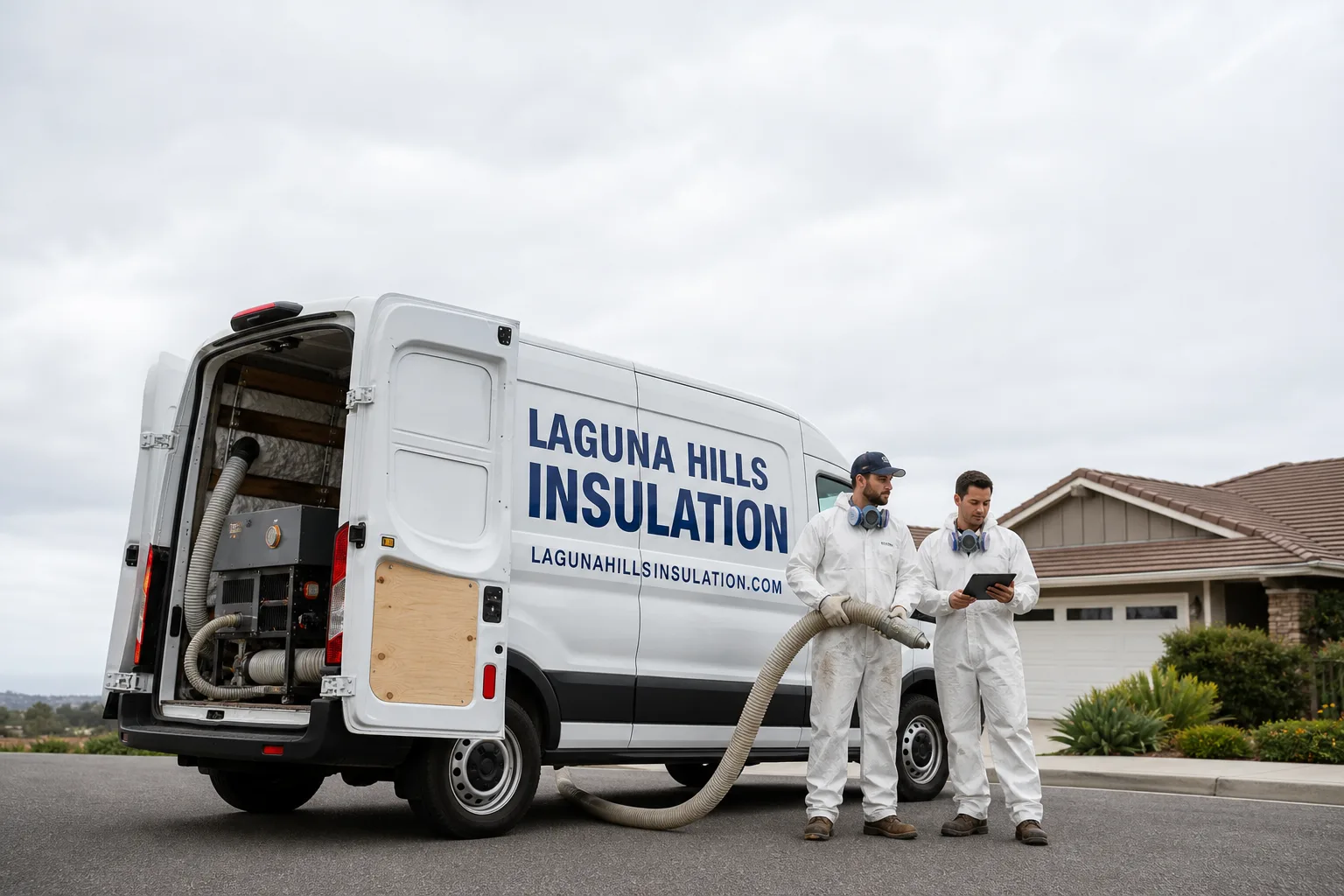
Fast, Reliable Attic Insulation Across Manhattan Beach
Attic insulation in Manhattan Beach is rarely about keeping heat in. It’s about controlling moisture, stopping salt-air corrosion from eating your framing, and buffering the marine layer that rolls in off the Pacific most evenings. We’ve worked in enough sand-section bungalows and walk-street cottages to know exactly what coastal air does to insulation over time. If your attic smells musty in the morning or your upstairs runs five degrees colder than the rest of the house, call (866) 393-6041. We’ll give you a straight answer about what’s going on up there.
We’re not the closest insulation contractor to Manhattan Beach geographically, but we’re one of the few who actually understands what beach-adjacent attics deal with. That knowledge is worth more than a shorter drive. Garrett Lund built Laguna Hills Insulation around the idea that the material should match the environment, not whatever happens to be on the truck. For Manhattan Beach homes, that usually means moisture-tolerant products and stainless fasteners, not just the highest R-value on the shelf.
Why Laguna Hills Insulation Is Manhattan Beach’s Preferred Attic Insulation Company
Homeowners in Manhattan Beach call us because we speak the language of coastal construction. When a homeowner in the sand section tells us their attic insulation has failed for the second time in a decade, we don’t pitch a thicker batt. We look at what salt air did to the fasteners. We check whether the ventilation was ever sized for marine-layer humidity. We ask about the crawlspace below, because in raised beach bungalows the damp comes from underneath as much as from above. That diagnostic approach matters more here than almost anywhere else in the South Bay.
Our Attic Insulation team carries eight manufacturer lines, so a Manhattan Beach job doesn’t get forced into one brand’s limitations. Rockwool for fire resistance and moisture tolerance on the sand section. GreenFiber cellulose for older cottages where recycled-material density makes sense. Owens Corning or CertainTeed fiberglass when budget drives the decision. We stock enough locally to keep typical Manhattan Beach projects moving without waiting on a distributor.
Response time to Manhattan Beach from our Laguna Hills base runs about 45 minutes for estimates and same-day for most emergency top-up or removal calls. Garrett’s crews know the 90266 and 90267 ZIP codes, the permit quirks on walk streets, and the parking realities near The Strand. That local familiarity saves homeowners real time.
Attic Insulation Removal in Manhattan Beach
Attic insulation removal in Manhattan Beach homes is a different job than it is inland, because here we’re often removing batts that have been quietly soaking up marine-layer condensation for 30 years. The process involves pulling out old, compromised material, inspecting the framing underneath for salt corrosion or moisture damage, treating any affected wood, and preparing the attic for new insulation that’s actually suited to coastal conditions. A typical removal in a Manhattan Beach bungalow or sand-section home runs $1,200 to $3,400 depending on attic size, access, and how compromised the old material is.
You need removal when insulation is mold-stained, when it’s matted down from years of humidity, when rodents have nested in it, or when a remodel is exposing framing that needs inspection first. In Manhattan Beach, there’s an additional trigger we see constantly: corroded staples and fasteners. The staples holding 1960s batt insulation eventually rust through in salt air, the batts sag or drop entirely, and suddenly your attic has uninsulated gaps exactly where damp onshore air wants to infiltrate. Patching over that doesn’t work. The old material has to come out so the framing and fastening system can be redone correctly.
Removal Before a Remodel
Removing old attic insulation before a remodel gives your contractor a clean look at the framing, which matters enormously in Manhattan Beach where original beach cottages often hide salt-weathered joists and hangers. We work alongside general contractors on walk-street rebuilds and sand-section additions, clearing attics so structural engineers can inspect what’s actually there. In pier-foundation homes, we’ll also flag crawlspace dampness that will eventually reach the attic if it isn’t addressed.
Mold and Moisture Remediation Prep
When marine-layer humidity has condensed on cold attic sheathing for years, you get mold on the underside of the roof deck and on insulation fibers themselves. We remove the contaminated material, prep the surfaces, and install vapor-management details that actually work in coastal air. Then we put in insulation that can handle the humidity without becoming a mold host.
Insulation Contractors in Manhattan Beach
Insulation contractors working Manhattan Beach need to understand something most inland installers never think about: the marine layer isn’t rain, but it works on your attic like a slow, damp breathing cycle every single day. We’re Manhattan Beach insulation specialists in the sense that we’ve diagnosed enough attics between 90266 and 90267 to know exactly what that breathing does. Hiring a contractor who treats your attic like it’s in Torrance will get you an insulation job that fails on coastal terms within a few years. That’s the difference.
We perform blown-in attic insulation, attic batt insulation, attic insulation top-up, and full replacements in Manhattan Beach, along with attic baffle and ventilation prep work. A typical blown-in top-up for a 1,200-square-foot Manhattan Beach attic runs $1,800 to $3,900 depending on target R-value and access difficulty. Full replacement with removal runs higher, typically $3,200 to $7,000 for older sand-section homes with compromised material. Every quote is itemized, and estimates are free.
Blown-In vs. Batt in Coastal Attics
Blown-in insulation settles into every odd corner of a 1940s beach cottage attic, which is an advantage when the framing is irregular and the access is tight. But over a damp crawlspace in the sand section, batts with proper fastening sometimes make more sense because they’re easier to remove and inspect later. We’ll tell you which fits your specific house after looking at it, not before.
Ventilation Prep Before Insulation
Attic baffles and ventilation prep matter more in Manhattan Beach than inland because trapped marine-layer moisture is the primary destroyer of insulation here. We install baffles to keep airflow moving under the roof deck, check that existing vents are actually pulling air, and address any condensation patterns we find before new insulation goes in. Insulation without working ventilation in a fog-zone attic just creates a damp sponge overhead.
Trusted Brands We Service in Manhattan Beach
We install and service Owens Corning, Johns Manville, Knauf, Rockwool, CertainTeed, Icynene, Demilec, and GreenFiber insulation in Manhattan Beach. For coastal attics specifically, we lean on Rockwool’s moisture resistance and fire rating for sand-section homes, GreenFiber cellulose for homeowner who want recycled material, and Owens Corning or Knauf fiberglass for straightforward budget-driven top-ups. Because we’re not tied to a single manufacturer, we stock replacement material and compatible fasteners locally, so a Reflectix repair in Manhattan Beach or top-up doesn’t stall waiting on a truck from a distribution center. You get the right product for salt air and humidity, not the product that’s easiest for us to sell you.
Common Attic Insulation Problems We See in Manhattan Beach Homes
- Marine-layer condensation on sheathings and batts. Ocean air rolls in at night, hits the underside of a cold roof deck, and condenses. In vented 1950s attics with no vapor management, that moisture wets the top of the batt insulation, compresses it, and eventually grows mold on the fibers.
- Salt-corroded staples releasing batts. The original fasteners in beach bungalow attics rust through in the saline air. Batts peel off the rafter bays and leave open gaps where damp onshore air pushes right into the living space. Patching over rusted staples just creates a second failure point.
- Pier-foundation moisture migrating upward. Homes raised on piling or engineered foundations in the sand section pull dampness from the crawlspace into the framing. That moisture rises through wall cavities and shows up in the attic as soggy insulation and rusted joist hangers, even when the roof itself is dry.
- Undersized insulation doing nothing against fog-bank cold. Older Manhattan Beach attics often have R-19 or less, which was never enough for the damp chill that sits over the coast in June. Homeowners feel it as drafty upstairs rooms and a furnace that cycles more than it should, even in a mild climate.
Here’s what we’ve learned doing this work in Manhattan Beach: on a walk-street cottage near The Strand, our crew found the original 1950s attic had rusted-through joist hangers and salt-corroded staples holding failing batt insulation. We removed the old batts, treated the damp framing, and installed Rockwool batts with stainless fasteners and a vapor-permeable air barrier to prevent condensation. The homeowner reported the attic finally felt dry and the street noise from the beach was noticeably reduced. That’s what coastal-correct insulation does: it solves the moisture problem and the comfort problem at the same time.
Pricing for Attic Insulation in Manhattan Beach, CA
Attic insulation in Manhattan Beach typically runs $1,800 to $7,000 depending on scope. Blown-in top-ups for moderate attics land between $1,800 and $3,900. Full removal plus new batt or blown-in installation in older sand-section cottages runs $3,200 to $7,000, with the high end representing raised homes that need framing treatment and fastener replacement. Rockwool and spray foam options sit at the upper end of those ranges because the material costs more, and in coastal conditions it’s often worth it. Here’s a straightforward breakdown:
- Blown-in attic insulation top-up: $1,800-$3,900
- Attic batt insulation replacement: $2,400-$5,200
- Attic insulation removal (standalone): $1,200-$3,400
- Full removal and replacement: $3,200-$7,000
- Attic baffles and ventilation prep: $400-$1,200
What moves the price in Manhattan Beach is access, framing condition, and whether the old fasteners are rusted enough to replace. A walk-street cottage on a tight lot with a scuttle access takes longer than a newer build with attic stairs. Call (866) 393-6041 and we’ll walk your specific attic with you. The estimate is free, and you’ll get actual numbers, not a vague range.
We Also Serve Cities Near Manhattan Beach
We handle Attic Insulation in Manhattan Beach and the surrounding South Bay, including Redondo Beach, Rolling Hills Estates, Palos Verdes Estates, and Torrance. Coastal conditions shift a bit from one to the next, but the salt air and marine layer don’t respect city lines. If you’re near Manhattan Beach and your attic feels damp or smells musty, we’ll come take a look.
Serving Manhattan Beach, CA — Our Local Coverage Area
We’re based in the Manhattan Beach area and know this community well. Use the map below to see our service coverage — if you’re nearby, we can almost certainly help.
FAQs About Attic Insulation in Manhattan Beach
Attic insulation in Manhattan Beach’s sand section fails faster because salt-laden marine air corrodes the steel staples and fasteners holding batts in place, while daily marine-layer humidity keeps attic framing and insulation damp for hours at a time. Inland attics dry out; sand-section attics often don’t. Once the fasteners rust through, batts sag and fall, leaving gaps that let foggy air pour in. Fixing it requires removal, fastener replacement with stainless hardware, and moisture-tolerant insulation. Call (866) 393-6041 for an inspection.
You need to remove old attic insulation in Manhattan Beach if it’s mold-stained, matted by humidity, rodent-soiled, or held up by rusted fasteners. Adding new insulation on top of compromised material buries the problem and leaves the failed fastener system untouched. In raised beach bungalows with pier foundations, removal also gives us a chance to check crawlspace moisture that’s migrating upward. Removal typically runs $1,200 to $3,400 depending on attic size. Call (866) 393-6041 and we’ll tell you if removal is actually necessary for your home.
Rockwool mineral wool and closed-cell spray foam from Icynene or Demilec perform best in Manhattan Beach’s coastal humidity because both resist moisture absorption far better than standard fiberglass. Rockwool doesn’t host mold and holds its shape even when humidity spikes. Closed-cell spray foam air-seals and insulates in one application, which stops damp onshore air from moving through the attic at all. GreenFiber cellulose with proper borate treatment also works well in older cottages. The right choice depends on your attic’s ventilation and framing condition. Call (866) 393-6041 for a material recommendation based on what’s actually in your attic.
Attic insulation reduces noise from the beach in Manhattan Beach by adding mass and density to the attic assembly, which dampens the sound of waves, Strand traffic, and early-morning activity. Mineral wool products like Rockwool are notably better at this than standard fiberglass because of their density. In raised beach cottages with thin roof decks, a properly installed dense insulation layer can make a real audible difference. The homeowner in the walk-street cottage we worked on reported noticeable street-noise reduction after we installed Rockwool batts.
During an attic insulation removal in a raised Manhattan Beach bungalow, expect us to pull the old material, inspect the framing for salt corrosion and moisture damage, treat any affected wood, and prepare the space for new ventilation and insulation. The process takes one to two days for most beach cottages, depending on access and how much framing work is needed. We’ll also check the crawlspace below for dampness that’s feeding the attic problem. Garrett Lund’s crew will walk you through what we find before any new material goes in. Call (866) 393-6041 to schedule a removal assessment.
Written by Garrett Lund, Owner at Laguna Hills Insulation, serving Manhattan Beach and the South Bay coastal communities.