
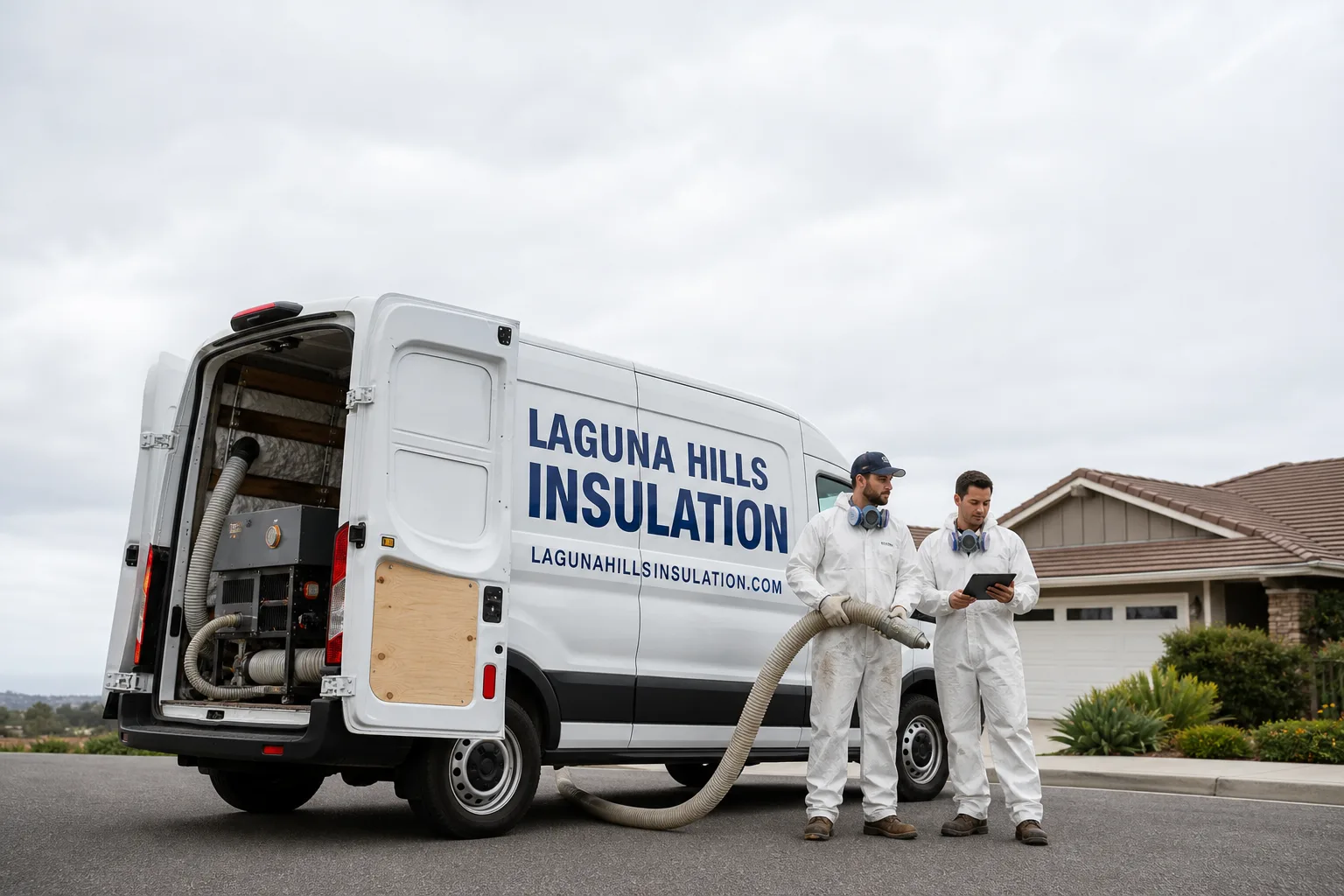
Fast, Reliable Attic Insulation Across La Palma
Attic insulation in La Palma, CA typically costs $1,800 to $4,200 for a full retrofit, with top-ups running $800 to $1,600 and batt replacement in smaller tracts landing between $1,400 and $2,800. Most jobs in the 90623 zip code are completed in a single day. The catch in this city is access: those original 18 to 24 inch hallway scuttles in 1960s tract homes mean whoever shows up has to actually know how to work through them without losing material, time, or your patience.
That’s where we come in. Laguna Hills Insulation sends technicians to La Palma regularly, with most calls confirmed within 24 to 48 hours. If you’re fed up with a bedroom that bakes all summer while the rest of the house runs the AC full tilt, call us at (866) 393-6041. We’ll tell you straight what’s actually going on up there.
Why Laguna Hills Insulation Is La Palma’s Preferred Attic Insulation Company
Garrett Lund built this company around a simple annoyance: most insulation contractors push one product line and call it a day. La Palma homes don’t need a product line. They need someone who can look at a 55-year-old attic with displaced batts, uninsulated flex duct, and a scuttle barely wide enough for a ladder, then pick the material that actually solves the problem. That might be blown-in fiberglass from Owens Corning. It might be GreenFiber cellulose to fill the irregular cavities left by a 1980s garage conversion. It might be closed-cell spray foam from Demilec to seal and insulate in one pass.
We stock material across eight manufacturer brands because La Palma’s housing stock demands it. Most homes here were built between 1963 and 1972, before Title 24 had any teeth. The attics are shallow, the vaulted ceilings create chase pockets, and the original fiberglass batts are thin, settled, and frequently moved aside by decades of cable and HVAC work. One product cannot fix all of that well. Three methods under one roof can.
Insulation Contractors in La Palma
Insulation contractors in La Palma deal with a specific set of conditions you won’t find in newer Orange County developments. The houses are wood-frame and stucco with low-pitch roofs. The attic access is a hallway scuttle, typically 18 to 24 inches wide. The ductwork is flex duct, often uninsulated, running through an attic that routinely hits 130 to 150°F in August. A contractor who doesn’t understand these realities will under-insulate corners, skip air sealing, and leave you with the same uneven temperatures you started with.
Retrofit-First Planning
Working through a tight scuttle changes everything. We pre-cut material, stage it in the hallway, and plan bag counts around the opening, not the attic square footage. Rushed jobs through small access points leave corners bare. We don’t do rushed.
Air Sealing Before Insulation
Before we blow or lay anything, we seal the top plates, wire penetrations, and recessed can housing gaps. In La Palma’s heat, R-value alone won’t stop conditioned air from leaking into a 140°F attic. Sealing first is the difference between a job that works and a job that just looks thick.
Attic Ventilation in La Palma
Attic ventilation in La Palma is not a checkbox. It’s the mechanism that keeps your attic from turning into a convection oven that cooks your insulation, your ductwork, and your second-floor comfort. Most of the original 1960s and 1970s tract homes here were built with minimal eave or gable venting. When we add insulation, we check the venting math first. Trapped heat in a low-pitch roof shortens shingle life and forces your AC to work harder than it should.
Soffit and Eave Vent Restoration
In many La Palma homes, original soffit vents are blocked by years of paint or, in some cases, were never adequate to begin with. Adding intake ventilation along the eaves is the typical starting point for a retrofit that actually performs. Without it, exhaust vents just pull from the living space.
Radiant Barrier and Low-Pitch Roofs
Low-pitch roofs leave little room for ridge venting, so we often recommend a combination of balanced soffit intakes and a low-e radiant barrier stapled to the rafter undersides. That combination is particularly effective in La Palma, where summer attic temperatures run hotter than coastal cities by a wide margin. It’s not uncommon to see a 20 to 30 degree surface temperature drop, which takes real load off your ductwork.
Trusted Brands We Service in La Palma
We work with Owens Corning, Johns Manville, Demilec, and GreenFiber, among others, because La Palma attics need different answers depending on the situation. Tight scuttle and shallow pitch? Blown-in fiberglass from Owens Corning gets through the opening and covers the irregular footprint. Need to seal vaulted ceiling chases and add R-value at the same time? Demilec’s closed-cell spray foam is the right tool. Sustainability matters to you? GreenFiber cellulose is recycled, dense-packed, and fills the odd cavities from those garage conversions that dot the 90623 tract. We keep material allocations staged for La Palma jobs, which means less downtime and faster scheduling for you.
Common Attic Insulation Problems We See in La Palma Homes
- Displaced original batts. Decades of cable installers, HVAC techs, and phone line runs have moved the 1960s fiberglass around. The result is bare drywall patches that show up as hot spots on thermal imaging, even when the attic looks partially insulated.
- Uninsulated flex duct in hot attics. Attic temperatures here push 130 to 150°F in summer. Ducts without insulation or with degraded outer jackets lose a meaningful share of your conditioned air before it reaches the register. That’s money and comfort leaking into a space nobody lives in.
- Tight scuttles leaving corners bare. That 18 to 24 inch hallway scuttle makes it physically hard to reach the outer edges of the attic. We plan every La Palma job around that access point, pre-staging material and working outward from the scuttle. Corners are where the heat gets in.
- Vaulted ceiling chase pockets. The vaulted or partially vaulted ceilings common in this city create sloped cavities that batts don’t fit well. These pockets are routinely under-insulated, especially after room additions. Dense-packing or spray foam is usually the fix.
Pricing for Attic Insulation in La Palma, CA
Attic insulation top-ups in La Palma typically run $800 to $1,600 for a standard 1,200 to 1,600 square foot single-story home. Full replacement with Owens Corning blown-in fiberglass lands between $1,800 and $3,200, depending on access difficulty and whether we’re dealing with vaulted chases. Batt replacement in smaller tract homes is usually $1,400 to $2,800. Air sealing adds $400 to $900. The tight scuttle adds labor time, but we’d rather spend an extra 45 minutes working through it properly than leave corners bare. Estimates are free. Call (866) 393-6041 and we’ll give you a real number, not a vague range.
We Also Serve Cities Near La Palma
Our Attic Insulation team regularly handles jobs in Cerritos, Cypress, Buena Park, and Hawaiian Gardens. The housing stock and access conditions are similar, so we know what to expect before we arrive. If you’re in La Palma or anywhere nearby, the same planning and material selection applies.
Serving La Palma, CA — Our Local Coverage Area
We’re based in the La Palma area and know this community well. Use the map below to see our service coverage — if you’re nearby, we can almost certainly help.
FAQs About Attic Insulation in La Palma
La Palma sits several miles inland in northwest Orange County, so summer attic temperatures regularly reach 130 to 150°F, which is significantly hotter than coastal attics. That heat load degrades the effective performance of thin or settled insulation and forces your AC to run longer. The practical fix is to bring insulation up to current R-value minimums and ensure ventilation is actually moving air. Call (866) 393-6041 for a thermal assessment.
Yes, and we do it regularly. The original hallway scuttles in these tracts were never designed for modern insulation work, which is why we pre-cut batts, stage material through the opening, and use blown-in fiberglass where the access limits maneuverability. Corners and eaves get covered because we plan around the scuttle, not in spite of it.
Dense-packed cellulose or closed-cell spray foam usually performs best in the sloped chase cavities created by vaulted ceilings. Batts don’t conform well to those shapes and leave gaps. We stock GreenFiber cellulose and Demilec closed-cell spray foam specifically for these irregular cavities. The right answer depends on the specific chase geometry, so call us for an evaluation.
The most common cause is displacement. Original fiberglass batts from the 1960s and 1970s have been moved, compressed, or removed entirely by decades of HVAC and cable work, leaving bare drywall patches that read as hot spots on a thermal camera. Even when insulation looks present from the scuttle, it’s often not where it needs to be. We find this on most La Palma retrofit jobs.
Yes. Most original La Palma tracts were built with minimal venting, and low-pitch roofs limit what you can do with ridge vents. We restore soffit intakes, verify the intake-to-exhaust ratio, and add radiant barrier where it makes sense. Ventilation and insulation work as a system, not separate fixes. Call (866) 393-6041 for a quote.
Written by Garrett Lund, Owner at Laguna Hills Insulation, serving La Palma and surrounding cities.