
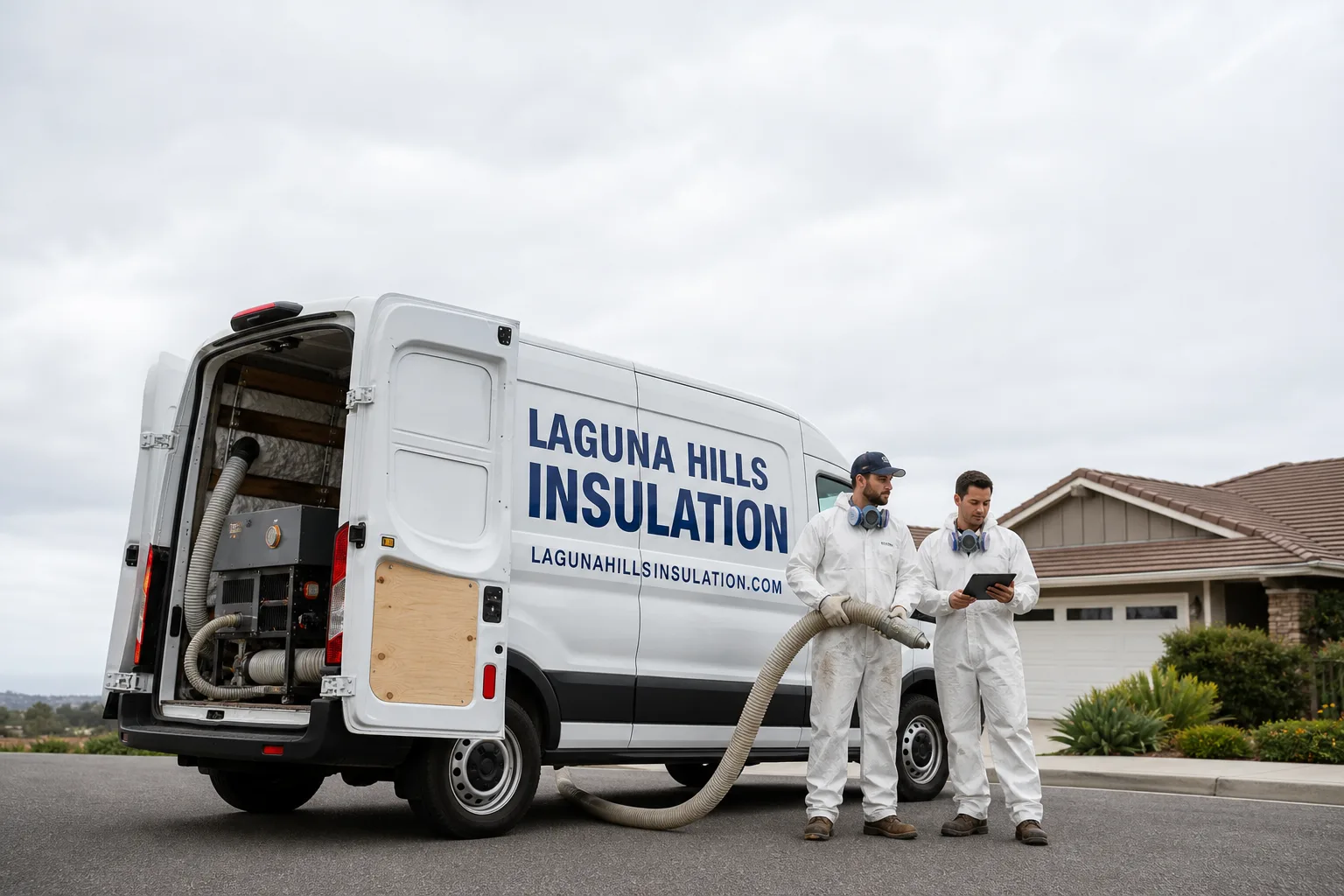
Fast, Reliable Attic Insulation Across Compton
Attic insulation in Compton runs $1,800 – $4,500 for a full replacement in a typical 1,200 – 1,600 sq ft home, with top-up jobs starting around $900 – $1,400. Most Compton homes were built between 1945 and 1970 with thin original batts or empty cavities, so replacement is more common here than topping off. We service every Compton ZIP code, 90220 through 90224, and can often be on site within 48 hours. Call (866) 393-6041 for a straight answer and a free attic inspection.
Why Laguna Hills Insulation Is Compton’s Preferred Attic Insulation Company
Laguna Hills Insulation works across the full insulation spectrum. We’re not tied to one product line or one method, so when a 1950s bungalow near Compton Creek needs R-38 fiberglass batts and a vent cleanup, that’s what we propose. When a post-1980s infill home near Wilson Park could benefit from air-sealing spray foam, we quote that instead. The right material wins the job, not the easiest upsell.
Garrett Lund leads our installation crews, and his approach is material-agnostic: eight manufacturer brands, three methods, one specialist. We stock Owens Corning, Johns Manville, Knauf, and Rockwool among others, so Compton customers are not limited to whatever a single-line contractor happens to have in the truck. You get the product that fits your attic, your walls, and the way your home behaves in Compton’s marine-layer climate.
Our response to Compton is consistently under 48 hours for inspections, and we coordinate closely with homeowners doing Title 24 compliance upgrades or Energy Upgrade California retrofits. We know what inspectors look for in 90223 and 90224, and we install to those standards the first time.
Insulation Contractors in Compton
Insulation Contractors in Compton deal with a housing stock that’s older and more wind-exposed than most South Bay cities. The job here often starts with an attic that hasn’t been properly looked at in decades: settled batts, clogged vents, and R-values that are a fraction of what the label on the bag says. A typical full attic insulation replacement in Compton runs $2,200 – $4,500, while a top-up over existing but degraded material runs $900 – $1,400. The precise scope depends on what’s actually living in your attic space.
Retrofit Assessments for Older Tract Homes
Homes built in the 1940s through 1970s across Compton’s 90220 and 90221 ZIP codes were rarely insulated beyond a thin layer of batt. The walls are often empty, and the attic insulation has compacted to maybe R-11 or R-13. We evaluate what is up there, measure existing depth, and recommend either a full removal and replacement or a strategic top-up based on what we find. No appliance-style checklist; it’s an attic-by-attic judgment call.
Title 24 Compliance and Rebate Documentation
Compton is in the middle of a wave of Title 24 compliance upgrades tied to SoCalGas and Energy Upgrade California incentive programs. Attic insulation verified to R-38 is a common requirement for these rebates. We install to the spec the rebate requires and give you the documentation your program manager needs, so the upgrade is bankable, not just comfortable.
Attic Ventilation in Compton
Attic Ventilation in Compton is not an afterthought, it is the variable that decides whether your insulation keeps working. Coastal air moves through this city constantly, picking up dust from the Alameda Corridor and dropping it into any attic with open vent screens or gaps. When soffit and ridge vents clog, airflow stalls, summer heat builds, and even the best batts lose their performance. Ventilation repair or replacement in Compton typically runs $600 – $1,800 depending on how many vent runs are blocked or undersized.
Soffit and Ridge Vent Upgrades
Original vents on 1950s and 1960s Compton homes are frequently too small for modern attic insulation levels. We add soffit vent runs and install baffles to keep the insulation from choking the intake path. This prevents the moisture and heat buildup that shortens the life of your insulation and distorts the wood framing above it.
Vent Cleaning After Corridor Soot Exposure
Homes west of the 710 and along Compton Creek pick up more dust than the rest of the city. Vent screens in those blocks often look solid but pass almost no air. We pull, clean, or replace those screens as part of any insulation job in the 90222 and 90223 corridor. It is unglamorous work, but it doubles the life of the new insulation.
Trusted Brands We Service in Compton
We install and service the full range of materials from Owens Corning, Johns Manville, Knauf, and Rockwool, among five other manufacturer lines. For Compton retrofits, Owens Corning R-38 batts are a workhorse choice for older Spanish-style and bungalow attics. Rockwool mineral wool comes into play when we’re asked for fire resistance or moisture tolerance, which matters in homes that have seen decades of marine-layer condensation. Parts and material are typically available within days for Compton jobs, and we plan deliveries around your schedule so the work doesn’t stall.
Common Attic Insulation Problems We See in Compton Homes
- Wind-driven soot contamination near the Alameda Corridor: Dust and diesel soot blow through older vent screens and settle into batts, reducing R-value and turning fiberglass into a clogged, dusty mat. This is the single biggest reason Compton attics need replacement rather than top-off.
- Settled or disturbed batts from decades of partial renovations: Many 1940s-1970s tract homes have had wiring, plumbing, or HVAC work done in the attic at some point. Every trade leaves footprints and gaps, and the insulation never recovers on its own.
- Undersized or blocked original attic vents: Single-story Spanish-style homes from the 1950s often have too few soffit and ridge vents. The attic breathes poorly, heat lingers, and insulation breaks down faster than it should.
- Uninsulated wall cavities in older construction: Builders in Compton’s post-war boom relied on the mild climate and skipped wall insulation. Heat still enters through the attic, but the thermal bridging through walls makes attic performance even more important.
Pricing for Attic Insulation in Compton, CA
Here are honest numbers for the Compton market. A full attic insulation replacement with air sealing runs $2,200 – $4,500. An attic top-up over existing material runs $900 – $1,400. Ventilation upgrades add $600 – $1,800 depending on scope. Blown-in cellulose or fiberglass runs toward the lower end; batts and mineral wool run toward the middle; closed-cell spray foam runs higher but includes air sealing in the same application. We give you a written quote before work begins, and the estimate is free. Call (866) 393-6041 to schedule an attic inspection in Compton.
We Also Serve Cities Near Compton
Our Attic Insulation crews cover all of Compton plus the neighboring communities of East Rancho Dominguez, West Rancho Dominguez, Carson, and Gardena. If you’re in one of those cities and wondering whether your attic is working against you, we extend the same inspection service to your block. Attic Insulation in Compton is our central route, but the surrounding South Bay is part of our regular rotation.
Serving Compton, CA — Our Local Coverage Area
We’re based in the Compton area and know this community well. Use the map below to see our service coverage — if you’re nearby, we can almost certainly help.
FAQs About Attic Insulation in Compton
Because soot and dust from the Alameda Corridor and Compton Creek contaminate existing batts, reducing their R-value and making top-offs a band-aid over a clogged mess. Adding new insulation over contaminated material traps the problem. Replacement removes the degraded material and starts with a clean, properly vented attic. Call (866) 393-6041 and we’ll tell you honestly whether yours needs removal or just a top-up.
The most cost-effective upgrade for a 1950s bungalow in Compton is typically R-38 attic insulation paired with soffit vent repair, because the attic is where the fastest thermal loss occurs even when walls are empty. Wall cavity work is a separate and often invasive project that we do not perform; our scope is attic insulation, spray foam, and blown-in. For most of these older homes, bringing the attic up to R-38 delivers the biggest comfort gain per dollar spent.
Marine-layer mornings bring moisture that condenses in poorly ventilated attics, while afternoons heat up fast, so insulation here works primarily as a heat-reflective barrier rather than a cold-weather blanket. That means ventilation is non-negotiable: without airflow, moisture shortens insulation life and summer heat radiates down through ceilings. We size ventilation runs to the attic, not to a generic formula.
Yes, Compton homeowners frequently qualify for SoCalGas and Energy Upgrade California incentives when attic insulation reaches program thresholds, typically R-38 or higher. We install to those specs and provide the documentation your program administrator requires. We don’t administer the rebates ourselves, but we know what the paperwork needs to say.
We carry and install materials from Owens Corning, Johns Manville, Knauf, Rockwool, and four other manufacturer lines, covering fiberglass, mineral wool, spray foam, and cellulose. For Compton attics specifically, Owens Corning R-38 batts are our most common recommendation for older tract homes, with Rockwool used when fire or moisture resistance matters. The brand depends on the attic; the recommendation comes from Garrett Lund after we inspect. Call (866) 393-6041 for a free inspection and we’ll walk you through what fits your roof.
What Makes Compton Attic Insulation Different
Compton’s 1940s-1970s tract homes were built without wall insulation, but the bigger attic issue is what the wind carries in. Homes near Compton Creek and along the Alameda Corridor sit under a constant drift of airborne dust, diesel soot, and debris that settles into attic vents and batt insulation year after year. We recently handled an attic insulation job on a 1952 Spanish-style bungalow near Compton Creek, where decades of wind-driven soot from the Alameda Corridor had clogged the original vent screens and degraded the settled batts into a dusty mat. Our crew removed the old insulation, cleaned the vents, and installed Owens Corning R-38 batts with new soffit vents. The difference in that attic was immediate: airflow returned, the temperature dropped, and the homeowner’s summer cooling load finally eased off. That’s the work this city needs, and it’s the reason we price replacement honestly instead of pushing a cheap top-up that buries the problem.
Written by Garrett Lund, Owner at Laguna Hills Insulation, serving Compton since day one.