
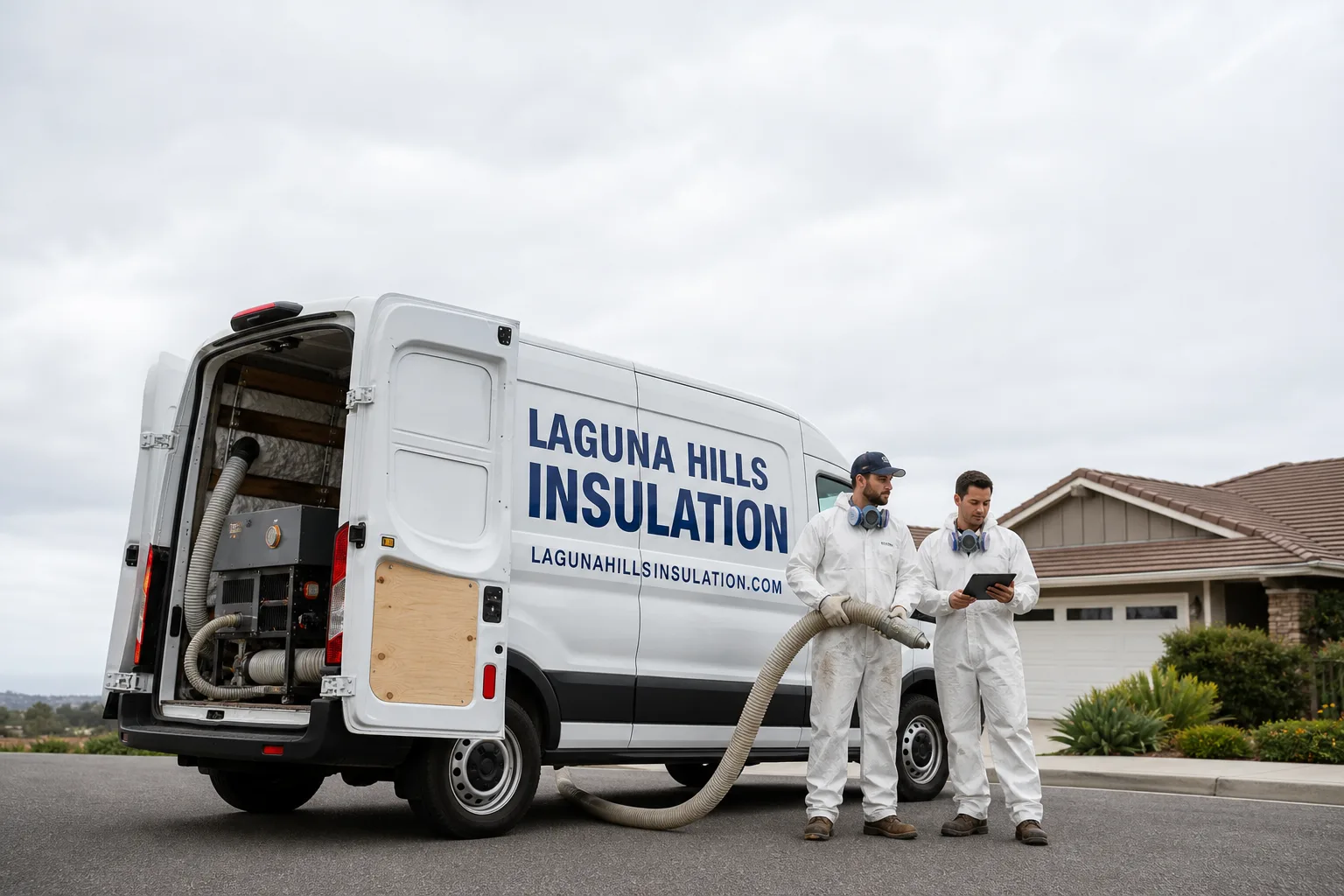
Fast, Reliable Attic Insulation Across Claremont
Attic insulation in Claremont costs $1.50 to $3.50 per square foot for blown-in fiberglass or cellulose, while spray foam runs $4.50 to $7.00 per square foot, and most retrofit jobs on older homes land between $2,800 and $6,500 total. We’re in and out of Claremont every week, and we know exactly what those 1920s Craftsman houses near the colleges throw at a crew. If your upstairs runs ten degrees hotter than downstairs every summer afternoon, the problem isn’t your AC. It’s what’s sitting between your ceiling and the roof. Call us at (866) 393-6041 and we’ll tell you whether you’re looking at a top-up, a full removal, or something more involved.
Why Laguna Hills Insulation Is Claremont’s Preferred Attic Insulation Company
Most insulation contractors stock one product line and bend every job toward it. We don’t work that way. Our Attic Insulation crews carry Owens Corning, Johns Manville, Rockwool, GreenFiber, Icynene, and Demilec, so the right material wins the job, not the easiest upsell. That matters in Claremont because the housing stock is genuinely difficult. A 1923 Craftsman with plaster-on-lath walls and balloon framing is a completely different animal than a 1965 ranch tract house off Foothill, and both need different treatment. Garrett Lund built our operation around that reality: diagnose first, match the material to the house, and skip the rigid product pitch. Claremont homeowners tell us they picked us because we explained what was actually in their walls and attic, then gave them a straight answer about what needed to happen.
We also understand the practical side of working around Claremont’s older neighborhoods. Tight driveways off Indian Hill, detached garages with no electrical panel access, historic district sensitivity near the Village. If you live in 91711, you can reach us the same day, and most attic insulation estimates in Claremont take us about 45 minutes to write up.
Attic Insulation Removal in Claremont
Attic Insulation Removal in Claremont is a job we see more often than most people expect, and it usually starts with one of two problems. The first is animal intrusion: rats, squirrels, or raccoons get into the attic space over older Claremont homes, tear up the existing insulation, and leave you with a contaminated, compressed mess. The second is age. Fiberglass batts installed in the 1970s or 1980s have lost much of their loft, and if there’s been any roof leakage, the material is matted, moldy, or holding moisture against the ceiling framing. Removal in Claremont typically runs $2.50 to $5.00 per square foot, and it’s a step you don’t want to skip if what’s up there is already shot.
When Removal Comes Before New Insulation
If we’re doing a full attic retrofit on a 1950s ranch near Memorial Park, we almost always recommend removing the old layer first. You can’t air seal through a layer of dusty, compressed fiberglass, and you can’t inspect the top plates, wiring, or recessed light housings with insulation packed over them. Getting down to the bare ceiling lets us find the actual leaks before we put anything back.
Rodent Damage and Contamination
Rodent activity leaves urine, droppings, and chewed material throughout the attic. Blowing new insulation over that doesn’t solve the problem, it buries it. We remove the contaminated material, treat the space, and then address the entry points before reinstalling anything. On Claremont houses with original wood siding and gable vents, sealing those access paths is half the battle.
Insulation Contractors in Claremont
Insulation Contractors in Claremont fall into a few camps. There are generalists who’ll add it to a punch list alongside other trades, and there are specialists who know which material belongs in which section of which house. We’re in the second camp. A job on a 1940s bungalow off Arrow Highway might need dense-packed cellulose in the sidewall cavities, Rockwool batts in the kneewalls, and GreenFiber blown over the flat attic floor. A 1970s tract home near Claremont High might need nothing more than air sealing plus two feet of blow. If a contractor can’t tell you, specifically, which approach fits your house, you’re paying someone to learn on your home.
What We Look For Before We Quote
We go into the attic. Every time. We look at the existing insulation depth, the ceiling framing, the recessed can lights, the bath fan ducts, the top plates, and the condition of any electrical wiring. We note whether the attic has soffit venting, gable vents, or a ridge vent, and whether the existing baffles are still in place. That’s the only way to give you a real number.
Dense-Packing Plaster Walls in Claremont
Most Claremont attics aren’t the whole story. In the Craftsman and bungalow stock near the colleges, the original plaster-over-lath walls and true balloon framing mean an attic-only blow leaves the wall cavities completely empty. We dense-pack those cavities from the exterior, drilling small holes under the siding line, blowing the material tight, then patching and re-stuccoing the plugs. Attic work here has to account for the walls, not just the ceiling.
Trusted Brands We Service in Claremont
We carry eight manufacturer brands, but for Claremont attics, three get the most play. Owens Corning fiberglass goes in when the goal is maximum R-value per dollar. GreenFiber cellulose suits the older houses because it settles into the odd cavities and open chases you only find in pre-war framing. And Rockwool batts handle the kneewalls and any fire-mitigation zones around flues or chimneys. For air-sealing retrofit work, we turn to Demilec spray foam. We stock the material for these jobs locally, so once your Claremont attic is diagnosed, we’re not waiting a week on a supplier.
Common Attic Insulation Problems We See in Claremont Homes
- 1950s-1970s ranch attics with R-19 and no air sealing. The Pomona Valley heat pushes 95°F-plus air into the attic every summer afternoon, and without air sealing, that hot air bleeds down through ceiling penetrations. The R-value number looks fine on paper; the comfort math fails every August.
- Kneewall bays with zero insulation. In the Craftsman homes near the colleges, the flat ceiling gets treated but the vertical kneewalls behind second-floor rooms stay empty. Santa Ana winds drive heat through those bays in September, and cool nights drain it back out in January.
- Balloon-frame wall cavities left completely empty. A crew blows the attic, packs up, and leaves. The walls are still uninsulated, and the house is still losing energy. This is the single most common miss we find in Claremont retrofits.
- Old fiberglass compressed by decades of storage and foot traffic. Claremont homeowners put boxes in the attic, lay plywood over the joists, and crush the insulation underneath. Compressed fiberglass drops from R-30 to something closer to R-15, and nobody notices until the second-floor temperature swings get bad.
Pricing for Attic Insulation in Claremont, CA
Here’s what a Claremont attic job actually costs. Attic insulation top-up, where the existing layer is dry and clean and we just add material, runs $1,500 to $2,800 for a typical 1,200 to 1,600 square foot attic. Full removal and replacement runs $3,500 to $7,000 depending on access, roof pitch, and whether we’re also dense-packing walls. Adding air sealing before the blow adds $800 to $1,500 and is worth every dollar. For a specific number on your attic, call (866) 393-6041 and we’ll send someone out. Estimates are free, and we won’t quote you a number over the phone without seeing the space.
We Also Serve Cities Near Claremont
We run crews to Claremont and every surrounding city: Montclair, La Verne, Upland, and San Antonio Heights. If you’re in the Pomona Valley corridor, we’re already working nearby and can usually schedule even a smaller attic job inside the week. No minimum job size, no surcharge for the drive.
Serving Claremont, CA — Our Local Coverage Area
We’re based in the Claremont area and know this community well. Use the map below to see our service coverage — if you’re nearby, we can almost certainly help.
FAQs About Attic Insulation in Claremont
Yes, and we do it without touching the interior. Dense-packing from the exterior means drilling small holes under the siding line, blowing GreenFiber cellulose or another dense-pack material into the wall cavity, then patching and re-stuccoing the plugs. The plaster stays intact. Balloon-framed Claremont homes are actually easier to dense-pack than modern platform-framed houses because the wall cavities run continuously from sill to attic, so the material fills the entire chase and closes off the chimney effect. Call us at (866) 393-6041 and we’ll assess whether your wall cavities are candidates.
Often, yes. If the existing layer is compressed, rodent-damaged, or contaminated, we recommend full removal before anything new goes in. Clean attic floors on ranch homes across the north and east sides of Claremont can sometimes take a top-up, but we’ll know in about five minutes once we’re in the space. The cost difference between top-up and full removal is real, and we’ll only recommend removal if the existing material is actually compromised.
Because 95°F attic air moving through a small penetration carries more heat into the house than the R-30 batts around it can stop. Leaks around top plates, recessed lights, bath fans, and interior wall cavities act like open windows. In Claremont’s hot, dry Pomona Valley climate, sealing those leaks before you add insulation is the single highest-impact move you can make on second-floor comfort. Adding more R-value on top of a leaky ceiling plate just buries the problem under new fluff.
Almost never. On a 1923 Craftsman off College Avenue near the colleges, our crew found original plaster walls, open balloon-framing chases, and attic kneewall bays with zero insulation despite 95°F-plus summers. We dense-packed the wall cavities through exterior drill holes, patched and re-stuccoed the plugs, then air-sealed the attic floor and brought the kneewall bays up with Rockwool batts before blowing GreenFiber over the flat ceiling. If your house has second-floor kneewalls, they’re probably letting heat pass around the edge of your ceiling insulation, not through it.
Our default for flat attic floors is blown-in GreenFiber cellulose or Owens Corning fiberglass, depending on the budget and the depth we need to hit. For kneewall bays, fire-break zones, and any area where moisture resistance matters, we prefer Rockwool batts. For small, odd-shaped cavities or areas where we need air sealing and insulation in one step, Demilec closed-cell spray foam. We choose the material based on the house, not the other way around.
Written by Garrett Lund, Owner at Laguna Hills Insulation, serving Claremont homeowners with attic, spray foam, and blown-in insulation retrofits.